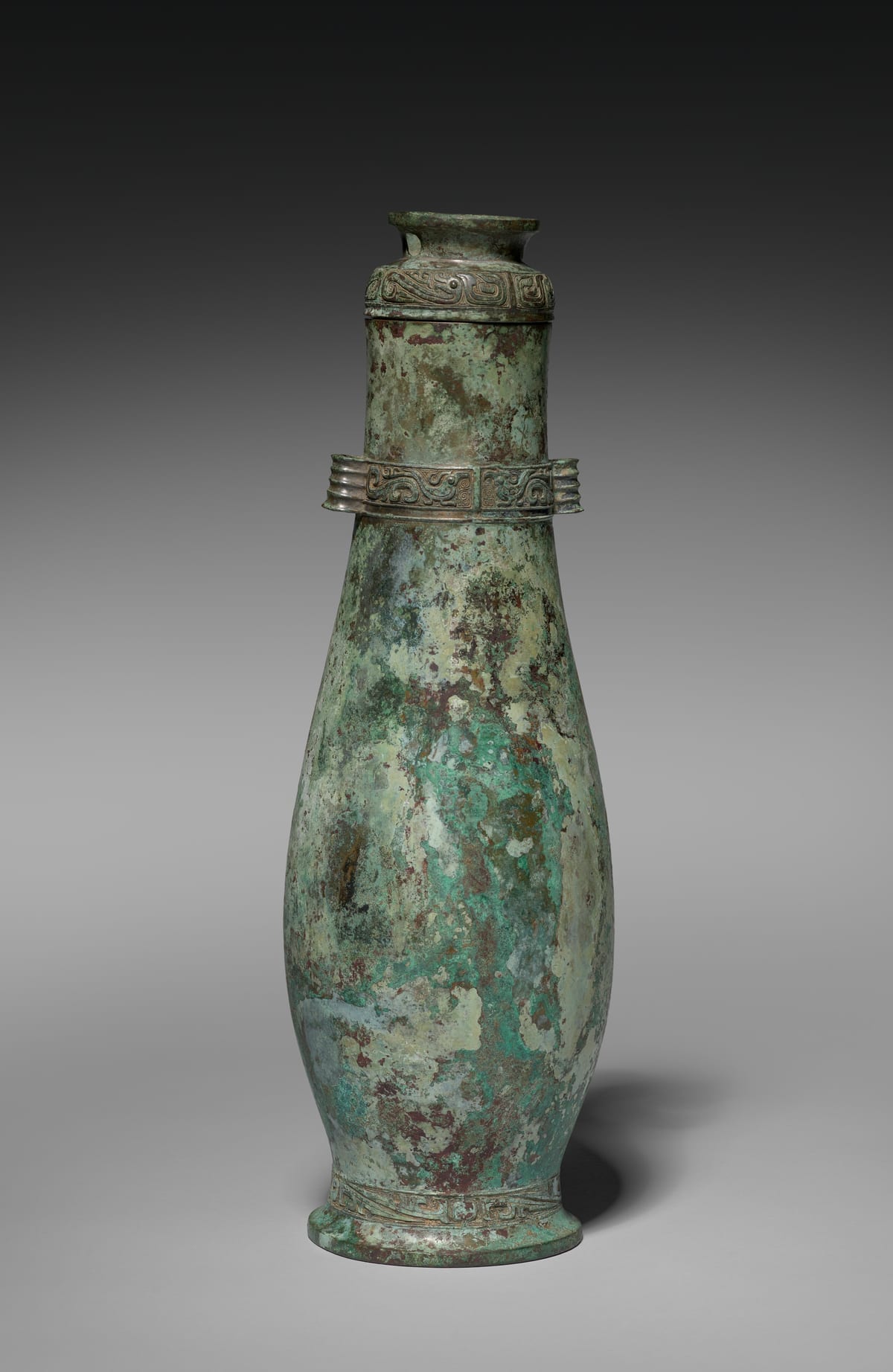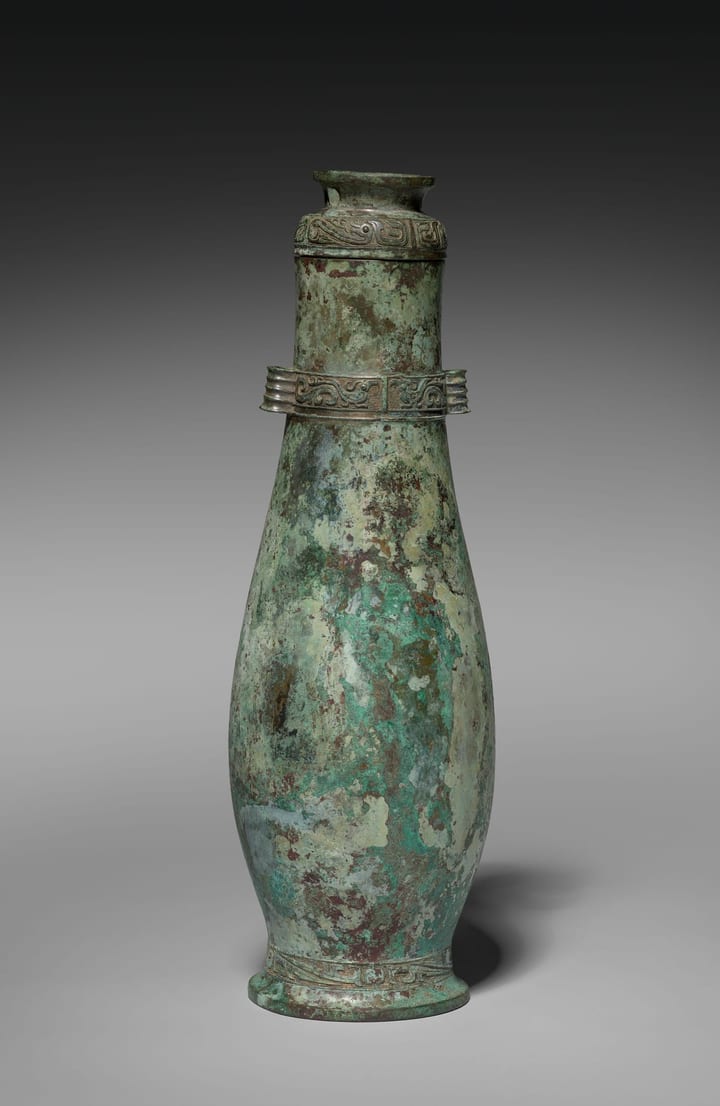
A slender covered vessel has several distinct parts
Cleveland’s illustrated hu, 1944.61, dates to about 1000–900 BCE. Its bands mark the cover, neck and foot. The museum suggests that the neck fittings held a carrying cord and notes that the inverted cover can serve as a cup. Those statements concern this particular vessel.
In the complete photograph, broad plain areas separate the decorated zones. Compare the long central body with the short cover and foot. A close view of the ornament answers a different question from a view of the complete profile; keep both scales of looking available.
A motif can change while a vessel name continues
The Met’s hu 1988.20.4a, b belongs to the late ninth or early eighth century BCE. It is bronze and stands 55.2 centimeters high. Its label discusses an eye-like feature surrounded by curling, hooked lines, interpreting the design as a transformation of the earlier Shang animal mask into ornament.
That is a curator’s interpretation of a specific pattern. Compare the location of the eye and the line around it before extending the explanation to other vessels. The word hu identifies the container in the catalogue; it does not give every surface motif a single meaning.
An inscription can provide evidence beyond the surface design
The Asian Art Museum dates the Fan Ju Sheng hu to approximately 900–850 BCE. The bronze has a twenty-nine-character inscription inside its lid. The museum reads it as commemorating a wedding gift commissioned by Fan Ju Sheng for his eldest daughter. Its label also identifies dragon-head handles holding rings and three wavy decorative bands.
Here the written record supplies a social occasion that the outer silhouette alone cannot establish. Notice where the inscription is located and consult its museum translation separately from the exterior photographs. This one commission does not establish that every covered hu was a wedding gift.
A rounded jar makes gold decoration part of its surface
Cleveland’s hu 1929.984 dates to the early 400s BCE. It is bronze with gold inlay, 27.6 centimeters high, with a broad rounded body. The museum describes depressions cast into the surface and then filled with gold. Its account places the vessel amid an increasing emphasis on prestige and luxurious display.
Follow the sweeping lines around the curved body, then compare their spacing with the much plainer illustrated vessel. The two catalogue entries offer different forms and different surface treatments. A related guide on gold and silver inlay follows that decorative practice across other objects; here it remains attached to this named wine-container form.
What looks like inlay may require technical investigation
The Met catalogues hu 29.100.545 as fifth-century BCE bronze inlaid with copper. Its accompanying scientific commentary adds a crucial detail: radiography indicates that decorative metal pieces were positioned in the mold before the surrounding metal was poured. The visible effect therefore does not by itself reveal the order of manufacture.
This example gives a practical way to read a material label alongside a technical explanation. Ask whether a pattern was cut and filled after casting or incorporated during it, and look for the museum’s evidence. Neither a bright line nor a patterned photograph resolves that question without further study.
Images and credits
Wine Vessel (Hu), China, Western Zhou dynasty, c. 1000–900 BCE. Bronze. Cleveland Museum of Art, 1944.61. Purchase from the J. H. Wade Fund. CC0. Complete museum photograph, resized.