How to read a Chinese bronze jue
Begin with the silhouette. Follow the lip toward the long spout, then return across the opening to the opposite end. Locate the handle and trace each visible leg to its attachment. This sequence separates the vessel’s container, supports and projections before attention shifts to surface decoration.
UMMA’s jue, 1974/1.170, has an oval cup, rounded base, three tapering legs, a loop handle, a channel-shaped spout and two capped projections at the rim. Its record discusses the uneven spacing of the legs and the outward angle of the one beneath the handle. The museum also states that the function of the rim projections is unresolved.
A narrow band can organize the decoration
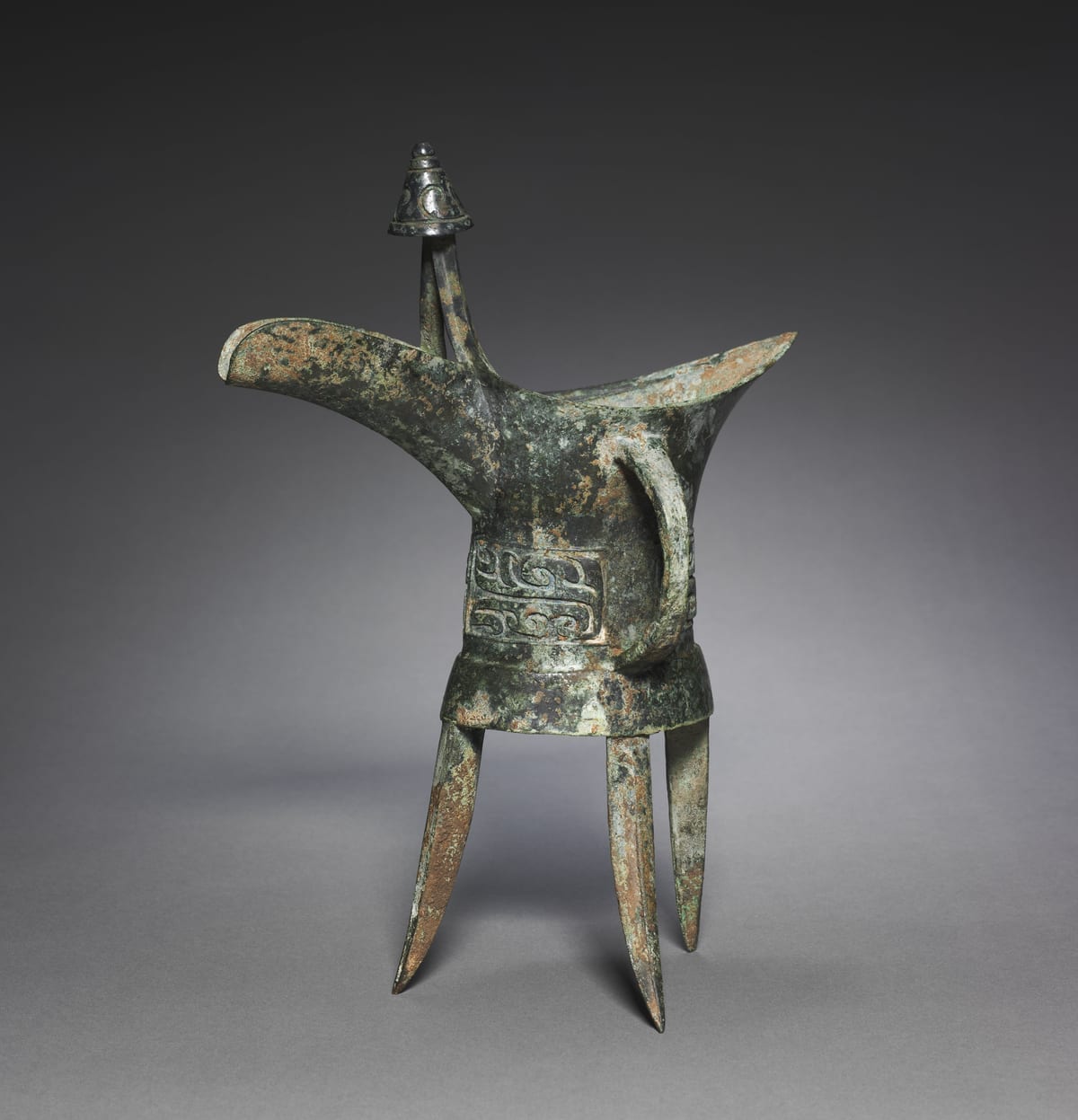
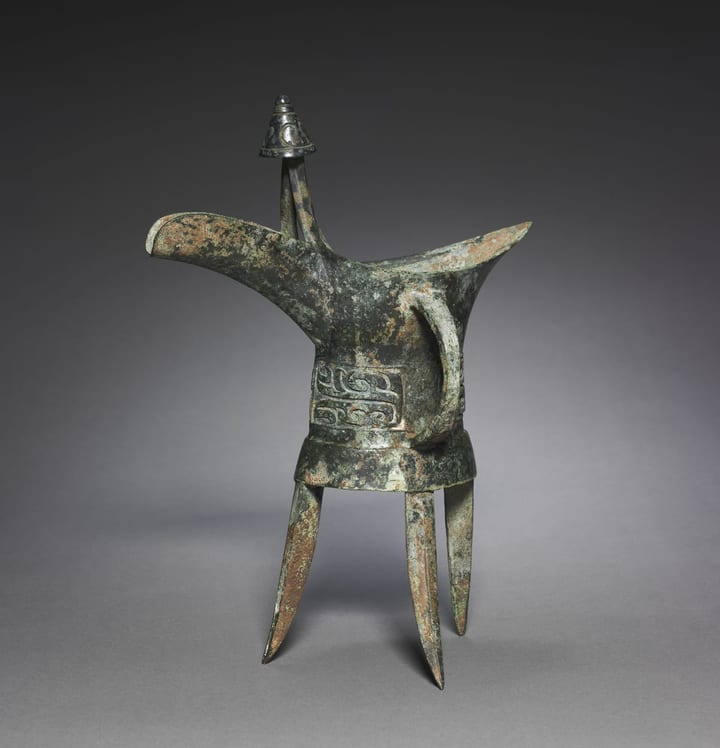
The complete photograph shows Cleveland’s Wine Cup (Jue), 1982.148. The museum dates it to around 1400 BCE and identifies it with the Shang dynasty’s Erligang phase. Its recorded overall measurements are 32.4 by 24.2 centimeters. The catalogue describes a narrow decorative band around the middle, with two eyes surrounded by curling forms opposite the handle and roughly balanced units beside it.
Compare that band with the long undecorated stretches of the legs and the projecting rim. Reading ornament by its position makes a specific observation possible without assigning a fixed symbolic message to each curl. Turn back to the catalogue when a visual impression needs a name.
Angular shapes do not prove hammered manufacture
The Met’s Wine warmer (Jue), 2003.432, is bronze and dated to about the sixteenth century BCE. The museum calls attention to the angular outline, thin walls, a folded-looking rim and a strap-like handle. It proposes that such features may recall an earlier hammered-sheet-metal tradition, possibly introduced from western Asia. This is an interpretation of the shape, not a statement that this surviving vessel was hammered from a sheet.
Keep those two questions separate when reading a label: what manufacturing evidence does the record identify, and what earlier design might the finished outline evoke? A resemblance can frame a historical hypothesis while leaving the material process of an individual object to technical investigation.
Clay molds explain the hollow cast form
The Met’s account of early bronze casting describes making a model, taking a clay mold from it and dividing the mold into sections so the model can be removed. After firing, the sections are assembled again. A core reserves the space inside a vessel, and patterns can be worked on the mold’s inner surface before firing.
That process offers a way to think about the relationship between a hollow cup and relief decoration. It does not let a photograph reveal every mold joint, casting repair or later alteration. Those are questions for the object’s technical record; a green surface alone does not supply a production date.
Ritual setting and handling remain distinct questions
The Met’s jue 24.72.9 dates to the late eleventh century BCE. It belongs to a group said to have come from a tomb discovered in 1901. The museum notes different inscriptions and styles within the group; its proposed arrangement on an altar table is partly hypothetical. The record therefore presents a possible ritual setting while retaining uncertainties about the assemblage.
Seattle’s jue 49.200, dated to the twelfth or eleventh century BCE, is described as a tripod for warming and serving wine. Its label also discusses the collecting of ancient vessels from the Ming dynasty onward and their occasional reuse for drinking. These different settings remind the reader to ask whose use a label describes: an ancient ceremony or a later collector’s gathering.
Our guide to bronze zun vessels compares another named family of containers. The gu-shaped-vase guide follows an ancient vessel name into later porcelain. Compare outlines across those guides, while keeping each catalogue’s identification, material and period attached to the correct object.
Images and credits
Wine Cup (Jue), China, Shang dynasty, Erligang phase, c. 1400 BCE. Bronze. Cleveland Museum of Art, 1982.148. John L. Severance Fund. CC0. Complete museum photograph, resized.