Reading Chinese Bronze Zun Vessels by Their Profiles
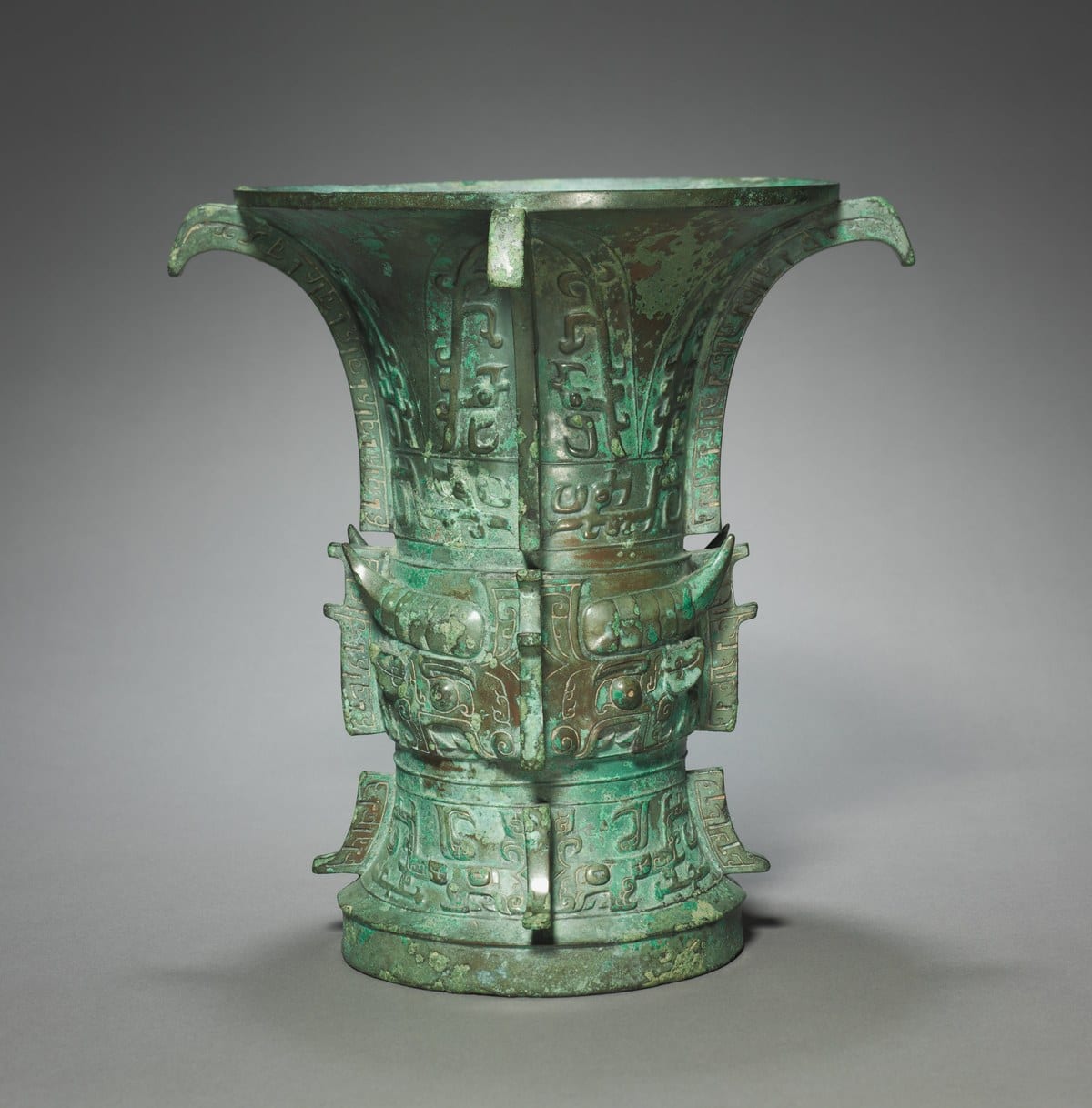
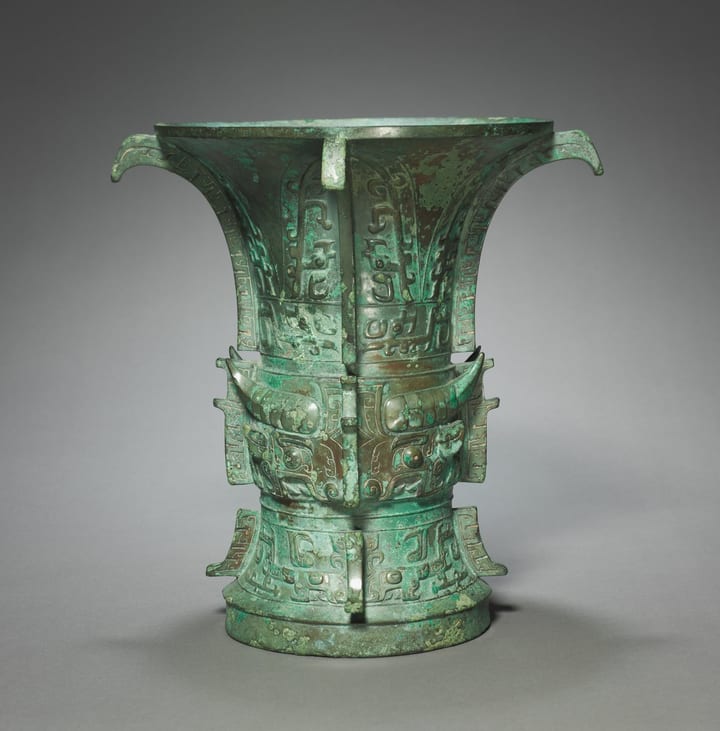
Cleveland’s photographed zun, 1951.151, dates to around 1000 BCE in the Western Zhou dynasty. It is bronze and 29.5 centimeters high. The museum identifies buffalo heads with projecting horns on the middle section and four notched flanges below the flared mouth. Follow how the ridges divide the ornament before tracing the profile from rim to foot.
The Met’s zun 1985.214.6, dated to the thirteenth through tenth centuries BCE, also has a wide, outward-opening lip. Its central decoration includes a stylized animal mask called taotie. Compare the outline with the relief: the vessel’s mouth and the mask occupy different parts of the design.
A square body can carry animals at its corners
The National Museum of China’s Four-Ram Square Zun has a square mouth and body. Curled-horn heads project from the four shoulders, while the animals’ bodies and legs extend across the vessel and ring foot. The museum records a height of 58.3 centimeters. The animals articulate the container’s corners rather than replace its overall square outline.
The museum’s account describes separately casting horns and dragon heads before joining them through further casting. Its explanation relates the projecting attachments to this particular complex object. That account adds a construction question to a visual comparison: where does a feature meet the wall?
An animal can supply the container’s overall form
The Smithsonian calls S 1987.44 a ritual wine container in the form of an animal. Its current catalogue dates it to about 1025–950 BCE, in the early Western Zhou, and gives its origin as possibly Shaanxi province. It measures 47 centimeters across its recorded width, compared with 30.4 centimeters high.
This is a different relationship between vessel and animal. Read the complete outline before identifying a particular detail as decoration. The record’s possible origin remains a qualification; neither an animal-shaped body nor a familiar pattern supplies a secure place of manufacture.
Casting connects the hollow body and its ornament
The Met explains early piece-mold casting through a model, a clay mold divided into sections, and a core that preserves the vessel’s interior cavity. After firing, the sections were assembled for casting. Patterns could be worked into the mold’s inner surface before firing. The account explains how a hollow vessel could carry sharply defined ornament.
A general process helps frame the questions raised by an object, while its own technical record supplies specific construction evidence. Compare that account with the Four-Ram Zun’s separately made attachments before assigning one production sequence to every form.
Ceremonial context belongs beside the shape
Toledo’s zun 1958.6 is dated to the thirteenth through eleventh centuries BCE. Its label describes low-relief patterns, animal masks and projecting rams’ heads at the shoulder. The museum proposes offerings to departed ancestors as a possible use. Its interpretation gives the decorated container a ceremonial setting while preserving uncertainty about the particular event.
Our gu-shaped-vase guide follows another ancient wine-vessel name into later porcelain. Keep gu and zun with their respective catalogue identifications. A shared flaring mouth provides a useful visual comparison, while each record preserves its own material, date and account of use.
Images and credits
Wine Vessel (Zun), China, Western Zhou dynasty, c. 1000 BCE. Bronze. Cleveland Museum of Art, 1951.151. Gift from Howard Hollis and Company. CC0. Complete museum photograph, resized.