Read the handle, cover and body separately
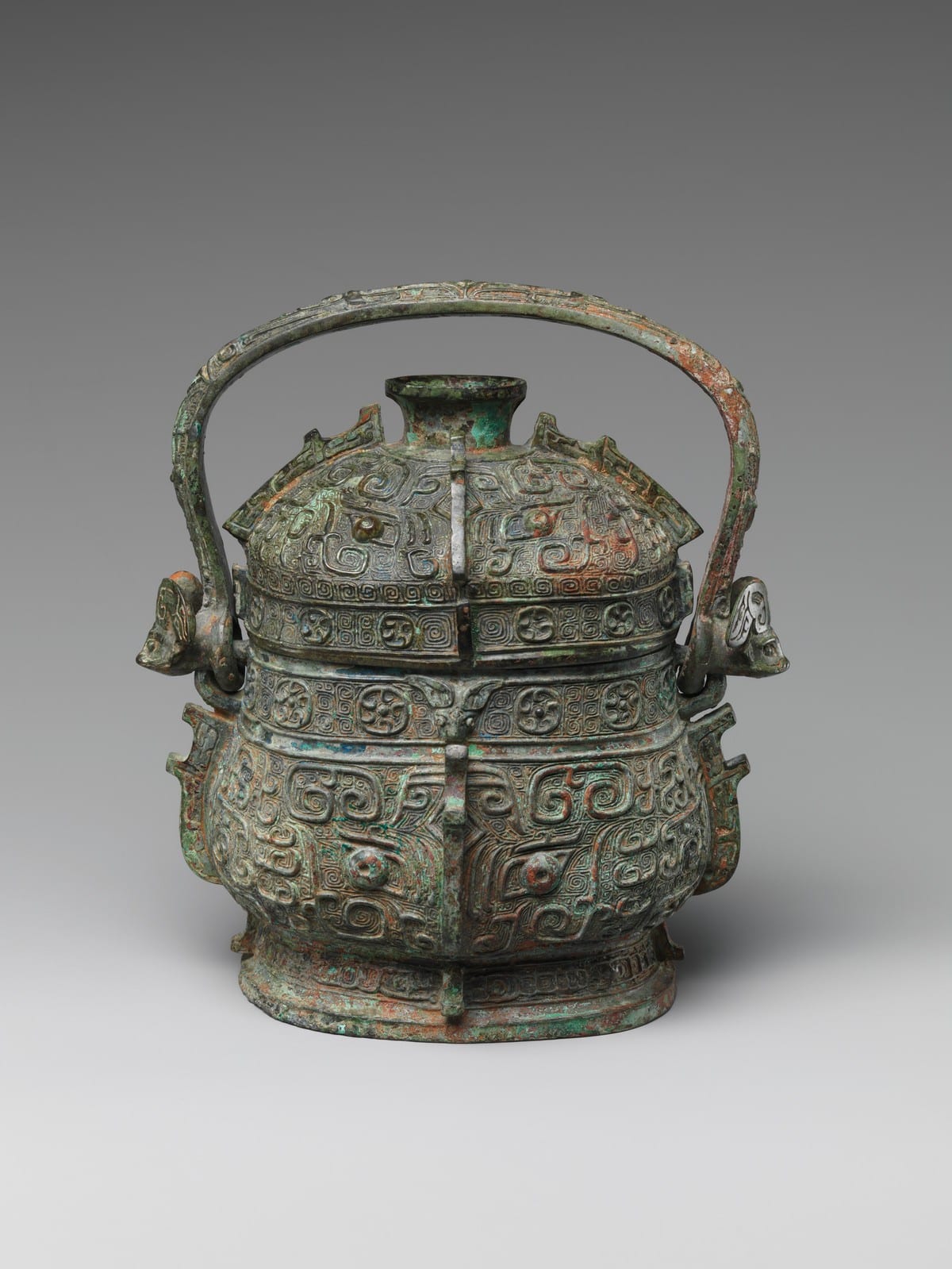
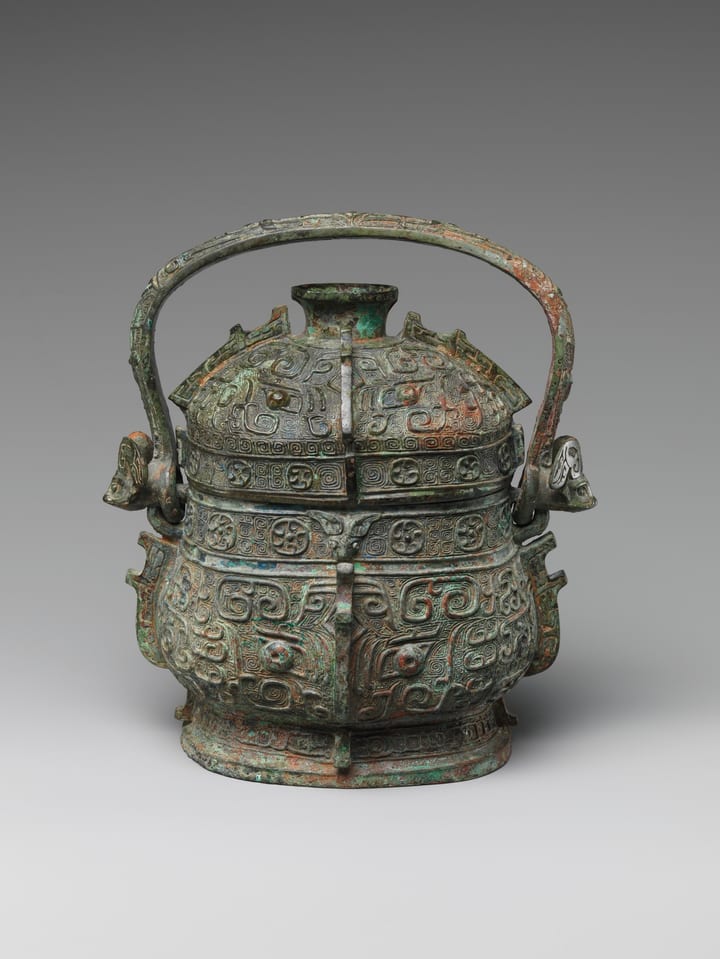
The photographed Met you, 1987.310a, b, is dated to the tenth–ninth century BCE. The museum records animal masks on its body, animal heads at the handle ends and inscriptions beneath the lid and on the body.
Begin with the outline before concentrating on a single creature. Trace the curve of the handle and locate its connections, then follow the boundary where the cover meets the body. This separates questions about the container’s parts from questions about its ornament. A complete view can show how those features relate without revealing every hidden surface.
An altar group supplies evidence beyond one silhouette
The Met’s vessel 24.72.2a–c belongs to a group said to have come from a tomb uncovered in 1901. Its catalogue dates the bronze to the late eleventh century BCE. The museum’s reconstruction uses corrosion outlines left on an altar table to place two you containers beside a central zun. It presents the arrangement of the other objects as hypothetical.
The catalogue also notes differences in style and inscriptions within the group. It proposes accumulated family-shrine wealth as one interpretation. The reconstruction is therefore evidence to examine, rather than a complete script for a ceremony. Compare an object’s inscription, its association with other vessels and the physical marks on the supporting table as separate sources of information.
A you can also take an animal form
The Smithsonian’s F1942.14a–b takes the form of two horned owls standing back to back. Its current record dates it to about 1150 BCE and gives Anyang, probably Henan province, as its origin. The museum describes scale-like patterns across the bodies, wings and legs, and identifies the heads on the lid through their round eyes, bent beaks and horns.
Here the animal is more than a motif placed on a wall. It supplies much of the container’s shape. Compare that relationship with a conventional rounded vessel carrying a separate mask. Keep the museum’s identification beside each example instead of assigning every small bird-like detail the same species or meaning.
Mold and core explain the hollow cast form
The Met’s account of early bronze production describes forming a clay mold around a model, dividing it into sections, firing the pieces and assembling them for casting. A core preserves the interior cavity of a vessel. Ornament could be worked into the mold’s inner surface before firing.
That explanation connects a hollow container with relief decoration. It does not, by itself, identify the exact assembly sequence or later repairs of a particular you. The relationship between a projecting attachment and the container wall needs object-level technical evidence. A detailed photograph is useful for looking, while examination and a conservation record address different questions.
Scale belongs beside the decorated surface
Seattle Art Museum’s you, 56.33, is catalogued as cast bronze from China and dated to the eleventh century BCE. It is 36.8 centimeters high. The catalogue’s measurements help restore physical scale to an image viewed on a small screen.
When comparing museum photographs, first check whether a dimension includes the cover, handle or a separate support. Display size is not object size. Keep the stated units and components together rather than assuming that two similarly framed photographs show equally large vessels.
Compare vessel families without merging their records
The bronze hu guide follows covered wine containers through their proportions, decorative bands and inlaid surfaces. The zun guide compares flaring, square and animal-shaped forms. Those pages provide companion questions, while this guide concentrates on you covers, handles and documented assemblages.
A useful comparison starts with the museum’s name for the object, then moves through outline, material, date and evidence of use. Similar ornament can appear on different vessel families. Conversely, objects sharing a catalogue name can have markedly different bodies. Preserve those differences when moving from one record to another.
Images and credits
Ritual wine container with handle (You), China, tenth–ninth century BCE. Bronze. The Met, 1987.310a, b; Gift of Charlotte C. and John C. Weber, 1987. Public domain/CC0. Complete museum photograph, resized.