Chinese woodcarving techniques: three spatial choices
Relief, fudiao (浮雕), raises an image above a lower background. Wuxi Museum distinguishes shallow and high relief according to the projection of the forms. A deep scene may look strongly three-dimensional while still belonging to a panel. Its background and the relationship between successive levels remain part of the composition.
Openwork, toudiao (透雕), removes background areas to create openings. Carving in the round, yuandiao (圆雕), develops a form in three dimensions that can be appreciated from several directions. These terms describe spatial treatment rather than a fixed list of subjects. A flower, human figure or animal could be represented through different approaches.
Why a door uses both solid and open areas
The Hakka Museum’s late-Qing set of eight partition doors provides a concrete design lesson. Its account describes a combination of relief, pierced carving and lacquer painting. Different techniques occupy different parts of the door rather than competing for a single label.
The museum explains that the lower area uses solid boards because it is exposed to knocks and helps block water and dust. Higher pierced sections admit light and air. Their position also places delicate decoration farther from children’s reach. This is a documented solution for this architectural ensemble, showing how intended use can guide the placement of carving.
Its narrative and auspicious decoration has a social setting too. The museum interprets the ensemble in relation to a lineage hall and aspirations for descendants. That reading belongs to these doors; it is more informative than assigning one universal meaning to every densely carved panel.
Openwork can be single-layered or spatially layered
The National Museum of China’s Chaozhou exhibition distinguishes wire-sawn openwork from multilayer openwork. In the first approach, a design is drawn on prepared wood, sawn out and refined with carving tools. Multilayer work develops scenes across several depths. A pierced design is therefore not necessarily a deep, crowded scene.
The same exhibition identifies both openwork and carving in the round in a Qing architectural bracket showing plum blossom and a rooster, held by Guangdong Museum. The combination demonstrates that these categories can describe different parts of one composition.
A small sculpture with openings through its forms
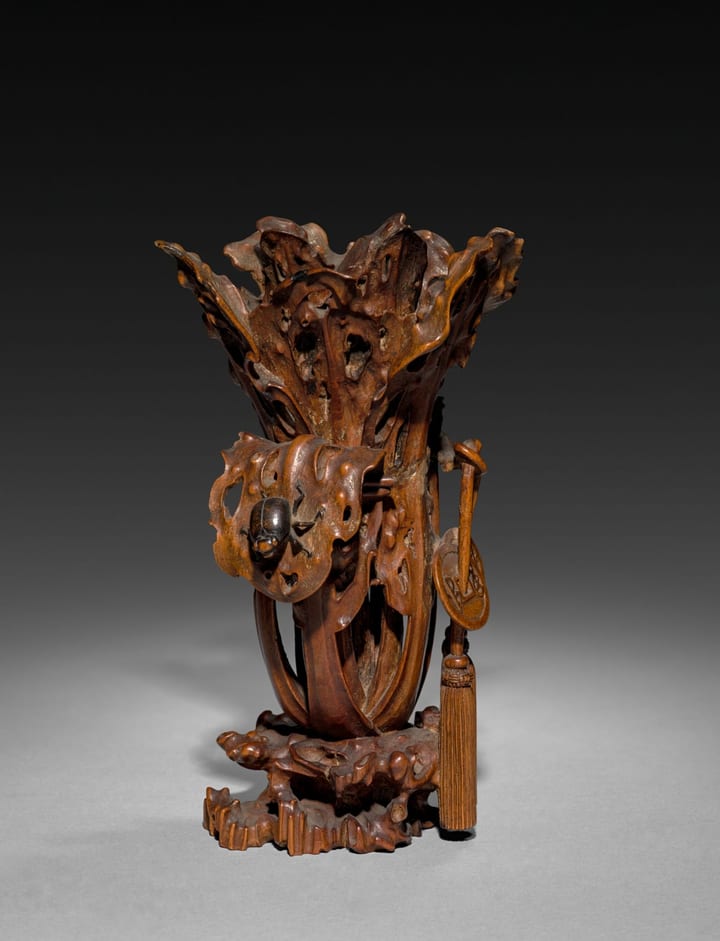
Cleveland Museum of Art’s Cabbage and Beetle, accession 1966.376, is Chinese carved wood dated to the mid-1700s. The museum states that the cabbage on its gnarled rock was carved from a single piece. It specifically notes openings between the stems, in leaves and in the rock.
This is a useful example of modeled volume working together with voids. Follow the outer silhouette, then the spaces between the stems: both contribute to the sculpture’s structure and appearance. The catalogue also records a dark-painted beetle and a lighter finish elsewhere. Those colors are part of the object’s treatment, rather than evidence identifying its wood species.
Openwork beneath a furniture surface
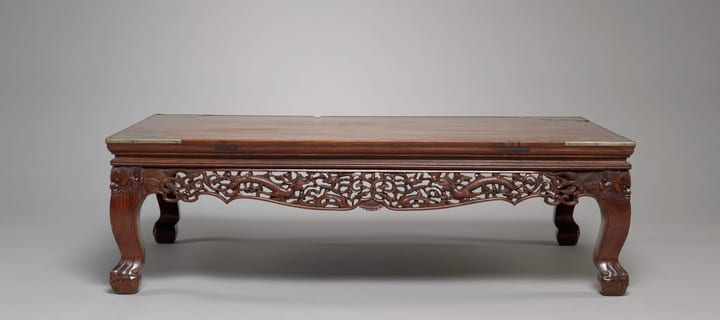
Cleveland’s Low Table with Dragons in Clouds, accession 1964.228, offers a different scale and purpose. Dated to the 1600s–1700s, it is catalogued as rosewood (huanghuali) and metal. The museum explicitly draws attention to its openwork carving, curved legs and metal-fitted corners.
In the photograph, the pierced ornament extends beneath the solid tabletop. Compare the continuous working surface above with the interrupted decorative band below. The two zones do different visual work within a usable furnishing. The museum relates kang tables to raised living platforms in northern China and wooden daybeds in the warmer south.
Material and finish shape the comparison
Wood is not an interchangeable carving blank. The V&A’s technical account explains that individual tree properties and available dimensions affect sculpture; uneven drying can create cracks along the grain. These material considerations help explain why a proposed design must be matched to the piece of wood, without prescribing one timber for every technique.
The Dongyang heritage record emphasizes relief, including several depths and layered approaches, while naming a range of timbers. It also describes a preference for retaining the wood’s visible character. That regional account sits beside Chaozhou examples with lacquer and gold decoration. A finish and a carving method are different aspects of the same object.
Use the Dongyang guide for its regional tradition and the boxwood guide for a particular material and figural approaches. Bamboo carving introduces a hollow stem and its surface layers. This comparison instead asks what the maker retains, lowers, pierces or models in space.
Images and credits
Low Table (kang zhuo) with Dragons in Clouds, China, 1600s–1700s. Rosewood (huanghuali) and metal. Cleveland Museum of Art, 1964.228; Severance and Greta Millikin Collection. CC0. Complete museum photograph, uncropped and resized for display.
Cabbage and Beetle, China, mid-1700s. Carved wood. Cleveland Museum of Art, 1966.376. CC0. The museum records a single piece of wood with openings and contrasting surface coloration; no wood species is specified. Complete museum photograph, uncropped and resized for display.