Begin with the flaring mouth
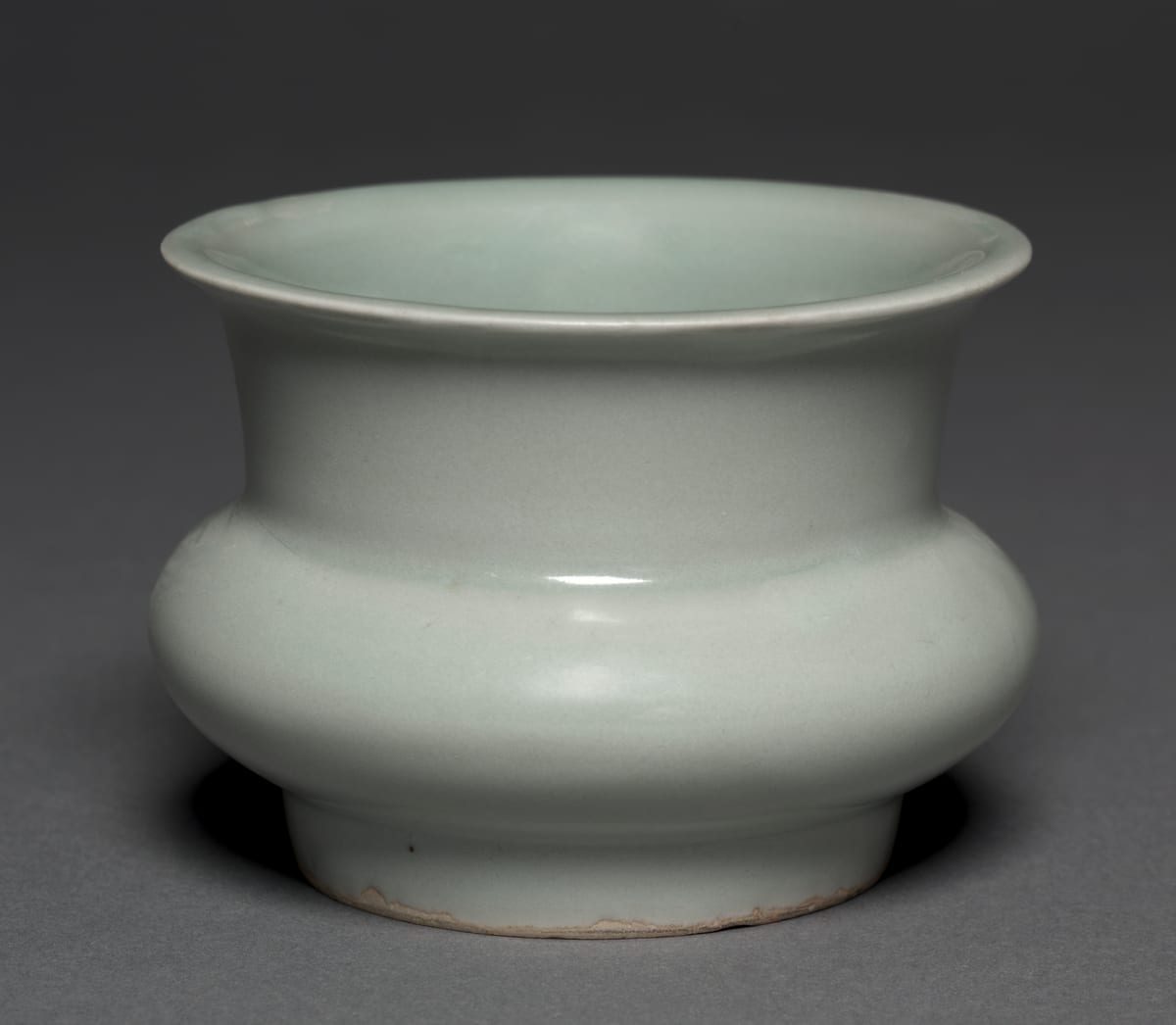
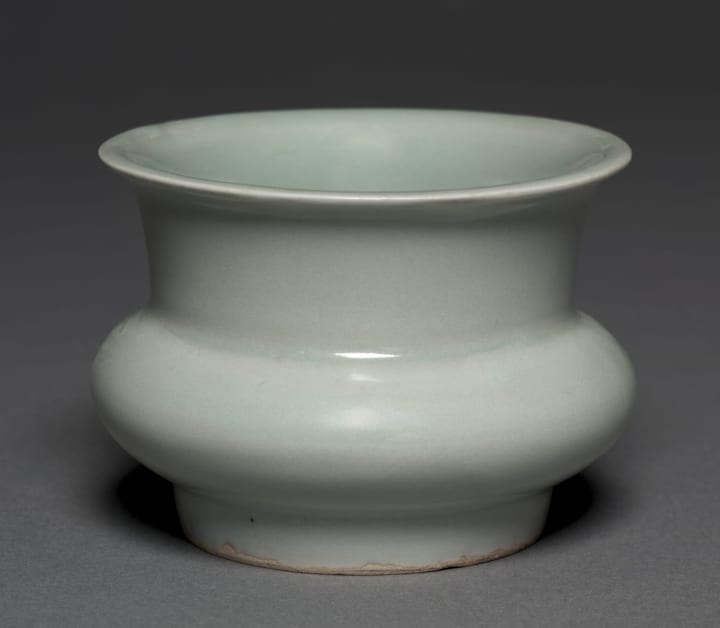
The illustrated vessel is Cleveland’s 1957.73, catalogued as Vase in the Shape of a Grain Measure (Zhadou). The museum dates it to 1127–1279 and identifies it as Longquan ware from Zhejiang. Its listed overall measurement is 9 centimeters, with a diameter of 8.4 centimeters.
Follow the outline from the rim inward and down to the rounded body. Then compare the short base with the wider upper opening. The photograph offers a clear profile; the museum’s title supplies a particular identification. Keep both in view rather than replace the record’s name with a single assumed function.
Slops jar describes a documented use
The Smithsonian’s F1951.12a-c is porcelain decorated with cobalt beneath a transparent glaze. Its label explains zhadou as slops jars for table refuse and notes the alternative terms leys jar and spittoon. Flowers and fruiting branches decorate both the interior and exterior.
The same record retains uncertainty about its date. This unmarked example might belong to the Chenghua reign or as late as Zhengde; the museum gives the broader range 1450–1521. A floral design or a familiar shape therefore does not establish a precise reign by itself.
Compare the recorded name, material and date separately. A familiar profile does not answer all three questions.
A white ware example makes construction visible
The Ashmolean’s LI1301.137 is catalogued as a white ware zhadou or spittoon, dated to the eighth or ninth century. Its entry records thrown stoneware, a white glaze, a glazed rim and an unglazed base. The longer discussion describes a broad, low body, a funnel-like neck and a small opening into the container.
The record’s main place entry names the Xing kiln sites in Hebei, while the accompanying discussion says the piece may instead have come from Ding kilns in the same province. Retain that qualified attribution when comparing it with the Longquan example.
This comparison also separates appearance from making. The technique entry supplies evidence for throwing; the visible cream-colored surface alone cannot identify the potter’s tools or an exact firing schedule.
Decoration can identify a particular comparison
The British Museum’s Room 95 guide discusses a dish and zhadou with dragons, PDF A736 and A734. It describes incised five-clawed dragons chasing flaming pearls among ruyi clouds, with a green-and-yellow color scheme. Both pieces carry Zhengde marks, and the guide assigns them to Jingdezhen in 1506–21.
The guide calls zhadou bowls for slops. Keep this description with its specific ceramics, and compare the recorded marks, decoration and place together.
A bronze label can preserve another interpretation
Cernuschi catalogues bronze M.C. 1018 as a vase in the form of a zun. Its account compares the shape with ceramics of the later fifteenth and earlier sixteenth centuries. Although such objects are often called zhadou or spittoons, the museum notes an interpretation that their form imitates ancient zun vessels.
A broad mouth invites comparison, while this historical interpretation asks about the model being recalled. Keep it qualified and attached to the bronze rather than transfer it to every ceramic vessel.
Compare related vessels by their distinct parts
Our ewer guide follows a pouring form’s spouts and handles. The covered-jar guide asks how lids and necks meet, while tea-bowl stands support separate bowls. Here, attention stays on the zhadou’s mouth, body and recorded names.
Compare a complete profile before a decorative detail. Read the dimensions, material and attribution beside it, preserving the differences recorded by the catalogues.
Images and credits
Vase in the Shape of a Grain Measure (Zhadou), China, 1127–1279. Longquan ware. Cleveland Museum of Art, 1957.73; Gift of Mr. and Mrs. Severance A. Millikin. CC0. Complete museum photograph, resized.