Read the profile of Chinese tea bowl stands
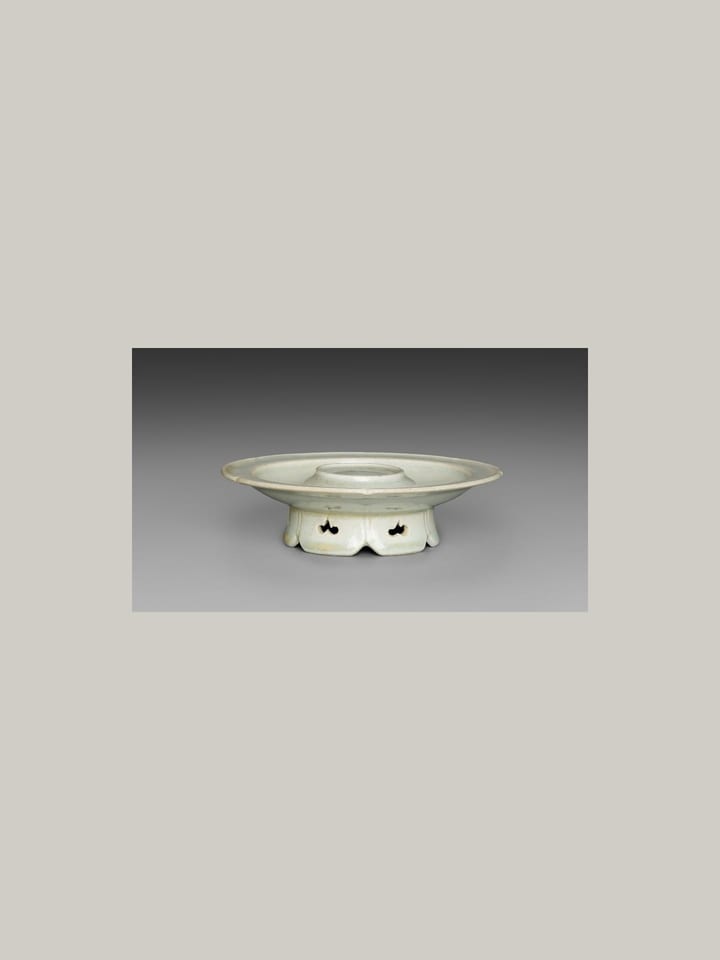
The Cleveland Museum of Art catalogues the pictured Southern Song porcelain stand with a separate qingbai cup. Viewed by itself, the stand shows how a small central ring rises within a much wider rim. Openings interrupt the foot below. The stand is 14 centimeters wide and 4 high.
Our porcelain stem cup guide gives a useful side-by-side comparison. On a stem vessel the raised foot belongs to the drinking vessel itself. To tell the forms apart, look closely at which sections would lift together.
The underside can show how parts were joined
The Palace Museum’s sky-blue Jun ware stand has one foot ring within another. Curator Guo Yukun proposes that its cup-shaped upper part and its surrounding support were formed separately, joined, then glazed together. The museum gives the stand a tentative Northern Song date. The visible join concerns the making of the stand itself. A drinking bowl could still be set on top as a separate piece.
Compare the openings of the central seats
A Northern Song Ding stand in the National Palace Museum has a deep receptacle with an open bottom. Its broad rim and foot carry metal mounts, while the upper collar has an unglazed lip. Incised meander bands run around the collar and the rim. This example makes it useful to distinguish the central seat from the larger edge around it.
The same museum places a Longquan stand near the Yuan–Ming transition on the evidence of its body and glaze. Its low collar encloses a recess with a solid bottom. Cut lines describing cranes and clouds show more strongly where the green glaze gathers. Look for the difference between the shape that holds the bowl and the pattern on the surface around it.
Bowls and stands could be made of different materials
The Smithsonian’s late-fourteenth- to early-fifteenth-century stand is lacquer on a wooden core. Carving exposes red lacquer beneath the black surface in the design. The museum relates stands like this to ceramic bowls used for hot drinks. It also cites accounts in which the drinker raised the stand to bring the bowl toward the lips.
In its discussion of the Ding example, the National Palace Museum mentions white bowls paired with black lacquer stands and black bowls with red stands. Those pairings draw attention to the silhouette where the two colors meet.
Our Qingbai porcelain guide follows the glaze across bowls, bottles and a wine-warming set. Here the stand and the cup make their relationship visible in another way, through a narrow seating ring and a surrounding rim.
Images and credits
Cup and Stand (stand), Southern Song China, twelfth century. Glazed porcelain. The Cleveland Museum of Art, 1980.185.b. Complete institutional photograph of the stand, resized. CC0. Display adds a neutral border.