One regional name, more than one tradition
Guangzhou’s heritage account places Guangxiu in Guangzhou and its historically connected Pearl River Delta localities, including Nanhai, Panyu and Shunde. Chaoxiu belongs to the Chaozhou and Chaoshan setting farther east. Yue is an umbrella connecting these traditions, rather than another name for only one city.
The national heritage register records Yue embroidery’s Chaozhou entry in the first list announced in 2006. This is a Chinese national designation, not a claim of UNESCO inscription. Keep the regional name attached when a museum or maker supplies it; similar flowers or birds cannot establish a workshop’s location.
Materials change the embroidered surface
Guangzhou’s account groups work by material, including silk, metallic thread and beadwork. It identifies Lingnan subjects such as lychees and kapok.
The Palace Museum’s historical definition adds less expected materials: peacock feathers formed into threads and horsehair-wrapped outlining. It lists screens and hanging pictures alongside clothing, purses and fan cases. A material may shape an edge or add brilliance rather than filling the whole image. Its presence needs an object record; it should not be guessed from a reproduction.
Chaozhou embroidery can build relief
The national Chaoxiu record describes combining stitching with padding, applying, piecing and embellishing. It singles out the Nine Dragon Screen for combining several methods, including raised work with couched gold thread. The resulting relief gives the dragon a different relationship to light and space from a flat stitched picture.
The record includes daily, ceremonial and theatrical uses. Read raised gold work in its particular setting, as one documented Chaoxiu method.
Bead embroidery adds another material vocabulary
The national register lists Yue bead embroidery as a 2021 extension associated with Chaozhou. Its record describes needle and thread attaching pearls, glass beads, sequins and other small materials to a supporting surface. Some glass-bead work covers the ground; other work places beads only in selected areas.
This makes coverage an informative viewing question. Look at how bright elements meet the exposed ground, and how their arrangement changes the object’s surface. The register includes ornamental works as well as bags, belts and other useful items. Beadwork therefore broadens the regional family beyond pictures made entirely with colored silk.
A Guangzhou textile made for overseas use
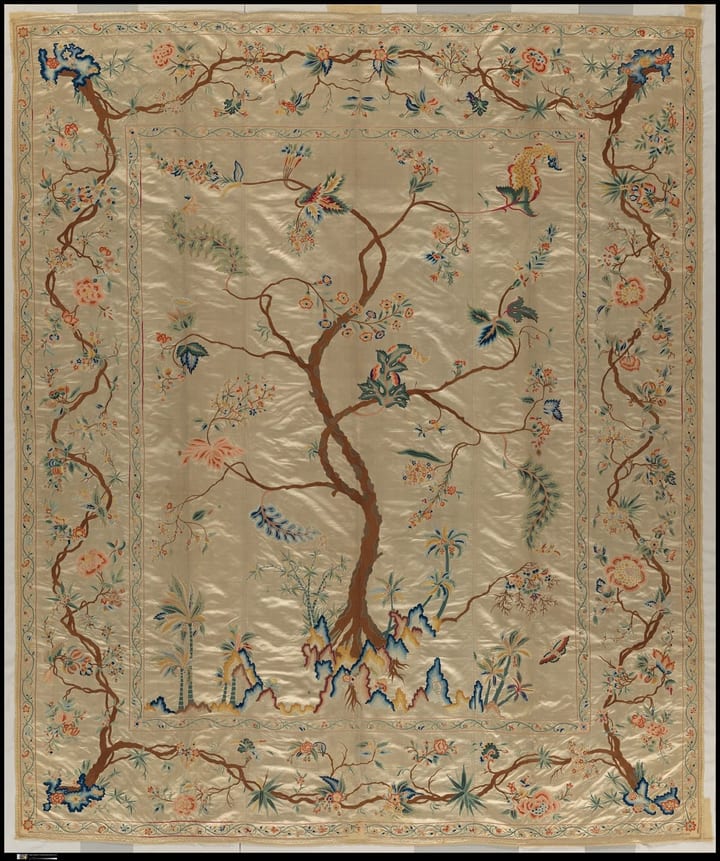
The photographed Chinese Palampore belongs to The Metropolitan Museum of Art, accession 47.63. Its catalogue identifies Guangzhou production, 1750–1800, in silk satin embroidered with silk for a European or American market. The central tree and surrounding floral borders show the composition of one documented textile.
The museum explains that Cantonese craftspeople adapted an Indian painted cotton palampore in silk embroidery. This example makes exchange concrete: an image and furnishing format moved between places and media. It does not document the individual embroiderer or identify each visible stitch.
How researchers distinguish related export work
Masako Yoshida’s 2014 study in the Metropolitan Museum Journal examines another group of Chinese export embroideries. It compares materials, stitches, motifs and compositions with surviving works and historical evidence. Some use silk and gilt-paper-wrapped threads, with dense animal-and-flower designs.
The study also makes its uncertainty explicit: proposed dates and histories for undated textiles are provisional. Its method is useful when looking at embroidery because a resemblance can begin a comparison without settling attribution. These studied panels are separate objects from the photographed palampore, and their technical findings should remain attached to them.
Transmission includes study, repetition and new choices
The official record for Guangzhou embroiderer Xu Chiguang describes learning from his father, Xu Song, from the age of seven. It records his work documenting traditional stitches, developing techniques and teaching later practitioners. This account presents family knowledge and sustained practice alongside individual artistic decisions.
A Guangzhou culture-authority report published in July 2024 describes a broader study involving museums, universities, practitioners and designers. Historic patterns were examined through subject, composition, color and stitching, with re-embroidery helping practitioners understand earlier methods. The report also records teaching material, oral-history work and new applications. It is evidence of specific protection and teaching activity, rather than a current class-booking notice.
Images and credits
Chinese Palampore, Guangzhou, China, 1750–1800. Silk satin embroidered with silk, made for the European or American market. The Metropolitan Museum of Art, 47.63; Gift of Louise Housman, 1947. CC0. Complete museum photograph, uncropped and resized for display.