Two threads do different work
The V&A distinguishes couching, which holds a laid thread with another thread, from goldwork, which identifies embroidery using gold or gilt-metal threads. One term concerns attachment; the other concerns material. Looking for small fastening crossings helps make that distinction visible.
Gold thread can have a layered construction
The Palace Museum distinguishes traditional flat and round metal threads. In its account, gold leaf is bonded to paper and cut into narrow strips, about half a millimetre wide. Wrapping a strip around cotton yarn or silk thread produces a round thread. A gold-looking line can thus be a composite rather than solid wire.
The entry also covers modern metallic-looking films. Identify the actual construction from the object’s material record.
A documented Chinese method uses paired lines
The China National Silk Museum’s Qing fragment has a blue satin ground with bats and longevity characters. Its explanation of panjin embroidery describes gold threads laid across the surface and held with short silk stitches, generally securing two gold threads together. The fastening points are staggered between neighboring groups.
The museum gives spacing of roughly three millimetres in this account. Treat that as the documented method described with this textile, rather than a measurement required of every Chinese couched work. The passage explains how repeated small attachments can organize a larger filled form.
Couching need not cover the whole picture
The Met’s Rank Badge with Silver Pheasant, accession 30.75.986, dates to the eighteenth or early nineteenth century. Its catalogue specifically identifies couching in the gold waves. The bird corresponds to the fifth civil rank, but that iconographic meaning does not explain the stitching of every part.
Penn Museum badge 52-23-31B offers another useful distinction. Its eighteenth-century Chinese record lists satin stitch, stem stitch, Peking knot and couched gold thread together. A wild goose and surrounding motifs form one composition made through several methods. Calling the object “couched” should not erase the other needlework.
The photographed object is a chair covering
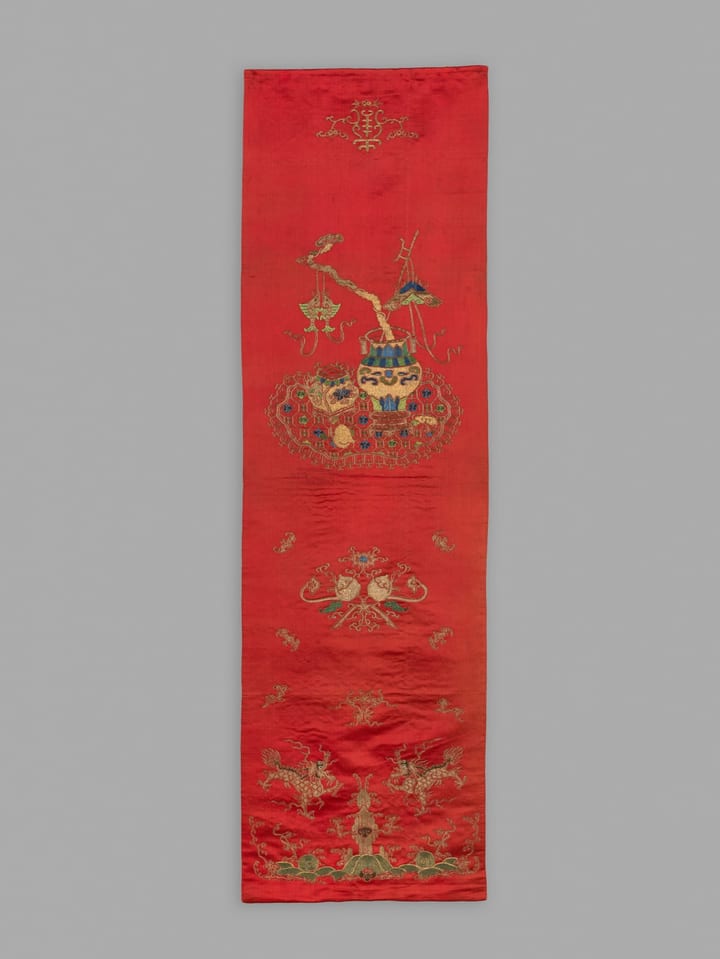
The photographed Chair Strip with Antiquities, Met 1978.211.2, is Chinese, Qianlong period, 1736–95. It was made as a temporary chair covering, mainly embroidered with couched gold on satin. The antiquities express good wishes: a halberd and angled stone chime form a celebratory rebus.
Raised gold work adds another dimension
The national heritage record for Chaozhou embroidery describes methods involving stitching, padding, applying, piecing and embellishing. Its Nine Dragon Screen combines these approaches, including raised, padded work with couched gold thread. Padding and fastening are related decisions but are not the same operation.
This documented regional achievement should not turn into a universal label. A flat couched outline need not have padding underneath, and the chair strip illustrated here is not catalogued as a Chaozhou example. Regional attribution needs its own evidence.
A practical demonstration is not a historical recipe
The Royal School of Needlework demonstrates turning paired metal threads at the end of a line. Its instructions keep them parallel and use evenly spaced securing stitches, firm enough to hold without denting the metal. At a turn, care is taken to avoid piercing the laid threads.
This contemporary teaching example helps explain the two-thread relationship. It does not establish which needle, fastening thread or turning sequence an unnamed historical Chinese embroiderer used. For looking at a museum textile, distinguish what its catalogue documents, what you can observe, and what remains unknown.
Images and credits
Chair Strip with Antiquities, China, Qianlong period, 1736–95. Silk and metal-thread embroidery on silk satin. The Metropolitan Museum of Art, 1978.211.2; Gift of Francis Keally, in memory of his wife, Mildred Taber Keally, 1978. Public domain, CC0. Complete museum photograph, uncropped and resized for display.