A limestone set gives a concrete early example
Henan Museum records ten polished limestone chimes excavated at Sanmenxia in 1961 and assigned to the Warring States period. Their lengths range from 61.2 to 31 centimetres, and their angled shapes have a slightly curved lower edge.
The museum connects the differing slabs with a range of pitches and describes alternating or successive strikes with the hands. Its account helps explain a set as coordinated sounding components. Those measurements and materials belong to this identified group; they should not be transferred to the later jade object pictured here.
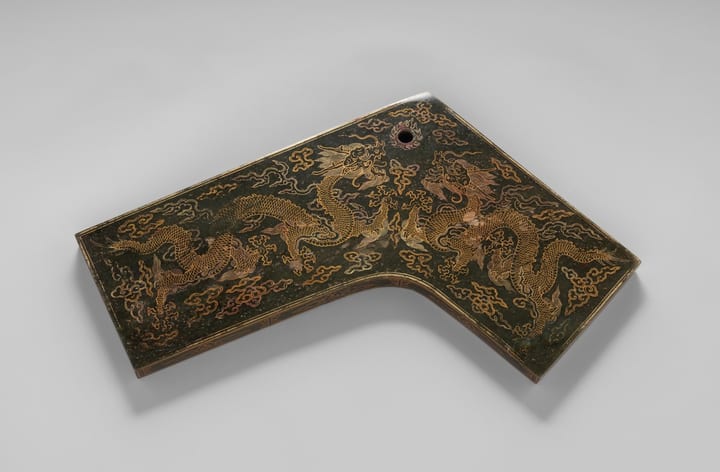
The photograph shows one later jade chime
The Met’s 03.15.1 is dated to 1716, in the Kangxi period. Its title identifies the pitch Linzhong. The complete photograph preserves the angled outline, a suspension opening and the gilded dragon-and-cloud decoration.
This is one Qing-dynasty chime, not a complete bianqing set and not a Warring States object from Marquis Yi’s tomb. Its surface and date provide a later comparison with archaeological stone ensembles.
A hanging hole belongs to the working structure
The National Museum of History’s set h0000267 contains ten differently sized, gray-white angled stones. Its record connects them with Eastern Zhou finds from Liulige in Huixian, Henan.
A round opening near each bend allowed a cord to suspend the stone from a frame. The surfaces are described as undecorated. This makes a useful structural comparison: changing size, the hanging point and the angled body all matter even when there is no elaborate carved image. Follow the actual group’s record before supplying a universal chime count or frame reconstruction.
Stone is usual, but the name is not a material guarantee
The Palace Museum calls its six late-Warring-States bronze objects bianqing. Each is a broad, flat, bent strip with an animal head at one end and a round opening.
The museum defines bianqing through an arranged group with differing pitches while noting that qing are commonly stone. These bronze examples are an important exception. A familiar instrument name, an angled outline and a material identification answer related but different questions; none should silently replace the others.
A dated imperial component preserves its pitch label
The Walters’ Chime from an Imperial Set, 42.274, is dated by an inscription to 1764. Its catalogue identifies nephrite jade, lacquer and gilding, and says it belonged to a set of sixteen made for Qing court music with bronze bells.
Two characters along an edge identify the pitch, while an inscription on the shorter side records the date. Those marks connect a surviving component with its musical role and court setting. This documented sixteen-piece ensemble is distinct from the ten-piece archaeological sets discussed above.
Painted stone could carry a different surface treatment
The Musical Instrument Museum’s Unearthed exhibition presents a Warring States stone chime with a phoenix pattern. Its account notes that some Chu-style painted decoration survives even though much colour has faded.
The object belongs to a decorated set, according to the exhibition description. Its surviving pigment offers a different surface from a plain polished stone or the incised gilding of the later jade photograph. Read the condition and treatment actually recorded for each object instead of imagining every chime as bare gray stone. The exhibition photograph documents surviving appearance, not the sequence of ancient painting or a tuning experiment.
Compare the ensemble with blown instruments
The related xun guide follows breath at a pottery vessel’s opening. The sheng guide follows air and free reeds. Bianqing instead organizes individually suspended sounding pieces for striking. Comparing these mechanisms keeps distinct instrumental knowledge visible within a broader musical setting.
Images and credits
Chime for Linzhong, China, dated 1716, Kangxi period; jade with incised gilded design. The Met, 03.15.1; Gift of Major Louis Livingston Seaman, 1903. CC0. Single Qing-dynasty chime, not a complete ancient set; full photograph, uncropped and resized.