Begin with the blowing position
Chow Fan-fu’s Hong Kong Chinese Orchestra note distinguishes horizontally played dizi from vertically played xiao. It identifies a membrane opening on its dizi examples, absent from xiao.
An edge turns the airstream into a musical tone
Grinnell College’s central-Chinese xiao examples retain a bamboo node at the top, with an opening and sharp notch. The player directs a focused stream of air towards that edge. Covering and uncovering finger holes changes the effective sounding length.
The catalogue distinguishes the instrument’s full length from its acoustic length: hole positions and internal design matter alongside overall dimensions.
Finger holes and vent holes have different jobs
The Horniman Museum’s xiao 1975.101, made around 1975, has five front finger holes and one thumb hole. Two pairs of vent holes lie farther down the back. Its top node forms an end cap with a U-shaped opening above the notch.
The visible holes are not all finger positions. This particular record also notes irregular finger-hole spacing and an inscribed D. Those details describe one surviving instrument; they are not a rule that every xiao has an identical fingering layout or tuning.
Xiao and dongxiao names depend on context
Grinnell uses xiao for its central-China examples and dongxiao for examples from the southeast coast and Taiwan, while acknowledging that either name can be used for both. Its southeastern specimens have an open, notched upper end and a slightly conical bore, rather than the retained top node described above.
The same account places dongxiao in Nanguan, the southern Fujian tradition also called Nanyin. There the player can closely follow the singer’s melodic line, adding delicate ornaments. Looking at the instrument and listening to its ensemble gives more information than treating its name as one universal construction plan.
The photograph shows a Yuping instrument
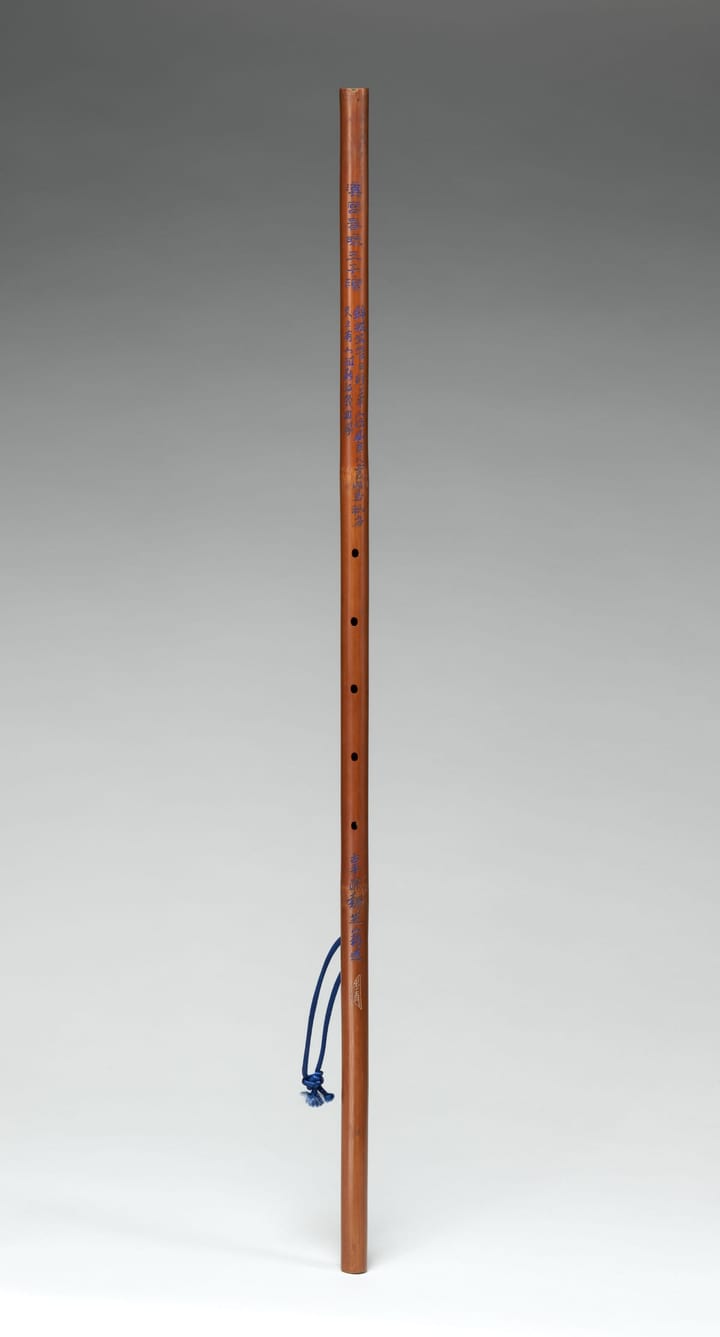
The Met identifies the illustrated Yuping Xiao, 2016.500, as the work of Zhishan Zheng, dated around 1890. It comes from Tongren, Guizhou, and is made of water bamboo. The catalogue records a length of 65 centimetres and a diameter of 1.4 centimetres.
The museum connects this type with solo playing and qin duets, noting its comparatively soft tone and the poems inscribed on some examples. The photograph presents this historical flute, rather than a Nanyin performance or a making demonstration.
Making and playing knowledge can develop together
The National Library of China’s record of Yuping maker Liu Zesong, with information dated May 2025, describes learning to play from his father at ten and beginning instrument making at fifteen. It identifies him as a representative bearer of the national Yuping xiao-and-di making tradition.
The record also describes his continuation of carving practices on dragon-and-phoenix flat xiao. This connects instrument making, family learning and decorative skill through a named practitioner, rather than an anonymous story about an unchanging craft.
Nanyin gives the flute a specific ensemble relationship
The national heritage record for Quanzhou Nanyin describes pipa and sanxian on one side, dongxiao and erxian on the other, and a central performer with clappers. It distinguishes instrumental suites, pu, from vocal pieces accompanied by these instruments.
In this setting, a flute phrase belongs within an organized musical relationship. Listen for its line beside the voice and strings, and for the timing marked by clappers. The Nanyin guide explores the larger tradition; the flute’s construction is only one part of that musical practice.
A museum performance makes the differences audible
Shanghai Conservatory’s Oriental Musical Instrument Museum describes a Fujian Nanyin dongxiao that is 58 centimetres long, with a reported mouth diameter of 4.4 centimetres. It identifies five front finger holes and one rear hole on this relatively thick, short bamboo form.
The account documents a 7 April 2025 museum demonstration including Meihua Cao and Zouma, with dongxiao alongside Nanyin pipa, sanxian, erxian and percussion. It offers a concrete comparison with the slender Yuping object pictured here: two documented instruments and musical contexts, not one standard model.
Images and credits
Yuping Xiao by Zhishan Zheng, China, around 1890; water bamboo. The Met, 2016.500, Gift of James C. Y. Watt, 2016. Public domain, CC0. Complete photograph, uncropped and resized.