Names and shapes follow the brush’s resting place
The Palace Museum lists bijia, bige, bichuang and bishan among names for brush supports. Its court examples include mountains, animals, bridges and plant forms. Mountain peaks are therefore a familiar approach within a wider range of designs.
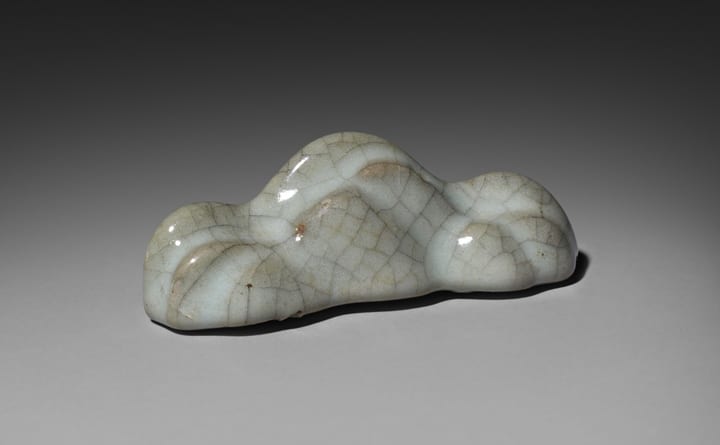
The photograph shows a Guan-ware miniature mountain
Cleveland’s Brush Rest, accession 1957.42, is assigned to Zhejiang in southeast China and dated to the Southern Song dynasty, 1127–1279. Its catalogue identifies glazed stoneware rather than jade.
The pale gray-blue surface has a network of cracks. The museum describes thicker glaze collecting in the deeper areas and compares the softened mountain appearance to mist. Look at the ridgeline and then the changes of glaze across its slopes. The photograph records this surviving object’s surface, rather than a recipe for reproducing the glaze.
Five metal peaks connect function with retreat
The Met’s copper-alloy rest 2015.500.6.81 is dated to 1562. Its five peaks leave valleys for multiple brushes, so the landscape outline also organizes the working support.
The museum links mountains with immortals, hermits and the literati wish for retreat during unsettled times. That interpretation belongs to this documented mountain form; it is not a fixed meaning to assign to every animal, flower or bridge-shaped rest. The catalogue also makes this a different historical example from the Southern Song ceramic in the photograph.
Jade can turn an existing shape into piled rocks
The Palace Museum’s Qing jade rest, 故00096400, is 6.6 centimetres high and 10 centimetres long. Its account says the maker used the material’s original shape to suggest stacked ornamental rocks, arranging uneven heights and openings.
Careful polishing extends into the recesses as well as over the projections. Follow those alternating solid and open areas when studying the form. This is evidence for a particular jade object’s shaping and finish; it does not establish the cutting tools or polish used on a ceramic rest.
A bamboo rest carries a populated scene
Spurlock’s seventeenth-century Chinese rest, 2004.13.0022, is catalogued as carved bamboo. The description identifies mountains, trees, a house and figures. A small functional support can therefore carry a landscape populated with details, rather than simply repeat a row of bare peaks.
The museum discusses such furnishings alongside other valued study accessories. Compare the supporting outline with the carved scene: one organizes where the brush lies, while the other offers a close view of a small imagined world. No specific regional workshop is identified in this record.
Porcelain dragons can provide the same kind of hollows
The Rijksmuseum’s rest AK-RBK-1955-7 is a Chinese porcelain example painted in underglaze blue, dated about 1575–1599. Five-clawed dragons rise above rocks and waves, with hollows between their heads for the brushes.
The catalogue records a Wanli mark on the underside. Its description makes the relationship between ornament and use unusually clear: the dragon heads also establish the rest’s upper contour. Read the stated material and date alongside the mark, rather than using a dragon motif alone to identify the age or owner of an unfamiliar object.
Separate the support from the material’s wider craft
The related soapstone guide explores regional carving traditions and stone selection. A brush rest is instead defined by its desk function. The water-dropper guide follows another accessory: a vessel supplying water to the separate ink-grinding surface. Studying these tasks together helps explain how several small objects served different needs around the same brush.
Images and credits
Brush Rest, southeast China, Zhejiang, Southern Song dynasty, 1127–1279; glazed stoneware, Guan ware. Cleveland Museum of Art, 1957.42; John L. Severance Fund. CC0. Complete museum photograph, uncropped and resized.