Chinese porcelain stem cups have varied proportions
A late Tang green-glazed cup in the Palace Museum measures only four and a half centimeters high. Its lip opens in five lobes, and the foot spreads outward. The museum compares the shape with gold and silver cups made in the same period.
The rim is most useful for comparing profiles from above. From the side, look for where the wall of the bowl turns inward to meet the support. The relative width and height of the bowl and foot can be more useful than the total height alone.
Decoration extends down the foot
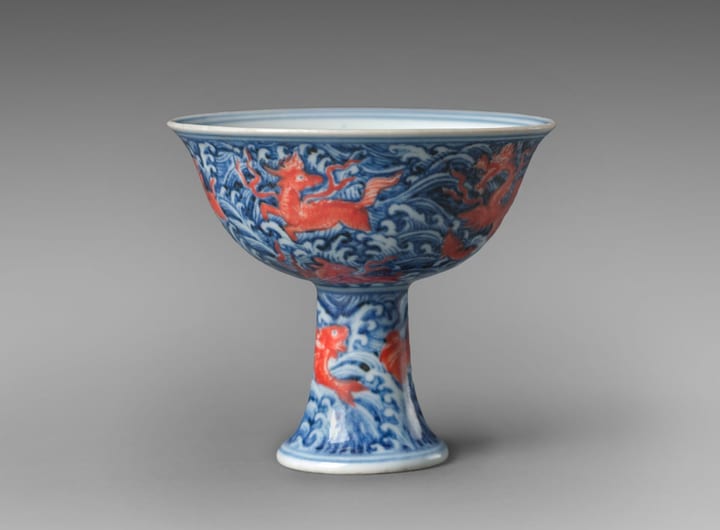
Cleveland’s illustrated porcelain cup bears a Xuande mark and dates to that Ming reign, 1426–1435. Red figures appear among waves on both the bowl and the stem. The record identifies two layers of color. Blue sits beneath the glaze, and the red is an enamel over it.
Look at the photograph as a side view. The stem widens near its base and presents enough surface for an independent band of imagery. The turn between cup and support interrupts the view, and the waves bring the two areas back together.
A reign mark can sit inside the bowl
The Palace Museum catalogues a wider Xuande vessel as a stem bowl. The outside shows two women looking at a painting. Trees and rocks occupy the hollow stem. Inside the bowl, two blue circles enclose the reign mark. The cup and bowl labels invite a closer look at the dimensions and how much space the maker gave the painting.
Excavated fragments show how parts meet
The 2024 Guanyinge kiln report documents separately formed bowls and feet joined at Jingdezhen. Figure 90 shows a surviving stem with part of the bowl attached. The foot edge is rounded, and the underside slopes inward.
Fragments can show the junction even when the rim is lost. For comparison, a full museum photograph gives the overall proportions and the positions of painted scenes. Together, these views help explain why the base, joint and rim are all worth examining.
Tea and wine appear in separate records
The National Palace Museum compares its Xuande Three Friends cup with references to stemmed tea vessels in Ming writing and Qing palace records. The records use more than one name for these cups. They also list stemmed wine vessels separately. These names give curators evidence of historical use alongside the shape and design of an object.
Our Shufu ware guide explains a Yuan porcelain category through its glaze and marks. It includes a stemmed example with an entirely different surface. Use the ware guide to understand the label and this guide to look at how the bowl and raised support are put together.
Images and credits
Stem Cup, Jingdezhen, China, Xuande mark and period, 1426–1435. Porcelain with underglaze blue and overglaze red enamel. Cleveland Museum of Art, 1957.60. John L. Severance Fund. CC0. Complete photograph, resized.