Start with the structure, then read the name
The Textile Research Centre in Leiden groups Peking knots with related names and variants for small knotted embroidery. A label such as seed stitch needs its context: the same centre’s separate seeding entry describes scattered short straight or back stitches. Those unknotted marks should not be substituted for the knotted technique discussed here.
Follow the catalogue’s wording; related names do not establish an identical working sequence.
How a small loop becomes a seed
The Palace Museum explains yuanzizhen, a Guangzhou embroidery term generally called dazi, as forming a small loop after bringing up the needle. The needle returns near the thread’s base and the thread is tightened to leave a seed-like unit. The museum emphasizes consistent pulling, evenly sized grains and orderly placement close to the ground.
Its example is Guangzhou vest material with a many-birds-and-phoenix design, made during the Guangxu reign. The record lists numerous stitches, including yuanzizhen. It shows that the knot belongs within a wider repertoire rather than defining every part of that textile.
Knots can make a detail, outline or filled area
The China National Silk Museum catalogues a Qing yellow-silk pouch decorated with a design wishing for many children and blessings. Its account explains that small seed units can be combined flexibly for flower centres and more elaborate patterns. The description connects the stitch to a specific portable object, with its own material and intended message.
The University of Oregon’s study of Chinese textiles identifies seed stitch in the dragon and phoenix bodies on a different pair of sleeve bands. Its discussion emphasizes the textured relief created by the accumulated stitches. A method used for a tiny centre can also help build a larger form.
Small embroidered forms could be prepared separately
The University of Rhode Island collection’s Chinese Embroidered Appliques, dated about 1850–1900, comprises seven pieces mounted on one sheet of paper. Silk floss forms flowers and butterflies on a woven ground. The record identifies Peking knots in filled areas and a couched white outline made with a different yarn construction.
The record’s count of ten knots per square centimetre applies to these pieces. Their prepared format suggests a set sold to decorate clothing or furnishings.
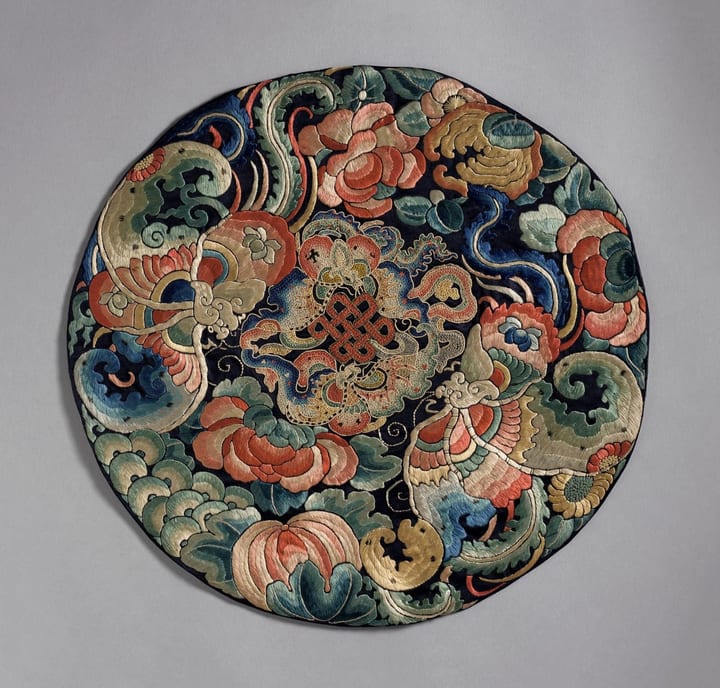
Read the photographed textile as a combination
LACMA’s Four Roundels group records different constructions for its four members. Member a is Chinese, late Qing, late nineteenth century, with Peking-knot and satin-stitch embroidery on silk satin. The other members include a tapestry-woven example and other embroidered fabrics.
The circular format is an object type, not a stitch. Its catalogue combines knotting and smooth satin stitch; the full photograph cannot identify every small passage.
Peking knot and Peking stitch need not mean one thing
The University of Oregon places seed stitch or Peking knot beside a separately described Peking stitch. In the latter, a row of back stitches is worked first, then another thread loops through that foundation. It can outline or fill an area, yet its two-stage structure differs from making separate knots.
Compare the written name with a diagram and worked example: similar English labels can conceal different thread paths.
Teaching connects looking with practical decisions
A China National Silk Museum report from November 2018 describes an embroidery-brooch course accompanying an exhibition. Students examined earlier textiles, selected materials and colours, and learned stitches before practising on supplied patterns. The report describes seed stitch as useful for both outlines and areas of colour.
Students then adapted what they had learned into their own motifs and finished the embroidered cloth as brooches. The documented sequence joins close looking, material choice, repeated practice and later design. It records a particular teaching activity, rather than a current class-booking offer.
Images and credits
Roundel, maker unknown, China, late Qing, late nineteenth century; Peking-knot and satin-stitch silk embroidery on silk satin. LACMA, M.53.1.17a, Gift of Mrs. Eloise Mabury Knapp. Photo © Museum Associates/LACMA, www.lacma.org. Public-domain download; uncropped and resized.