Read the linked structure before assigning a name
The Palace Museum calls bianzigu zhen an ancient embroidery technique also known as suoxiu. It describes thread linked through successive loops, producing a braid-like or chain-like line. That documented relationship explains the Chinese name without turning every later use of the word braid into the same stitch.
The Textile Research Centre in Leiden describes interconnected loops made with a needle or small hook, and lists several variants. Recognizing that relationship is a starting point; a technique family still contains different working methods.
A Han textile turns loops into a larger composition
The Nelson-Atkins Museum of Art catalogues Embroidery with Scrolling Forms, accession 2006.24, as Chinese, Western Han dynasty. Silk chain stitching decorates red silk tabby; the surviving textile is now mounted on new cotton. The stitched ground and the later support therefore belong to different stages of its history.
The museum describes scrolling clouds, dark blue disks and spiralling forms, with a saw-tooth border remaining along one long edge. A partial mountain form suggests that the surviving piece belonged to a larger design. Losses and cut edges matter when reading its composition: the rectangular mount does not establish the original complete format.
Distinguish a surviving fragment from its reconstruction
The China National Silk Museum’s 2018 exhibition records a Han red-silk fragment, number 1607, only three by eight centimetres. Lock stitching draws curling clouds and trailing forms in the pattern called changshou xiu, or longevity embroidery. A small remnant can preserve evidence of a thread path without preserving a complete garment.
The same exhibition separately labels a longevity-embroidery robe as a schematic reconstruction based on an excavated robe from Mawangdui tomb one. It should not be mistaken for that ancient original. A different exhibit, embroidered brocade socks numbered 2011.7.2, combines brocade with vine embroidery. Its loops retain openings, which the museum calls open lock embroidery. Keep that object description alongside the particular textile rather than assuming every open-loop label prescribes one modern sequence.
One object can combine weaving and several stitches
A 2015 China National Silk Museum exhibition describes Tang socks excavated at Dulan in Qinghai. Their leg, upper and sole use different fabrics and decoration. On the red patterned-twill upper, yellow and blue silk lock stitching forms small floral motifs. The sole instead has a stitched geometric grid.
A separate saddle-cloth fragment in the exhibition has a yellow silk ground with linked floral forms embroidered in white, brown, blue and green. These records show why identifying a stitch is only one part of understanding a textile: the location of the work, the woven ground and the assembled object also matter.
The photographed panel contains more than chain stitch
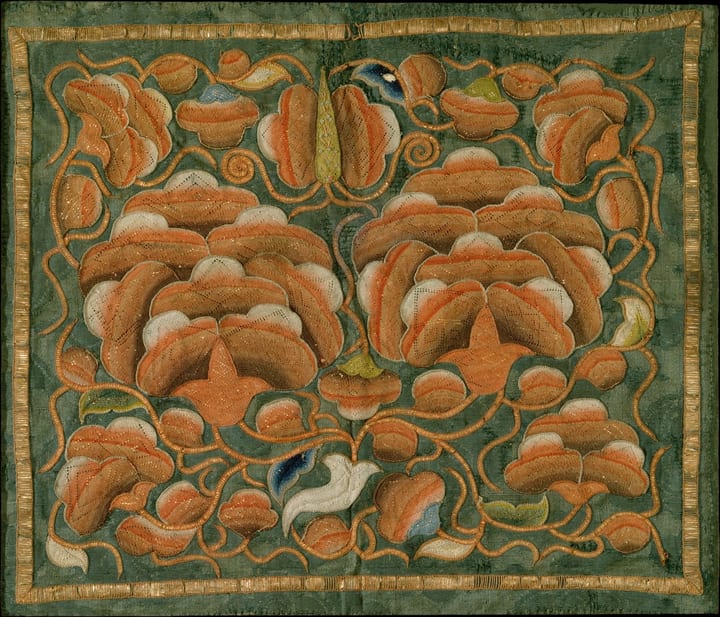
The Met’s Panel with Peonies and Butterfly, accession 1987.277, is Chinese, currently dated to the late fourteenth–fifteenth century. Its catalogue identifies silk needle-loop embroidery over gilt metal strips on silk satin damask. The full photograph shows the panel’s design; it is not a step-by-step sample of ordinary chain stitch.
The museum’s acquisition account specifically identifies coloured-silk open-chain stitching over strips in the stems and border. It distinguishes those passages from needle-looped flower areas and knot stitching on the butterfly. Read the winding stems beside the broad petals, following the documented division of work. A shared picture does not make all those structures interchangeable.
A later carrier gives outlining a different role
The Embroiderers’ Guild of South Australia Museum records baby carrier 2007-036 as a late twentieth-century Miao example from Guizhou. It has an indigo-dyed ground covered with red embroidered strips. The record distinguishes geometric counted-satin filling from chain-stitched outlines, together with braids and ribbons.
Here the chain line helps articulate shapes beside a different filling method. The carrier’s format and recorded community belong in the explanation as much as the stitch does. Its combination offers a useful comparison with the earlier museum examples.
Compare thread paths, not just surface texture
The Royal School of Needlework describes satin stitch as neighbouring straight stitches that fill an area smoothly. Its Chinese-knot entry instead describes a raised knot, which may be tightened into a small ball or retain a small loop. Neither description alone is the consecutive linking that defines a chain.
Choose a documented passage before comparing it with another: are you following a line of links, parallel filling or separate knotted units? Our seed-stitch and gold-thread-couching guides extend those comparisons. The broader embroidery-stitches guide explains how such choices contribute to a complete design.
Images and credits
Panel with Peonies and Butterfly, maker unknown, China, late fourteenth–fifteenth century. Silk needle-loop embroidery with documented open-chain stems and border. The Metropolitan Museum of Art, 1987.277; Purchase, Joseph E. Hotung Gift, 1987. CC0. Complete museum photograph, uncropped and resized for display.