Chinese Ru ware: begin with a place and a documented period
The National Palace Museum locates the Ru kilns at Qingliang Temple, or Qingliangsi, in Baofeng county, Henan. Its historical exhibition discusses Song written accounts as evidence of court use, alongside excavated material. This is more precise than using Ru as a general name for pale blue ceramics.
The same exhibition identifies its Ru dishes and narcissus basin as Northern Song works of the late eleventh to early twelfth century. Keep those dates with those objects. An association with the court does not establish an exact owner or reconstruct every vessel's original setting.
A shallow washer brings the surface into focus
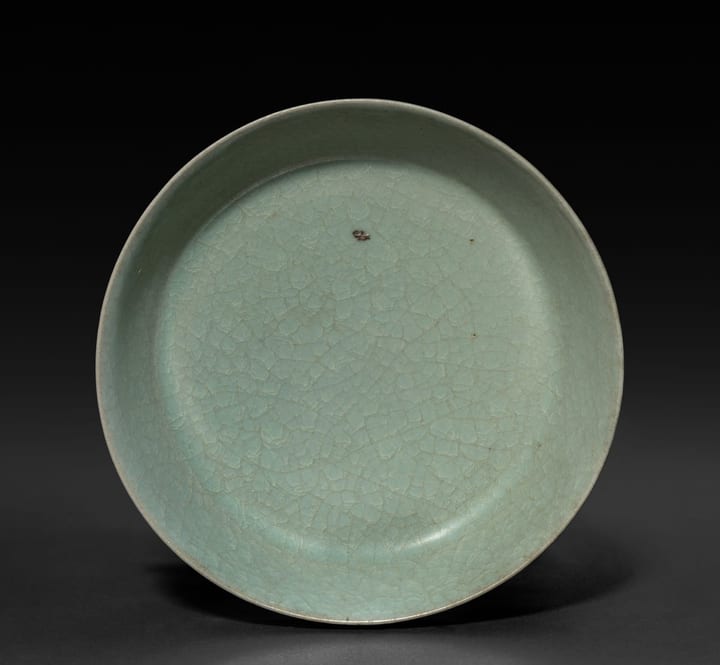
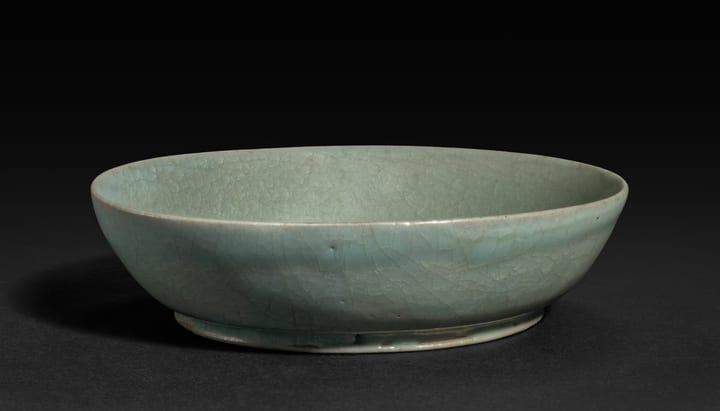
Cleveland Museum of Art's Brush Washer, 1957.40, is catalogued to Qingliangsi and dated from the late 1000s to 1127. At 12.8 centimeters across and 3.8 centimeters high, it presents its glaze across a broad, shallow form.
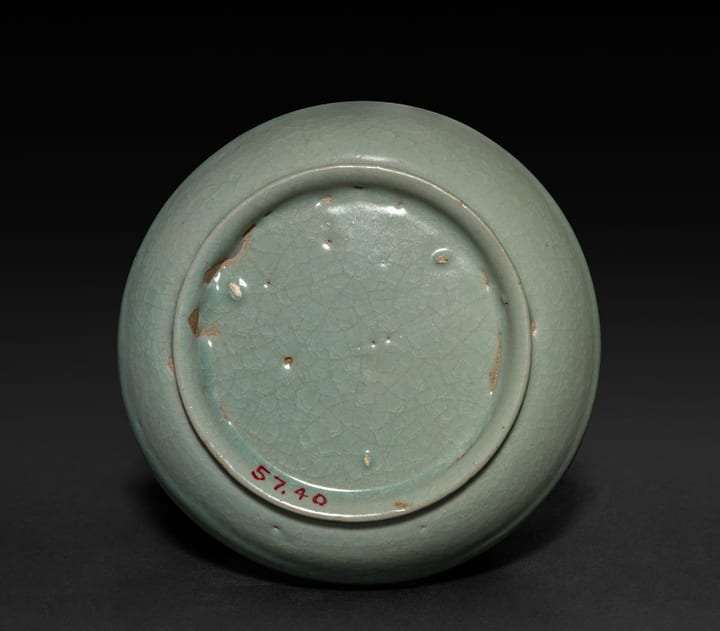
The museum describes an ash-grey body, soft grey-blue glaze, fine crackle, and small support marks on the base. Start with the complete silhouette: how does the low wall rise from the base, and how does light change across the interior? Then look at the surface details. This order connects the glaze with the vessel that carries it.
The underside records a solution to glazing and firing
The Ashmolean's Barlow Collection catalogue explains that tiny firing spurs allowed Ru vessels to be glazed over their bases while keeping broad glazed surfaces away from kiln furniture. Its documented washer, LI1301.229, has three minute support marks and is described as thrown stoneware.
This makes the underside useful evidence of making. Glaze coverage and contact points are related decisions, rather than unrelated decorative features. Record what a museum identifies on a particular piece; a few dots underneath another ceramic are not enough to assign it to the same kiln.
Read glaze variation without turning it into a checklist
A softly colored surface can still contain variation. Look separately at the rim, wall, well, and base. Reflections, curve, and the distribution of glaze affect what a photograph reveals. A detail image is useful for studying one passage, while the whole view preserves the relationship between parts.
Crackle is one recorded feature of the Cleveland washer, not an independent certificate of age. Nor should every dark speck or small irregularity be assigned a historical meaning. The useful question is how the observed surface agrees with the documented material and condition, rather than whether one attractive detail proves authenticity.
A later Ru-style glaze belongs to its own history
The National Palace Museum explicitly labels a lotus-petal vase as having a glaze imitating Ru ware. It dates that object, 故瓷012756N000000000, to the Yongzheng reign, 1723–1735. This is a Qing-dynasty object, not a Northern Song vessel merely because its glaze refers to Ru.
That distinction helps explain later admiration without calling every imitation a deception. A museum can identify both the historical model and the later object's own date. When reading a label, preserve words such as imitating, type, style, and attributed; they carry part of the evidence.
Compare ceramic traditions through different questions
Our Ding ware guide examines pale-glazed northern ceramics through shaping, decoration, and different firing supports. Longquan celadon offers another craft tradition for comparison. Similarities of color should prompt questions about body, place, and technique rather than erase the distinctions between them.
The Jingdezhen porcelain guide provides a broader production setting, while the blue-and-white guide follows painted cobalt decoration beneath glaze. These connections help locate Ru within Chinese ceramic history. They do not make every softly glazed vessel Ru, every blue surface painted, or every historic ceramic porcelain.
Museum photographs and credits
Northern Song Ru-ware brush washer, late 1000s–1127, from Qingliangsi, Baofeng, Henan. Cleveland Museum of Art, 1957.40; CC0.
Interior view of the same Northern Song brush washer, showing its glazed surface. Cleveland Museum of Art, 1957.40; CC0. This is another photograph of the same object.
Underside view of the same Northern Song washer. The red “57.40” is a modern museum inventory number. Cleveland Museum of Art, 1957.40; CC0.