Crackle is a glaze feature, not a complete identity
The National Palace Museum explains crackle through differences in expansion between glaze and body. It also notes that staining can deepen the visibility of the lines. The pattern is not simply a picture painted across an otherwise unchanged coating.
That account discusses crackled celadons more broadly, including Guan-related examples. Observe the network together with the recorded material and form.
A small brush washer offers a clear starting point
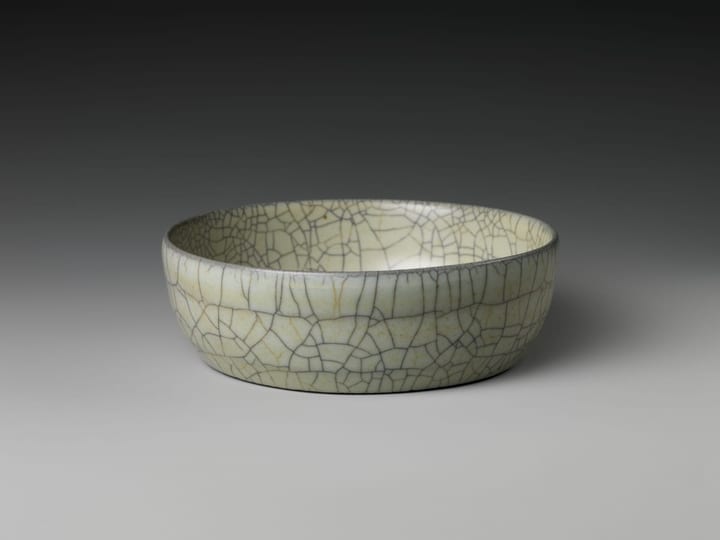
The Met’s Brush washer, 17.57.2, is Chinese stoneware with crackled glaze, catalogued as Ge ware and dated to the thirteenth–fourteenth century. Its curatorial note distinguishes thicker dark lines from thinner brown ones, using the familiar gold-thread-and-iron-wire description.
The photograph keeps the whole low vessel visible. Follow how the network changes between its interior and curved wall, then return to the simple outline. It shows the surface of this finished object, not a demonstration of firing or staining.
A drum-shaped bowl makes forming part of the comparison
The Ashmolean’s Ge ware bowl in the form of a drum, LI1301.156, is a thrown stoneware vessel dated to the thirteenth–fourteenth century. Raised bands of bosses recall the pegs of a drum; three small ruyi-shaped legs stop short of the supporting circular foot.
Its catalogue separates these features from the thick, opaque straw-coloured glaze and two crackle networks. Shape and surface create different aspects of the object.
An attributed vase keeps the kiln question open
Osaka’s Museum of Oriental Ceramics records a vase with two tubular handles, 00570, as Ge ware of the thirteenth century, Southern Song–Yuan dynasty. Its discussion connects similar sherds with Yuan layers at Hangzhou’s Laohudong site, while also noting other scholarly proposals concerning Longquan.
These are arguments about related evidence. They should not be shortened to a certain birthplace for every transmitted object. The museum also distinguishes the exposed body at lip and foot from glaze crackle, keeping two material observations separate.
The elder-brother story belongs to later accounts
The National Museum of China traces the tale of the Zhang brothers, each running a kiln, through Ming-period accounts and later elaboration. The story explains the elder-brother name, but should remain identified as a transmitted narrative rather than a securely documented workshop biography.
Its discussion also notes the importance of older and newer Ge categories in historical collecting. A celebrated name can gather changing interpretations over time. Reading the record’s date and wording alongside the object is more informative than using the legend to settle its production history.
A Xuande imitation is a Ming object in its own right
The Palace Museum’s bowl 新00109474 is explicitly catalogued as an imitation Ge-glaze bowl of the Ming Xuande reign. Its grey-blue coating has larger crackles inside, smaller ones outside, and fine networks in the centre and foot. The underside bears a Xuande mark in underglaze blue.
Those distinctions show how later makers engaged with the model across different parts of a vessel. Imitation in the museum title describes an artistic reference, rather than moving the bowl back into the Song dynasty or automatically calling it a deception.
Later makers adapted both glaze and vessel types
The Palace Museum’s 2017 exhibition account discusses Ming and Qing Ge-style wares as a later development. It includes archaistic incense burners and handled bottles, alongside writing accessories, chess pieces and furnishing vessels in forms fashionable in their own time.
The influence concerned glaze colour and crackled decoration as well as selected historical shapes. Keeping the later object’s function and date visible makes this a history of renewed making, rather than a list of things that resemble an earlier surface. The Ru and Qingbai guides offer other documented ceramic comparisons.
Research compares materials as well as appearances
A 2018 Palace Museum study used portable X-ray fluorescence to examine transmitted Ge objects and later imitations, comparing glaze composition with relevant kiln-site sherds. The research investigated relationships among groups and discussed production origins; it did not identify every object through a photograph.
This is why a museum’s proposed date, a kiln-site comparison and a material analysis should retain their own roles. An attractive crackle description cannot replace that work. Read the cited study as a particular investigation with selected samples, rather than a final answer for everything ever called Ge.
Images and credits
Brush washer, China, thirteenth–fourteenth century. Stoneware with crackled glaze (Ge ware). The Met 17.57.2, Rogers Fund, 1917. CC0; uncropped and resized.