Chinese rank badges: begin with the object record
Start with the country, dynasty, date range, and catalogue interpretation before assigning an animal to a rank. The Met notes that the Qing government largely adopted the Ming badge system but changed some of the animal choices. A single timeless identification chart would conceal that historical variation.
Then record the material and technique. A badge is a type of insignia, not a stitch name. The same general function can be served by woven tapestry or by embroidery, and those constructions deserve different descriptions.
A Kangxi-period crane gives one specific reading
The Met's rank badge 30.75.830 is assigned to the Qing Kangxi period, 1662–1722. Its catalogue identifies the crane with the highest civil rank. It also records silk and metallic-thread kesi, so the bird is part of a tapestry-woven textile rather than evidence that all badges were embroidered.
Keep those observations together: a dated badge, an identified bird, and a museum's rank interpretation. This is a supported reading of the example. It does not identify the original wearer by name or settle the meaning of a similar-looking bird on an unrelated textile.
A peacock badge connects image, materials, and garment
The Met's eighteenth-century Qing peacock badge, 36.65.5, is described as third-rank civil insignia. Its medium is silk, metallic thread, and peacock-feather-thread embroidery on satin. Here the material used in parts of the design is itself a documented detail, not something to infer from a shining photograph.
The catalogue says a former central split suggests a position on the front of a surcoat that opened down the middle. That wording matters: it is an interpretation of surviving construction. It helps reconstruct how the badge related to clothing while retaining the museum's degree of certainty.
A military example also preserves embroidery evidence
University of Alberta Museums identifies its nineteenth-century Qing back panel 2005.5.596.2 as a badge for a fourth-rank military official. The tiger appears with clouds, waves, and auspicious decoration. The interpretation is tied to that collection object and its date.
The museum describes tiny colored knots filling the design, couching that attaches outlining threads, and satin stitches in parts of the tiger. This gives the reader something concrete to examine beyond the rank label: different needlework decisions perform different jobs within one small textile.
Read a surviving panel as part of dress
A square in a museum case has been separated from at least some of its wearing context. Ask whether the record identifies a front or back panel, whether it was once paired, and whether a garment or associated portrait survives. The Met's peacock example shows how an opening can contribute to that discussion.
Do not turn a rank identification into a complete biography. An emblem can be meaningful without proving a wearer's name, a precise appointment, or the circumstances in which the textile was used. Missing context should remain visible in the explanation.
Historical insignia and continuing textile knowledge
Today, these museum examples help readers study relationships between official dress, images, and craft. University of Alberta Museums used its collection in a 2022 public account that paired whole badges with embroidery details, allowing the social interpretation and the making to be considered together.
Our kesi guide explains the woven method used in the crane example; the embroidery-stitches guide helps with needleworked surfaces. A modern textile inspired by a badge still needs its own maker, material, and design information. Resemblance does not give it the historical status of an original insignia.
Museum photographs and credits
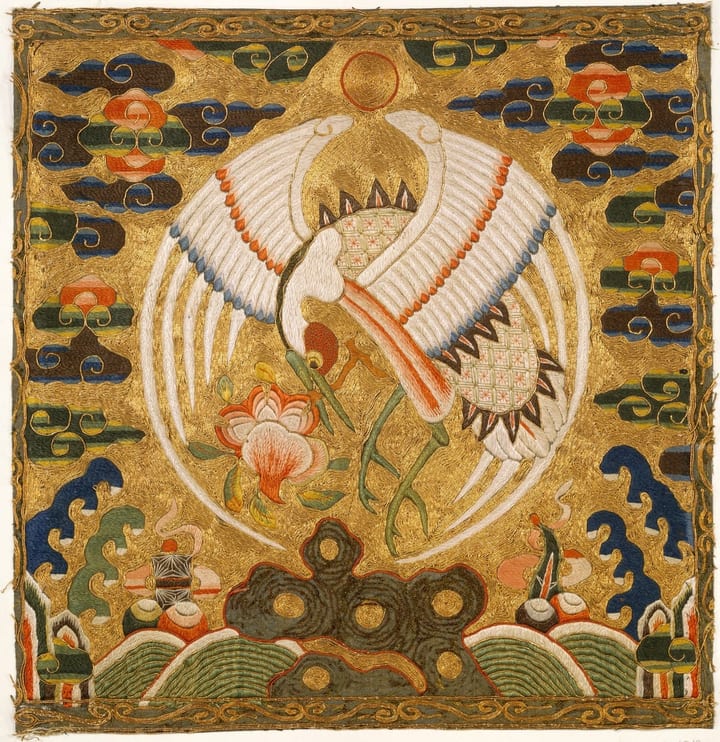
Chinese rank badge with crane, late 17th–early 18th century: silk and metallic-thread embroidery on silk satin. The Met, 36.65.10; public domain/CC0, via Wikimedia Commons; resized. Changes: EXIF orientation applied, resized without upscaling, metadata stripped, JPEG optimized. Source and rights links appear below. No museum endorsement is implied.
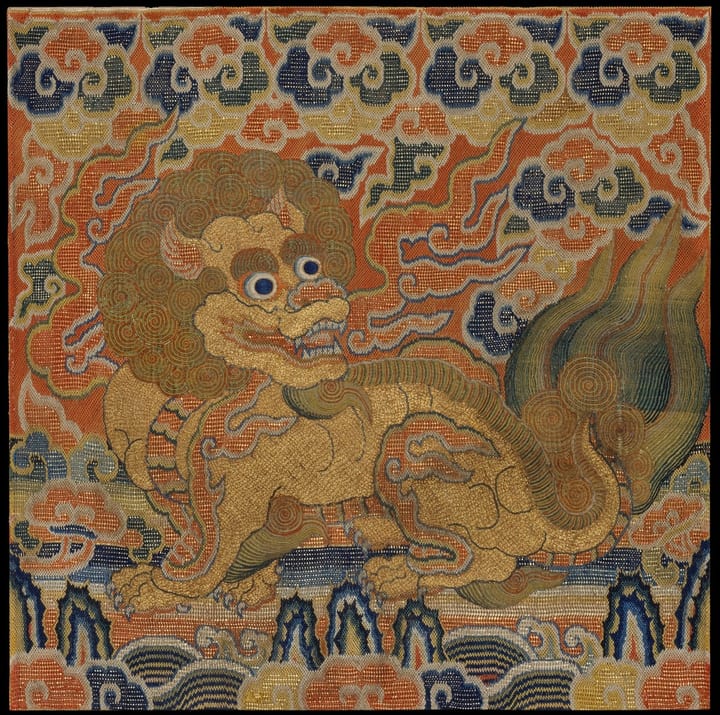
Chinese rank badge with lion, 15th century: silk and metallic-thread embroidery on silk gauze. The Met, 1988.154.1; public domain/CC0, via Wikimedia Commons; resized. Changes: EXIF orientation applied, resized without upscaling, metadata stripped, JPEG optimized. Source and rights links appear below. No museum endorsement is implied.
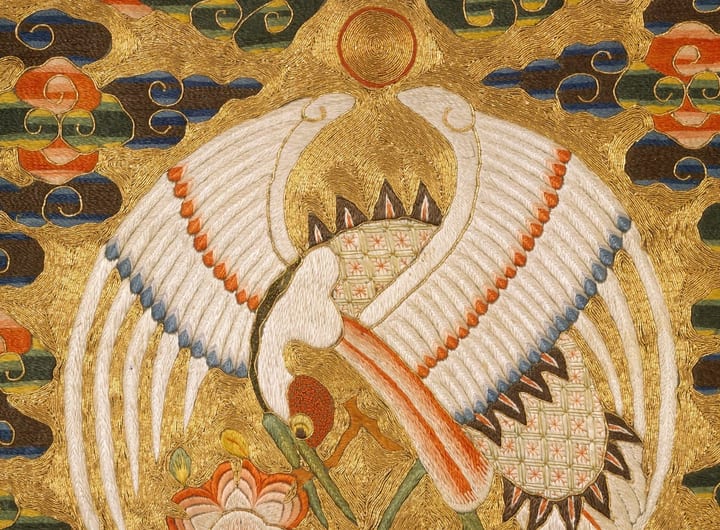
Detail crop of the same Qing crane badge, showing the central bird, clouds and sun. The Met, 36.65.10; public domain/CC0, via Wikimedia Commons; cropped and resized. This is the same object as the main image. Changes: Cropped as disclosed; EXIF orientation applied, resized without upscaling, metadata stripped, JPEG optimized. Source and rights links appear below. No museum endorsement is implied.