Chinese cong-shaped vases change more than the material
The Met’s thirteenth-century Longquan vase, 2007.193, has a solid base. Its label contrasts that construction with the open jade tube that supplied the form, explaining the ceramic object’s new flower-vase use.
A shared outline therefore does not establish a shared function. Compare the opening, enclosing body and base as well as the outer corners. The relationship to an earlier object becomes clearer when the changes are considered alongside the resemblance.
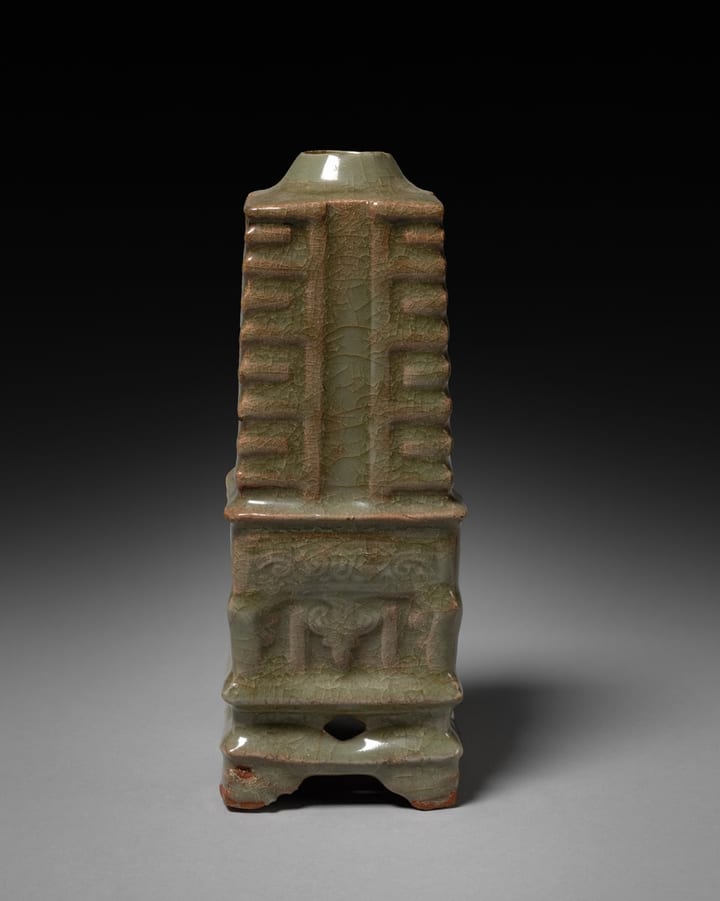
The illustrated vase belongs to a Yuan pair
Cleveland’s Vase in Shape of Cong, 1957.46.1, is one of a catalogued pair. It is dated 1271–1368, attributed to Zhejiang and identified as glazed buff stoneware. The photograph shows this one vase, rather than both members of the pair.
The repeated horizontal features at its corners create a different rhythm from the flatter central areas. Trace those features across an edge before comparing the lower decorative field. These are observations of the finished surface, not evidence of a hidden forming sequence.
A Song Longquan example emphasizes raised lines
The Palace Museum’s Song vase, 故00145410, has a square, straight-sided body with raised horizontal and vertical ornament on its four faces. It has a ring foot and celadon glaze, with the foot end left unglazed.
The catalogue treats it as an adaptation of a jade form. This directs attention toward how an older pattern of corners and divisions is reworked in a different substance, without transferring the date or ritual interpretation of a jade prototype to the ceramic vessel.
An early-twentieth-century court version has its own date
The Palace Museum’s Xuantong vase, 故00156515, carries raised Eight Trigrams on its four faces and a reign mark below. The catalogue considers it likely Jingdezhen imperial-kiln display porcelain for the court.
Its reference to earlier forms does not make it a Song object. The reign attribution and the proposed court setting concern this later vessel, while the older model explains an aspect of its design.
A wall vase alters the format again
A Yongzheng-period Palace Museum wall vase, 新00088536, offers another adaptation. Its mouth and foot are semicircular, while its body is rectangular. Gray-green glaze and raised trigram designs accompany a Yongzheng mark.
The museum describes an archaistic work recalling Song Guan-type ceramics. Here the form comparison includes a changed vessel format, rather than an assumption that every cong-shaped vase is a complete square tube standing independently.
Documented molding is a specific technical example
Getty’s CONA record for British Museum vase PDF.233 identifies molded sectional grooves imitating carved jade, and lists molding and glazing as techniques. That published record supports those operations for this example.
The museum object and its cataloguing entry do not supply a complete shared recipe for all cong-shaped ceramics. Forming a repeated relief and coating a surface are useful distinctions even where the exact assembly method is unrecorded.
Compare a vessel form with a glaze category
The Qingbai guide follows pale blue-white porcelain and the relationship between shallow decoration and glaze. Cong-shaped identifies an outline instead. The two kinds of label answer different questions; neither a pale color nor a square body fixes a complete production history.
Images and credits
Vase in Shape of Cong, one of a pair, Zhejiang, China, Yuan dynasty, 1271–1368. Glazed buff stoneware. Cleveland Museum of Art, 1957.46.1; John L. Severance Fund. CC0. Complete photograph, resized.