How does a Chinese ink rubbing work?
The University of Washington’s teaching demonstration at Xi’an’s Beilin shows moistened paper fitted against an engraved stone. Brushes and a felt-covered mallet press it into the cut areas. Ink is then dabbed onto the paper above the flat surface; the recessed strokes remain light.
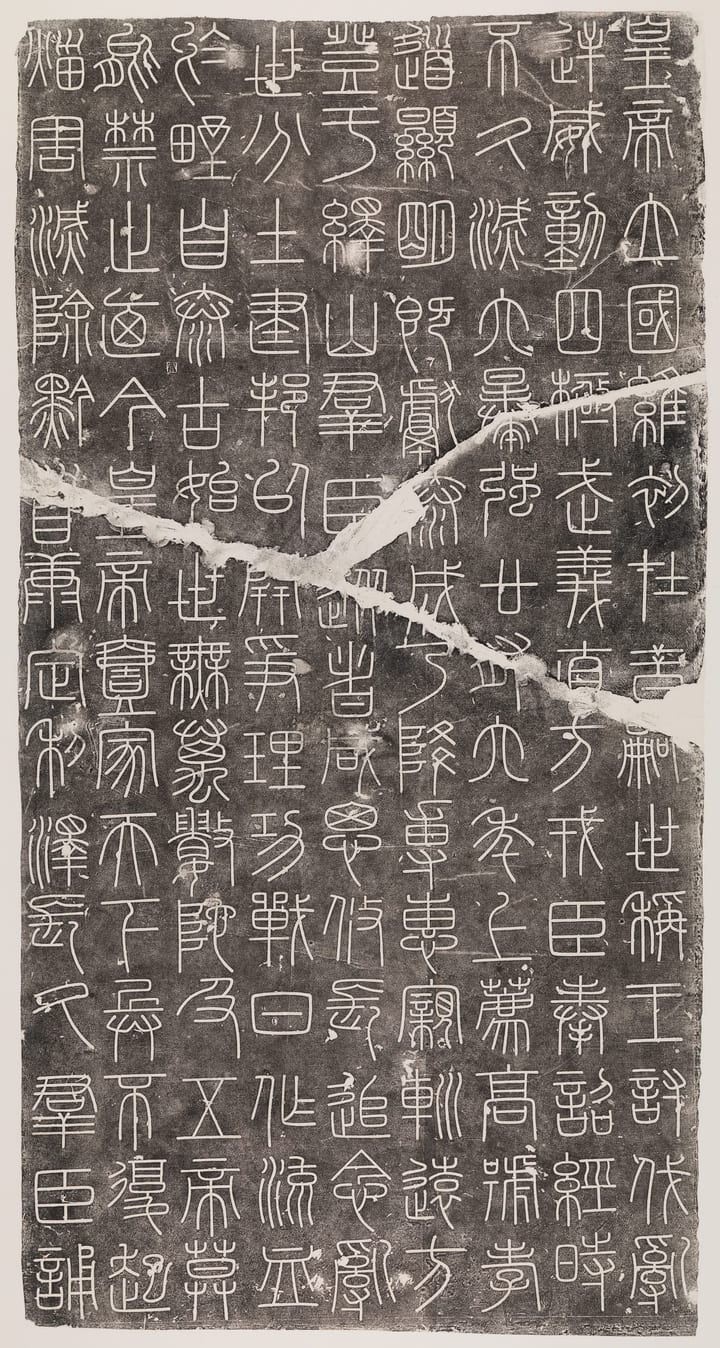
Look at the white characters against the dark field in the illustrated Mount Yi rubbing. That contrast describes the carved surface through ink on paper. The sheet is an impression of an inscription, rather than the stone itself or a brush-written manuscript.
A paper record that can travel
Kerrianne Stone’s account of the University of Melbourne collection explains how rubbings circulated Confucian texts recorded on steles. Paper copies were less expensive and easier to transport than the monuments from which they came. The same collection includes large sheets and books.
Its subjects reach beyond lines of writing. One rubbing maps the Temple of Confucius at Qufu, arranging its buildings around a central axis. The image carries information about a place as well as a text. A rubbing’s purpose becomes clearer when its subject and intended readers are considered together.
Read the dates in three layers
The Met’s Inscriptions from the Stele of Mount Yi, accession 1977.375.7a, b, makes the dating problem concrete. Its catalogue calls the paper works modern rubbings and dates the stele to the Song dynasty. The inscription ultimately recalls the First Emperor of Qin’s visit to Mount Yi in 219 BCE.
The museum explains that the Qin monument was destroyed and its text transmitted by scholars. These impressions therefore do not turn modern paper into a surviving Qin object. Distinguish the historical text, the later carved version and the date of the rubbing.
An album can preserve models for learning
Eight Kinds of Jin and Tang Writings in Small Standard Script offers another layered history. The Met dates its rubbing album to the seventeenth century, with a question mark, and records forty-five leaves in ink on paper. Its models are attributed to much earlier calligraphers, including Wang Xizhi, Yu Shinan and Chu Suiliang.
The catalogue explains that these writings were preserved in carved stone during the Tang dynasty and continued to be rubbed into modern times. The album belongs to that chain of transmission. Its later paper format makes earlier writing available for study without being the earlier calligrapher’s original sheet.
Imperial collecting shaped what was transmitted
The Met’s Hall of Three Rarities and Collected Treasures of the Stony Moat anthology consists of rubbings mounted in thirty-two albums, dated to the second half of the eighteenth century. Sponsored by the Qianlong Emperor, it drew on calligraphy in the imperial collection.
Standard, running and cursive styles appear within a compilation that established an approved canon. The museum describes precise carving and a glossy black finish. These qualities belong alongside the selection of the models: skilled reproduction served a particular collecting and cultural project.
A rubbing preserves some qualities and changes others
Washington’s account notes that Mi Fu questioned whether rubbings could convey flexible brush movement and subtle ink tones. They could still communicate character composition and line structure. When studying one, distinguish the arrangement preserved by carving from the tonal effects of a handwritten original.
Skilled making continues through teaching and research
A Palace Museum report on Guo Yuhai’s May 2014 lecture describes his specialist rubbing work for exhibitions and publications. It also records a teaching lineage through Ma Ziyun, whose practice entered the museum, and pupils including Ji Hongzhang and Guo. Transmission concerns people and training as well as copies of texts.
The account describes work with inscriptions and ornament on stone and bronze. This broadens the subject beyond one stele or calligraphic style. The particular surface, selected information and purpose of the record matter to the maker’s task.
Learn through an appropriate teaching surface
The Beijing Stone Carving Art Museum’s 2019 public-programme account describes instruction by a senior rubbing technician. Its traditional-rubbing activity supplied stone and carved-stone boards for guided work. The same announcement listed a separate woodblock-printing activity using specially made blocks.
That distinction is useful when comparing workshop experiences. Ask which surface supplies the image and how paper and ink meet it. The historical examples here explain a skilled practice; the dated programme notice documents one teaching arrangement, rather than confirming current opening times or availability.
Follow the material and the mark
The woodblock-printing guide follows carved printing blocks and bookmaking; the seal guide follows the engraved seal and its stamped mark. Chinese ink rubbings add a different route between an inscribed object and a paper record. Compare these practices through the working surface, the resulting impression and the information each was intended to carry.
Images and credits
After Xu Xuan, Inscriptions from the Stele of Mount Yi. Modern rubbing; ink on paper. The Met, 1977.375.7a, b; Seymour and Rogers Funds, 1977. Photograph: Paul Lachenauer; CC0. One sheet of the pair, uncropped and resized for display.