Chinese moon flasks offer two broad decorating faces
The Palace Museum’s Qianlong-period baoyueping, 新00118010, has a flattened round body, raised centers on both faces and an oval foot. Ruyi-shaped handles connect the neck and shoulder. Its name describes the full-moon outline.
Read the vessel from the front, then consider its depth and narrow sides. A large circular field can organize a central design, while the neck, handles and edge require smaller patterns. This is a different decorative layout from a continuously rounded bottle.
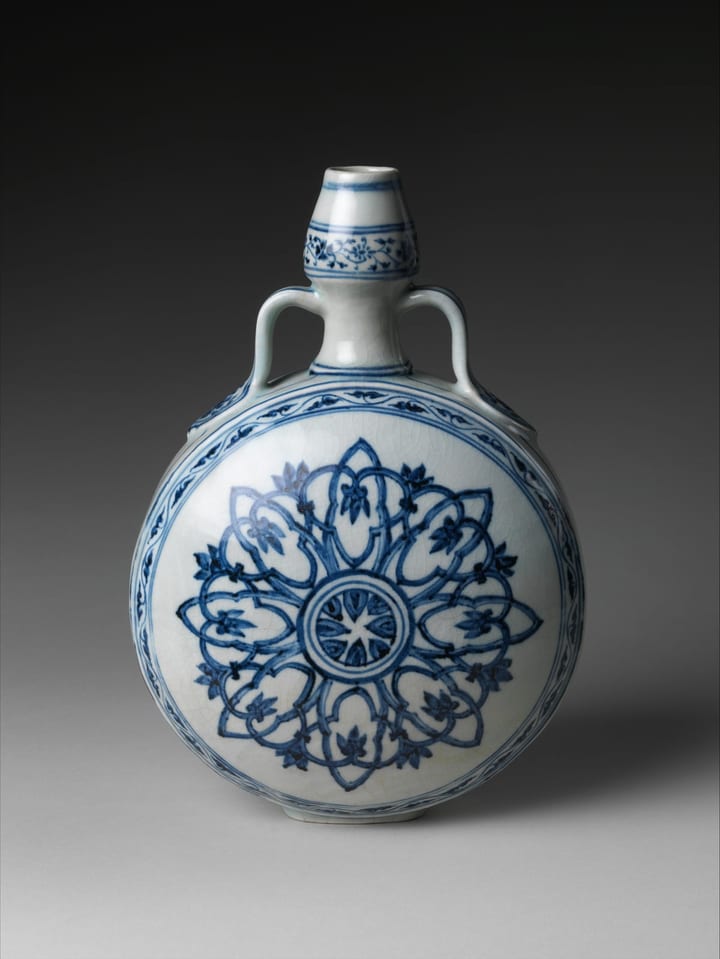
The illustrated Ming flask carries a medallion
The Met’s Flask with Medallion, 1991.253.37, is an early-fifteenth-century Chinese Jingdezhen porcelain. Cobalt-blue painting lies below transparent glaze. The museum identifies medallions on both front and back.
The photograph presents one face of the finished vessel, including its paired handles. It does not show a workshop or establish the original contents.
A documented dragon design begins with incision
For its flattened dragon-and-waves flask, 故00145554, the Palace Museum records a specific decorating sequence. A pointed tool first outlines the dragon and details such as eyes and scales. Blue painting fills the surrounding water; transparent glaze and high-temperature firing follow.
The dragon remains pale against the painted sea. This example explains how reserved areas and painted ground can work together, rather than treating every part of a blue-and-white design as a blue outline.
A Qing example refers back to early Ming wares
The Palace Museum dates lotus-scroll flask 故00156802 to Qianlong. Its form and decoration follow Yongle and Xuande models, while its own manufacture remains Qing.
A historical reference and an object’s date answer different questions. Retain both when comparing related silhouettes, especially where a later vessel deliberately follows an older design.
Bianhu includes related shapes beyond the full circle
The Palace Museum’s Xuande flask, 故00145575, has a gourd-shaped outline and a vertically flattened body. Ribbon-like handles connect its neck and shoulders. Its catalogue associates both form and arabesque decoration with West Asian Islamic objects.
This related bianhu is useful precisely because it is not simply another circular moon body. The broader flattened-flask category can include different outlines. Preserve the museum’s particular form name rather than making every flattened vessel an identical baoyueping.
Compare flattened flasks with meiping vases
The meiping guide follows a small mouth, short neck and full shoulders above a tapering body. A moon flask instead presents broad front and back fields separated by a shallow depth. Compare these structures before using painted motifs to classify the vessels.
Start with the object’s exact title, then its date and medium. Follow how decoration occupies the broad face, edge and neck. This approach keeps the form comparison useful without turning a museum label into a fixed account of travel, storage or ceremonial use.
Images and credits
Flask with Medallion, China, early 15th century. Jingdezhen porcelain with cobalt-blue painting beneath transparent glaze. The Met, 1991.253.37; Gift of Stanley Herzman, in memory of Adele Herzman, 1991. CC0. Complete photograph, resized.