Chinese Langyao red glaze: a name with a production history
The Palace Museum connects the name with Lang Tingji, a supervisor of ceramic production during the Kangxi reign. Its account places Langyao red within efforts to emulate the red glazes of the Ming Yongle and Xuande periods. The name therefore carries a historical association, rather than naming the individual hands that formed and glazed every vessel.
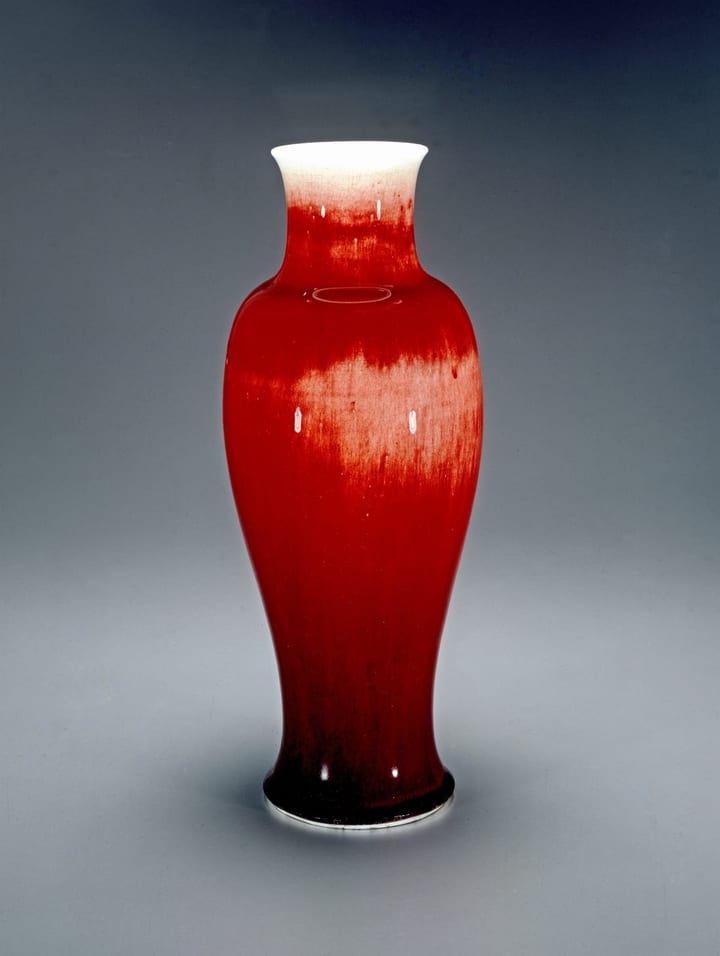
For a specific English-language example, the National Gallery of Art identifies the deep red monochrome surface of its vase called The Flame as langyao, also known in the West as oxblood or sang-de-boeuf. Keep those related names beside the object’s date and medium when comparing catalogues.
The meiping shows where red glaze begins and ends
The Palace Museum’s Kangxi meiping, 故00147034, is explicitly recorded as made at Jingdezhen. A small opening and short neck lead into a broad shoulder, with the body narrowing before the lower edge flares. Red covers the exterior, white glaze lines the interior, and the white body is visible at the mouth and around the foot.
This combination makes the boundaries worth examining. Follow the red down the outside, then compare the small pale interruptions with the large coloured field. The glaze’s relationship to the profile is part of the design, even where there is no painted motif.
The Flame demonstrates variety within a monochrome surface
The National Gallery dates The Flame, 1942.9.528, to the early eighteenth century. Its account identifies copper oxide as the source of the colour and describes differences within the red, small bubbles and a network of fine cracks. The pale upper edge and much darker lower area make the surface more varied than the word monochrome might suggest.
Here, monochrome refers to an approach to decoration rather than a promise of perfectly uniform colour. Compare the broad changes around the vessel before looking closely at the smaller marks. This connects the overall silhouette with details that become visible only at closer range.
Glaze thickness can change the appearance of related oxblood ware
Seattle Art Museum’s Vase, 50.59, dated 1700–1715, offers a related oxblood comparison. Its curatorial label describes pale, crackled green where the glaze is thin, and an almost black appearance where the copper-rich glaze is thicker. The glaze ends above the foot.
The University of Michigan Museum of Art’s Oxblood Mallet Vase, PG2020.2.69, supplies a differently shaped Kangxi-period example. Comparing these profiles helps separate two questions: what kind of vessel was made, and how its glaze behaves across the surface. Neither colour variation nor a familiar outline alone establishes a date.
Making red involves coordinated control
Gao Ran’s study, published by China’s national intangible heritage website, explains that copper-red results depend on the glaze composition, its application and the firing environment. It also distinguishes Langyao’s glassy, flowing and crackled character from other named copper-red surfaces. These are related ceramic approaches with meaningful differences.
UMMA’s account links oxblood colour to firing with reduced oxygen. This helps explain why glaze preparation and kiln control belong together: a copper-bearing material does not guarantee a particular red on its own. The useful lesson is the coordination of material, coating and firing, rather than an exact recipe inferred from a finished museum object.
Compare the layer that carries the colour
Our underglaze copper-red guide follows motifs painted beneath a transparent glaze. Langyao instead directs attention to the coloured glaze covering the vessel. The distinction changes what to look at: painted contours and spacing in one case, surface depth and the distribution of colour in the other.
Jun ware provides another comparison through selected blue and purple-splashed glazes. The tea-dust companion examines a speckled crystalline finish. Read these alongside the Jingdezhen guide to connect different surface treatments with the larger craft of making porcelain, while preserving each museum’s terminology.
Images and credits
Vase, called “The Flame,” China, Qing dynasty, early 18th century; porcelain with oxblood (langyao) glaze. Widener Collection, 1942.9.528. Courtesy National Gallery of Art, Washington. CC0.