Chinese Jun ware: read the object before choosing a date
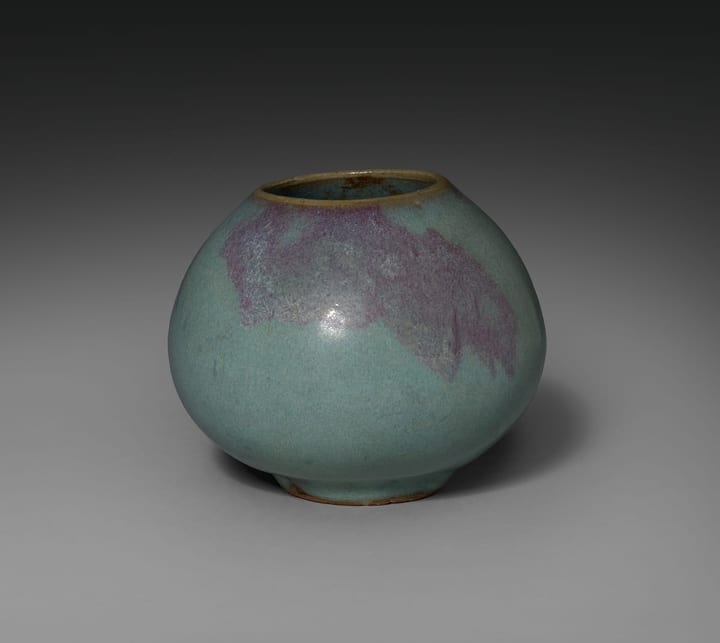
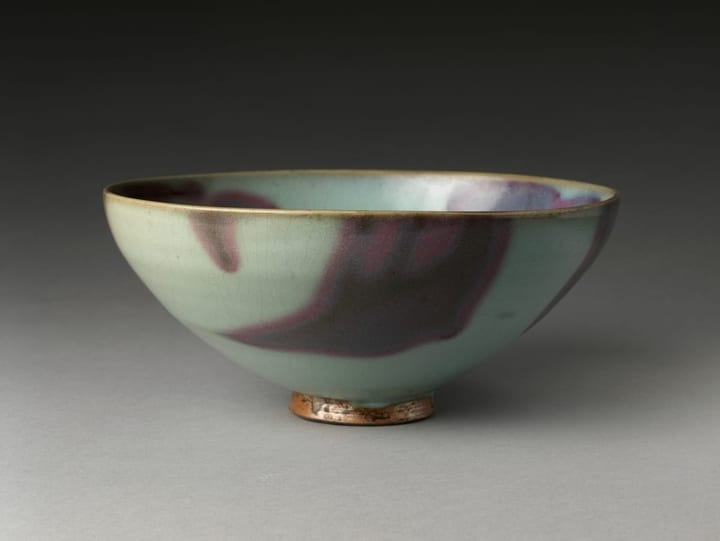
Cleveland Museum of Art dates its Jar with Cover, 1957.36.a, to the 1100s and preserves a Northern Song-or-Jin attribution. The Met assigns its Jun Bowl, 50.145.308, to the Jin dynasty, with a twelfth–thirteenth-century date. These are the catalogues' own distinctions, which should remain visible when the objects are compared.
Cleveland's numbered Jun Bulb Bowl, 1957.33, belongs to another group: its current record says early 1400s, Ming dynasty, and Juntai in Henan. The shared ware name does not turn that flower vessel into a Song object. Begin with each catalogue's period, medium, form and place rather than a single date attached to all Jun.
A blue-and-purple jar explains a deliberate decorating step
The Cleveland jar is described as porcelaneous stoneware with blue glaze and purple splashes. The museum connects the purple suffusions with copper-rich pigments splashed or brushed onto the glaze before firing. That explanation identifies a material choice and an application stage behind the fired result.
Look at the relationship between a colored passage and the jar's rounded wall. Does the purple occupy a broad field, narrow toward an edge, or merge gradually with blue? Then return to the silhouette. The shape and the distribution of glaze work together, so a close detail and a complete profile answer different questions.
A Jin bowl provides another account of glaze and firing
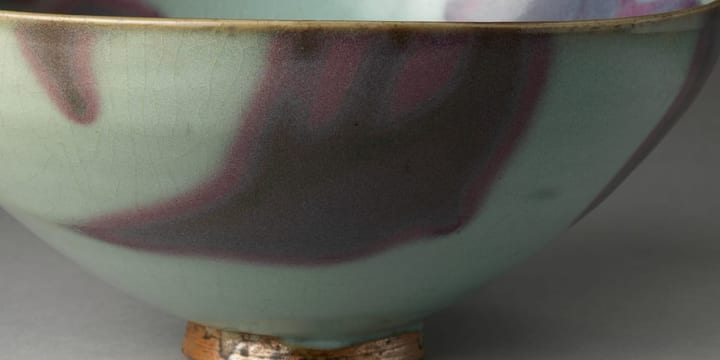
The Met's Bowl, one of a pair, is catalogued as stoneware with splashed glaze. Its explanation attributes purple splashes to copper oxide and describes the piece in relation to two firings used to achieve the thick, soft blue glaze.
Keep that account connected to the documented example. It supports an explanation of this making sequence without supplying an exact kiln temperature or a universal firing schedule. In a photograph, compare the interior, rim and exterior; the way a surface curves toward or away from light can change how strongly a color passage appears.
What kiln transformation means in an object record
The Palace Museum calls its Yuan-dynasty bowl, 新00053808, a sky-blue kiln-transformed glaze bowl. Its account discusses color developing in the kiln and the subsequent deliberate use of such effects. Here, yaobian, 窑变, helps name the fired glaze appearance and its production history.
The term does not remove the maker's decisions. Forming the body, applying glaze, introducing colorants where required, and arranging the firing remain stages of work. Equally, a finished color pattern cannot by itself reconstruct all those decisions. Use the source's technical explanation alongside the visible surface.
A bowl fused to its firing container reveals another side of making
The Palace Museum also preserves a Yuan Jun bowl still attached to a funnel-shaped protective firing container, or saggar. The museum explains that a firing fault joined the two and caused the bowl to be discarded at the kiln site. The exterior glaze stops above the foot, leaving the lower body exposed.
This example makes kiln loading tangible. A protective container can shield a vessel, yet contact and glaze behavior still matter. Comparing this failed piece with a complete museum vessel helps connect a polished surface with the practical problems of supporting, protecting and firing ceramics.
Numbered Jun flower vessels need their own labels
Cleveland's early-Ming bulb bowl carries the number two. The museum interprets the numbers as a size system and says this group is thought to have been made initially for the early Ming court. Preserve that qualification rather than turning it into a known commission for a named ruler.
Its lobed outline, short feet, blue interior and purplish exterior also give several surfaces to compare. The museum links the exterior color with copper pigment and identifies an interior firing feature conventionally called an earthworm trail. Those descriptions belong to this object; neither a numeral nor a glaze line alone supplies an authentication test.
Place Jun beside other ceramic traditions
Ru ware offers a comparison through glaze coverage and small firing contacts; Ding ware through pale surfaces, incised or molded decoration and support choices. Our Cizhou guide follows another set of decisions involving slip layers, painting and cutting.
Try the same viewing sequence across them: first identify the vessel, then its body and glaze, then its decoration and contact areas. For another glaze-focused comparison, continue to our Longquan celadon guide and examine how the surface works around rims, wells and feet.
Museum photographs and credits
Bowl (one of a pair), China, Jin dynasty, 12th–13th century; stoneware with splashed glaze (Jun ware). The Metropolitan Museum of Art, 50.145.308. CC0. One bowl is shown.
Jar (cover not shown) from Jar with Cover, Yuxian, Henan, China, 1100s; the museum dates it to the Northern Song or Jin dynasty. Porcelaneous stoneware with blue glaze and purple splashes, Jun ware. The Cleveland Museum of Art, 1957.36.a. CC0.
Detail cropped from the same photograph of the Jun ware bowl shown above, China, Jin dynasty, 12th–13th century. The Metropolitan Museum of Art, 50.145.308. CC0.