Chinese tea-dust glaze: speckles formed within a glaze
The University of Michigan Museum of Art describes tea-dust as an opaque crystalline glaze with a satin-like finish. Its account connects the small contrasting specks with crystals that form as the glaze cools. Thinking of the speckles as part of the fired glaze helps distinguish them from a pattern painted over a finished surface.
The institutions do not provide a single interchangeable formula. The Palace Museum and National Museum of China emphasise iron and magnesium, while UMMA’s explanation names iron, manganese and silicates. These descriptions support a crystalline finish; they do not justify turning several catalogue accounts into one universal recipe.
A large Qianlong zun makes the finish part of the whole form
The Palace Museum’s tea-dust xi-ear zun, 故00149204, is dated to the Qianlong reign and stands 51 centimetres high. Its form draws on ancient bronze vessels, with paired animal-shaped handles, a swelling body and a flared foot. Glaze covers its interior, exterior and the inside of the foot.
The museum places tea-dust within the named category changguan glaze, 厂官釉, and distinguishes related yellowish and greenish effects. For this vessel, it specifically chooses tea-dust. Follow that attribution instead of using every related historical glaze name as an exact synonym.
Handles and ornament carry another kind of information
The National Museum of China’s guan-ear hu has a more angular profile, tubular handles on the neck and raised peach-shaped decoration. Its record notes an incised six-character Yongzheng reign mark. That inscription is a documented feature; the appearance of the glaze alone is not a way to assign an unknown vessel to a reign.
Compare the raised ornament with the speckled finish around it. The modelling supplies recognisable shapes and edges, while the glaze supplies smaller variations across them. A vessel can combine these two scales of decoration without using a separately painted pictorial scene.
A vase and a water dropper show a useful change of scale
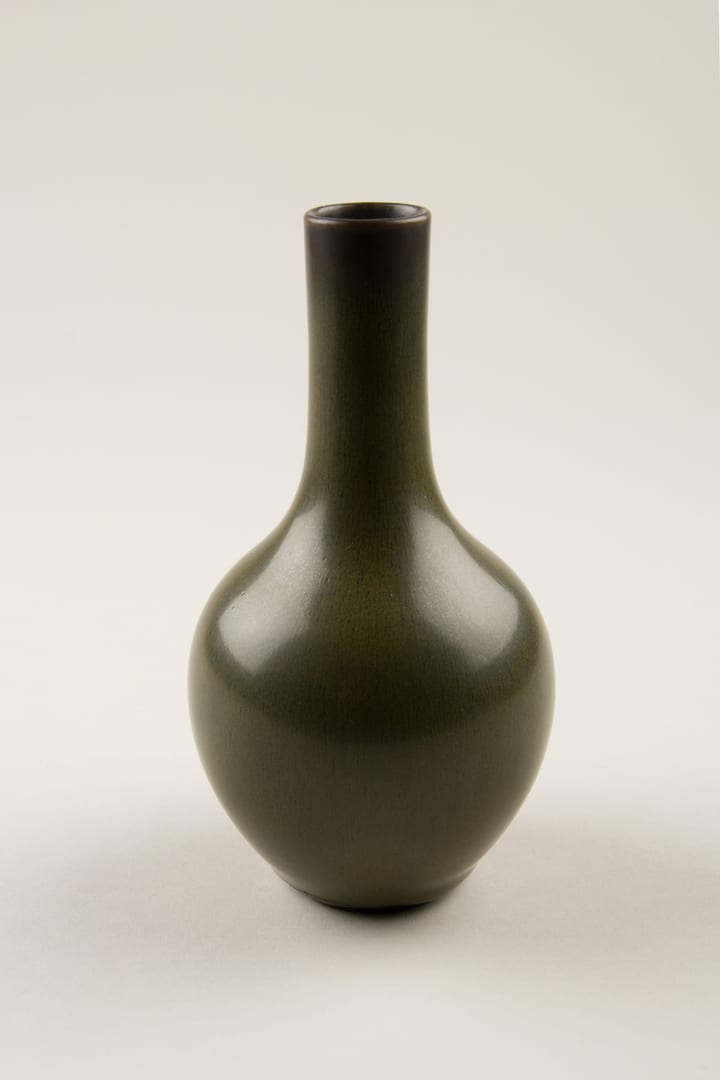
The Met’s Vase, 14.40.10, is an eighteenth-century Qing porcelain vessel with tea-dust glaze, explicitly catalogued as Jingdezhen ware. At 15.2 centimetres high, it gives a smaller comparison with the Palace Museum’s large zun. The name of the finish does not prescribe one size or profile.
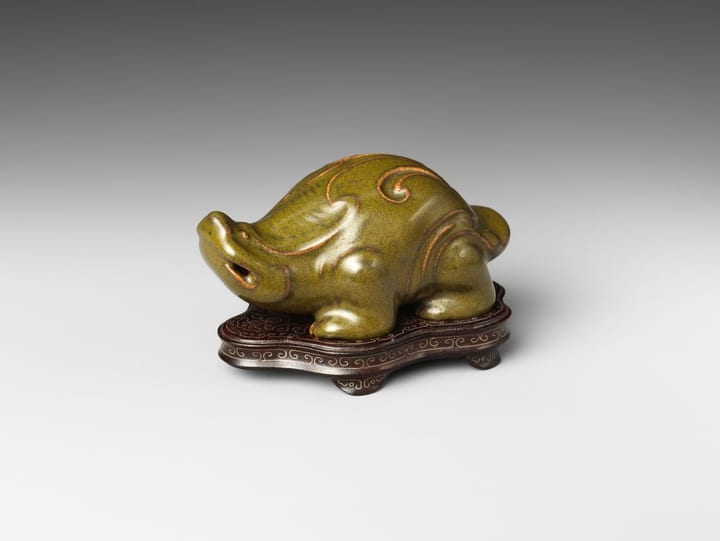
The Met’s Water dropper in the form of a mythical creature, 2019.316a, b, is also eighteenth-century Jingdezhen porcelain with tea-dust glaze. The museum explains that its greenish-brown surface evokes the patina of ancient bronze examples. Here, the glaze helps a compact creature-shaped writing accessory recall an object in another material.
Bronze references and porcelain bodies belong together
Seattle Art Museum’s Gourd-shaped vase, 37.109, is dated 1736–95 and attributed to Jingdezhen. Its label describes a large flask-shaped form with tea-dust glaze and notes the related wording used in Qing texts for imperial-kiln official glaze. This is evidence about a historical term, not a reason to assign every tea-dust object an imperial commission.
UMMA’s hu-shaped Vase, 1984/1.253, has a Yongzheng-or-Qianlong attribution. Its yellow-green, mottled finish and bronze-derived form offer another comparison. Consider the silhouette, handles and surface together: the bronze reference concerns both the shape and the visual character of the material.
Compare surface structure with neighbouring ceramic traditions
Yaozhou celadon directs attention to carved or moulded ornament under its glaze. Tea-dust directs attention to a crystalline, speckled finish. A shared greenish appearance does not erase that difference or establish a common kiln attribution.
The Langyao red companion follows a different monochrome effect, with colour and glaze thickness prominent in the cited vessels. Our Jingdezhen guide supplies regional context for the examples explicitly assigned there. These comparisons let you ask a precise question of an object: is the visible pattern shaped in the body, painted, or formed within the glaze?
Images and credits
Vase, China, Qing dynasty, 18th century; porcelain with tea-dust glaze (Jingdezhen ware). The Metropolitan Museum of Art, 14.40.10. CC0.
Water dropper in the form of a mythical creature, China, Qing dynasty, 18th century; porcelain with tea-dust glaze (Jingdezhen ware), shown on a stand. The Metropolitan Museum of Art, 2019.316a, b. CC0.