Chinese jiaotai marbled ware: colour established in the clay
Cleveland Museum of Art explains jiaotai as combining light- and dark-coloured clays to produce patterned material, then covering the resulting bowl with transparent glaze. The clay supplies the contrasting design; the glaze is a separate layer that lets it show.
The Museum of Oriental Ceramics, Osaka, gives a complementary definition of clay marbling: differently coloured slabs are piled and pressed or beaten before forming. Together, these accounts shift attention from a final painted mark to the handling of the material before the object has its finished shape.
Twisting and slicing can produce different arrangements
The National Museum of China describes overlapping and twisting two differently coloured clays for a Tang marbled pillow. The resulting grain can look fluid, but it follows deliberate material work. Changing the arrangement of light and dark clay changes the pattern available to the maker.
Henan Museum distinguishes whole-body and more localised jiaotai constructions. In one method, patterned clay is cut into slices and used in selected areas. A marbled patch therefore does not establish that the entire wall was made from one patterned mass.
A bowl opens the pattern to view
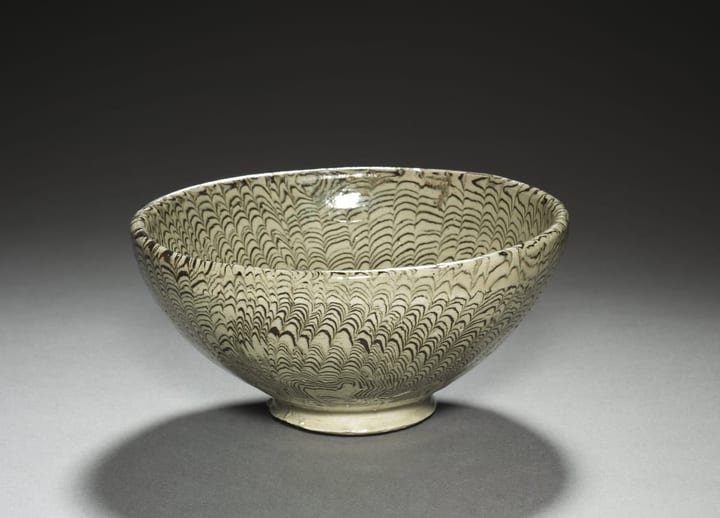
Cleveland’s Marbled Bowl, 2012.449, is dated to the 1100s and catalogued as Northern Song glazed stoneware. Its attribution to Henan, Xinwu and Dangyangyu is explicitly qualified as possible. That uncertainty belongs with the object rather than being replaced by a confident kiln name.
The bowl offers a useful way to follow a pattern across a curved field. Compare a broad band with a smaller turn, then follow the movement toward the centre and back to the rim. The contrast comes from the arranged clays, while the vessel’s curvature changes how much of the design can be seen at once.
Pillows put grain on a different kind of surface
The National Museum of China’s Tang pillow has a rectangular form with twisting, wood-like ornament. Its account relates the effect to admired figured-wood pillows. The ceramic object can recall the appearance of another material while retaining its own way of being made.
A pillow’s top and side walls provide separate fields for grain or a central motif. Compare their arrangement with the bowl’s open interior: the form changes how the decorated clay is presented.
A small water pot gives a compact comparison
The Met’s Water pot, 17.65, is dated to the eleventh–twelfth century, in the Song dynasty. Its medium is stoneware with marbled clay. At only 3.7 centimetres high, it brings the technique to a compact rounded object rather than a wide bowl or pillow.
The catalogue gives no exact kiln. Compare how the marbling wraps around this compact body with its spread across a bowl. A shared material treatment can serve different forms without proving a shared workshop.
Material compatibility matters as much as the pattern
Henan Museum’s discussion of making and reconstruction describes kneading, slicing, layering and moulding. It also stresses the need for the different clays to behave compatibly in firing, avoiding faults such as cracking or separation. The pattern must survive as a coherent ceramic object, not merely look convincing while the clay is soft.
Cleveland compares marbling with patterned glass, while Henan Museum reviews several possible influences, including figured wood. These interpretations support material comparisons without settling one origin story.
Distinguish mixed clay from surface painting
Cizhou and Jizhou offer comparisons with painted or carved slip and other surface effects. Fahua instead follows raised outlines dividing glazes. Read body, added material, decoration and glaze in order: the useful distinction is where the contrast was constructed.
Images and credits
Marbled Bowl (絞胎碗), China, 1100s, Northern Song dynasty; possibly Henan province, Xinwu, Dangyangyu. Glazed stoneware combining light and dark clays under a transparent glaze. The Cleveland Museum of Art, 2012.449, Gift of Donna and James Reid. Collection image: CC0.