Chinese fahua ware: boundaries made from clay
The Museum of Oriental Ceramics, Osaka, defines fahua through coloured lead glazes placed within raised outlines. It also records both stoneware and porcelain examples. Fahua therefore describes a decorative approach across different ceramic bodies, rather than one single material or one kiln.
The resemblance to cloisonné is useful when looking at the compartments of colour. In fahua, however, clay outlines form the divisions. The Kyushu National Museum and Osaka both discuss competing explanations for the technique’s origins, so resemblance should not become a claim that one specific invention story is settled.
The making sequence gives the lines a practical role
Worcester Art Museum’s account of its wine jar describes designs drawn with raised clay slip squeezed from a bag with a tube, with additional incised details. The porcelain body was fired before the compartments received their coloured glazes, which were then fixed in another firing.
This sequence separates shaping and outlining from the later colour treatment. On a curved wall, follow a line around one leaf or figure: does it divide two colours, provide an internal detail, or continue into a border? The outline contributes both to making and to the finished image.
An openwork vase combines colour with physical openings
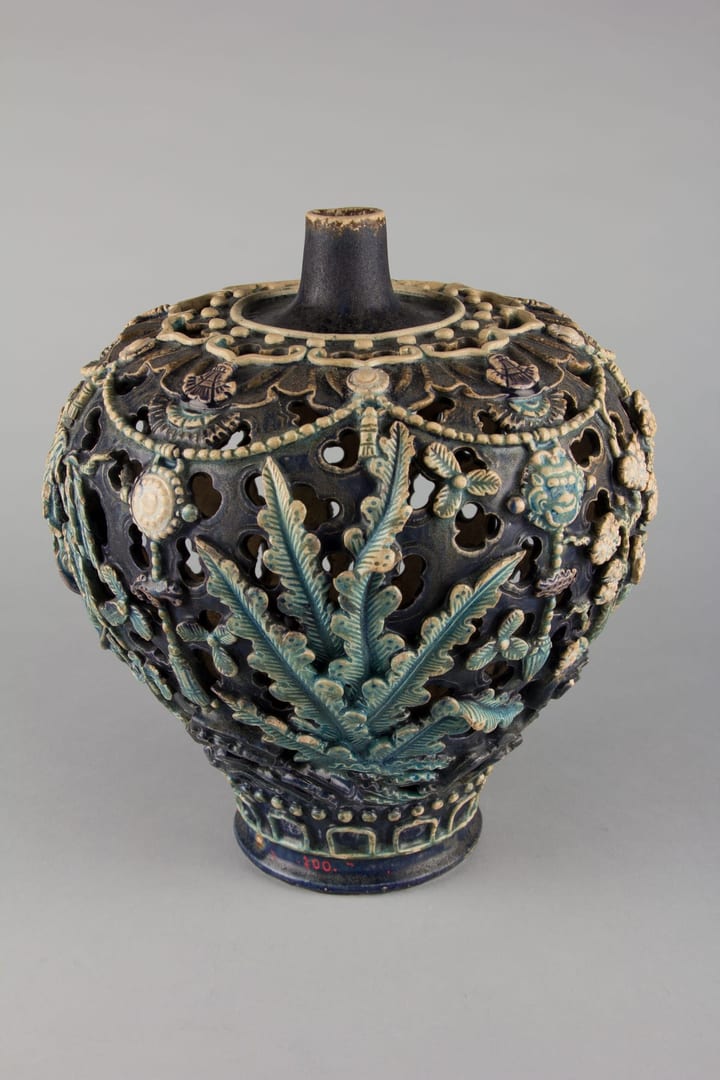
The Met’s Openwork vase with plants, 61.200.17, is dated to the late fifteenth–early sixteenth century, in the Ming dynasty. Its medium is stoneware with polychrome glazes, explicitly identified as Fahua ware. The record locates it in China without assigning a specific kiln.
Openwork adds a different question from the division of glaze colours: where has material been removed to create an opening? Compare the remaining ceramic framework with the coloured areas. These features can coexist on one object, but the pierced construction and the glaze boundaries perform different jobs.
Bands organise a rounded jar
The Palace Museum’s Ming figure-decorated jar, 新00062721, divides its imagery into four levels: clouds at the neck, a ruyi-shaped shoulder border, figures and buildings on the body, and a lower band of stylised lotus petals. The museum describes recessed, flat and raised elements working together.
Osaka’s fifteenth-century porcelain jar, 00561, offers another arrangement. Birds perch among flowering branches, with waves and other motifs filling the remaining spaces. Its dark-blue ground, white motifs and yellow accents show how the colour fields and their edges organise a large, rounded surface. Compare the main image with the smaller passages that connect it.
Porcelain and later decoration broaden the picture
Kyushu’s lidded jar with herons and lotuses, G122, is attributed to Jingdezhen and dated to the fifteenth–sixteenth century. The museum notes porcelain-bodied fahua production in Jingdezhen private kilns. Its account also identifies lacquer and gold treatment on parts of this particular jar, an additional feature rather than a requirement of fahua.
The National Museum of China’s Qianlong lotus-pond covered jar provides a later example. Its description combines raised fahua-style work on a blue ground with famille rose decoration and gold. A named decorative tradition could be adapted; this Qing object should not supply an identical palette or sequence for every Ming vessel.
Look at the edge, the field and the whole form
Begin with one bounded motif, then widen the view to the surrounding ground and the vessel’s profile. A raised line may carry the outline clearly even where adjacent colours are close in tone. A broad background can connect small motifs into one continuous scene around the body.
Our Tang sancai guide follows a tradition whose account emphasises flowing glaze colours. Fahua makes the boundaries between colours a central craft question. Jingdezhen provides regional context for the porcelain examples, while the jiaotai companion follows another route entirely: constructing a pattern from differently coloured clays. The famille rose guide is relevant to the documented Qianlong adaptation.
Images and credits
Openwork vase with plants, China, late 15th–early 16th century (Ming dynasty). Stoneware with polychrome glazes, catalogued as Fahua ware. The Metropolitan Museum of Art, 61.200.17, Bequest of John D. Rockefeller Jr., 1960. Collection image: CC0.