Read the stand as well as the mountain
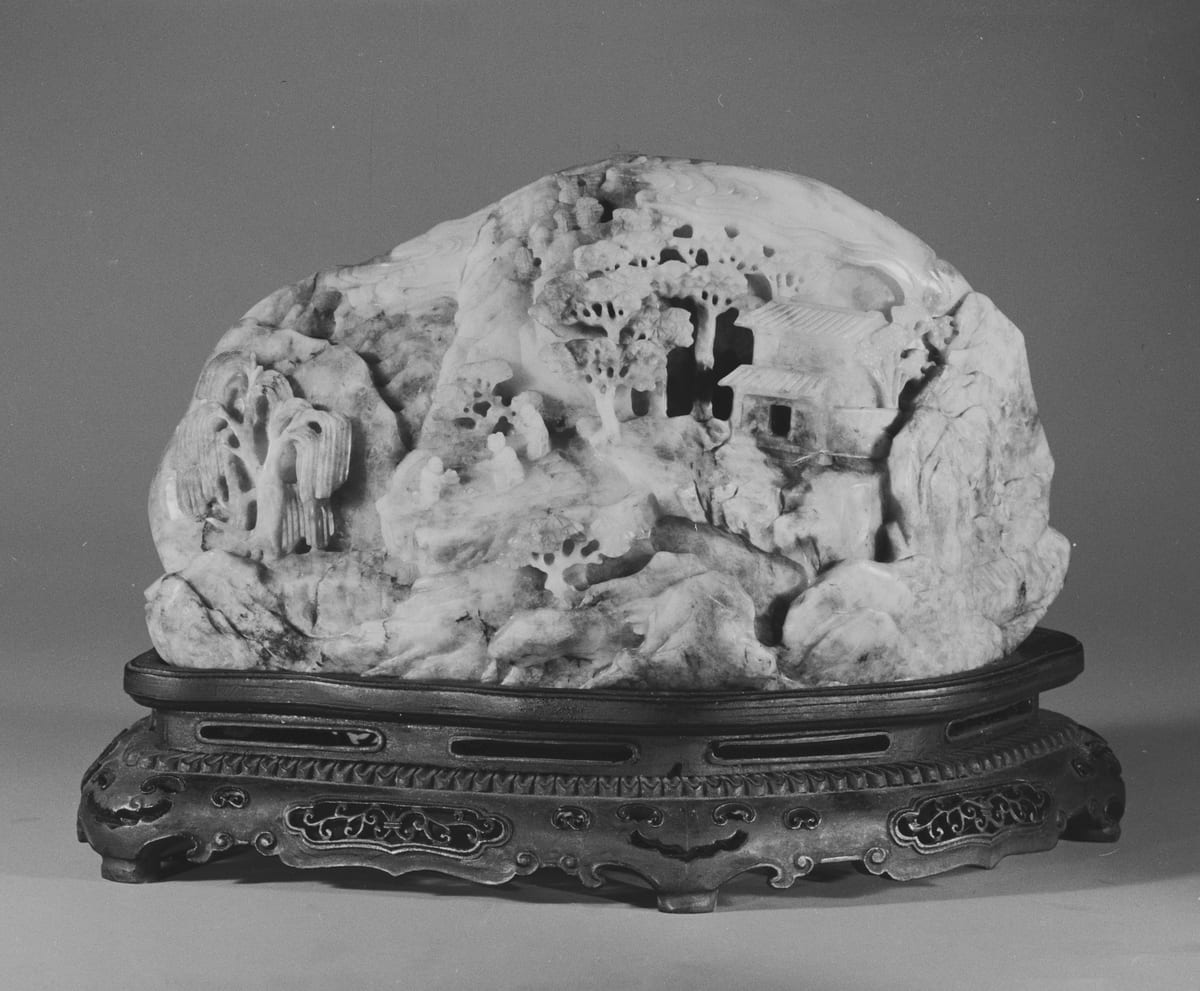
The pictured Met Mountain, 65.86.82a, b, is nineteenth-century Chinese jade. Its height is 11.4 centimeters, or 15.2 centimeters with the stand. The black-and-white museum photograph includes the complete support, figures, trees and pavilion-like architecture. It does not document the stone’s color.
Begin at the outline, then follow a ridge inward. Notice where an opening passes through the stone and where a shaded area remains a recess. Compare the support’s upper edge with the carving’s lower contour. A stand changes the height and presentation without becoming part of the represented terrain.
A literary gathering can become a carved landscape
Mia dates its Jade Mountain Illustrating the Gathering of Scholars at the Lanting Pavilion, 92.103.13, to 1790. The light-green jade was commissioned by the Qianlong emperor. The museum identifies the subject with Wang Xizhi’s account of a literary gathering at the Orchid Pavilion: cups floated along a winding stream, prompting drinking and poetry. The preface is carved on the front, while Qianlong’s poem appears on the reverse.
This record turns the scene into more than a generic group of people among rocks. The writing names a subject and creates a reason to study both faces. Keep the date of the carving separate from the earlier gathering it represents. A historical story can be reimagined in another period and another material.
Figures can suggest a journey through the stone
Durham’s guide identifies DUROM.2017.31 as a Qing jade mountain with a wooden stand, dated to 1700–1800. It describes figures approaching a walled settlement, probably intended as a spiritual retreat. The guide suggests an imperial workshop on the evidence of the quality of the carving and stand; it does not present that origin as certain.
Follow the figures’ route before trying to name their destination. A wall, a gate and a path can organize a journey for the viewer. The museum’s qualified interpretation supplies one context, while leaving room for the object’s uncertain workshop history. Detail and workmanship alone should not become proof of an imperial commission.
The scholar’s studio brings landscape within reach
The Crow Museum’s Immortal Landscapes exhibition placed carved jade mountains beside other natural forms associated with the scholar’s studio. Its account connects mountain imagery with retreat and imagined journeys toward an immortal realm. The listed examples include a nineteenth-century nephrite mountain, 1987.17, and an eighteenth-century nephrite mountain, 1960.36.
Read those themes as a museum’s interpretive framework. They need not identify every figure as an immortal or every roof as a temple. Compare the outside silhouette, the relative scale of buildings and figures, and the way different scenes occupy the available mass of stone. Those observations can make a small landscape easier to navigate.
A catalogue can preserve a narrower material name
The Met’s eighteenth-century Mountain Scene, 02.18.467, is catalogued as nephrite. Its Chinese title identifies a mountain-travel scene. It measures 24.4 centimeters high and 26.5 centimeters wide, with a recorded depth of 5.5 centimeters. Those proportions differ from the compact illustrated Mountain.
Comparing records helps separate material identification from appearance. Nephrite is the term used for this particular work; jade is the broader label on the pictured object. A pale or dark area in a photograph does not settle that distinction. The measurements also help a viewer think about depth instead of treating the carving as a flat picture.
A tool record explains possibilities, not every earlier workshop
The Met’s twentieth-century drill 1981.296.16 is steel. Its label describes relief carving, undercutting and fine shaping with different drill heads. The tool runs on a rotating shaft while sand mixed with water is applied at the working tip. This documents abrasion as a means of shaping the stone.
The tool is later than the Qing landscapes considered here, so its record cannot identify the equipment used for any one of them. Our jade-carving guide follows materials and abrasion more broadly. This guide concerns the finished landscape: the relation between paths, buildings, figures, openings, inscriptions and the stone that contains them.
Images and credits
Mountain, China, 19th century. Jade. The Met, 65.86.82a, b; Alfred W. Hoyt Collection, Bequest of Rosina H. Hoppin, 1965. Public domain/CC0. Complete black-and-white museum photograph, resized; stand included.