Openwork can surround a smooth cup
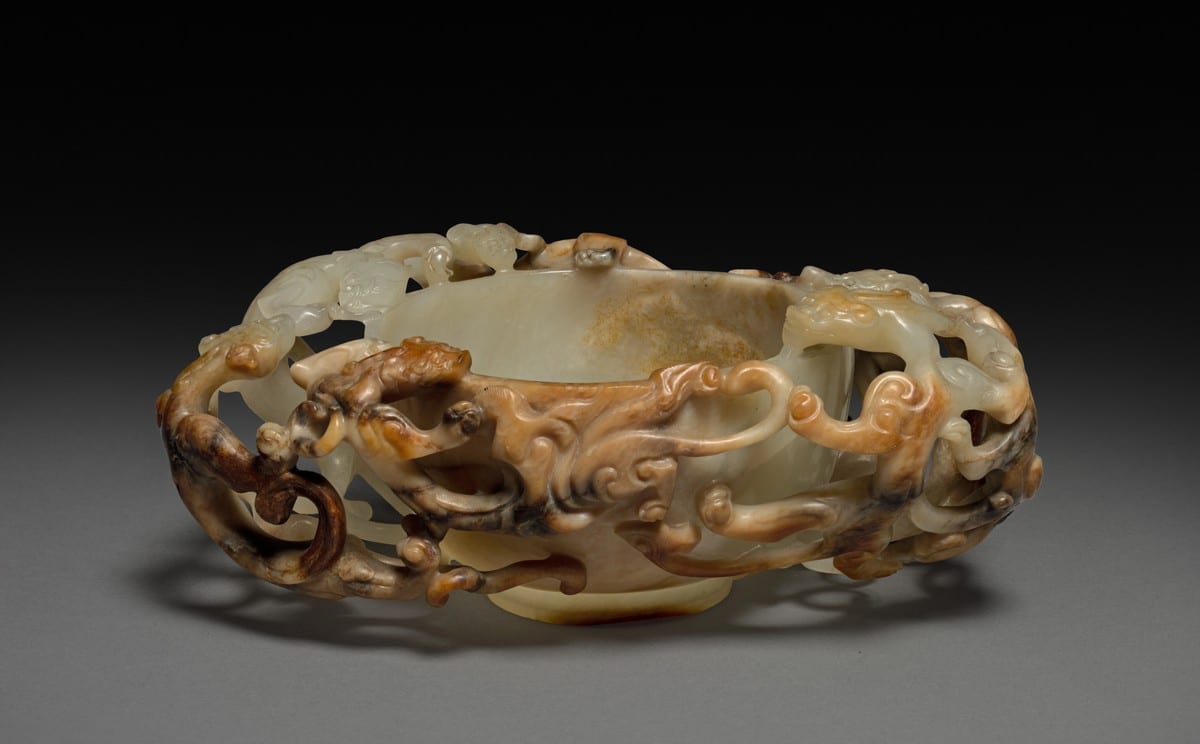
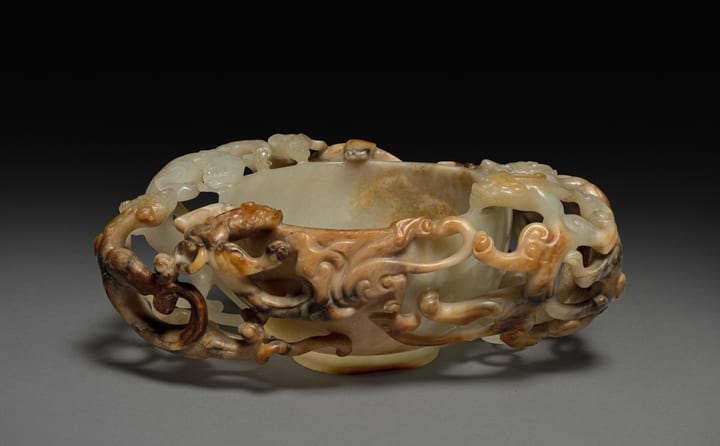
Cleveland dates the pictured cup, 1952.502, to 1736–95 and records its height as 5.7 centimeters. Its description identifies interlacing dragons carved from a rounded piece of jade. The photograph shows a smooth inner bowl within the surrounding openwork.
Follow the rim around the hollow, then look outward at the branching forms. Some parts frame open spaces; others return toward the vessel wall. The pale bowl and darker areas of the carving can be compared in the same photograph without treating color as a mineral identification. Seen from this angle, the cup offers both a continuous container and a much less continuous outer silhouette.
A figure can also become a handle
Cleveland’s Cup with Daoist Figures, 1952.510, is dated to 1736–95. The museum identifies two female immortals as handles and a procession of immortals, musicians and attendants around the body. Its measurements distinguish a 10.3-centimeter mouth from a total width of 16 centimeters including the handles.
Those two measurements answer different questions. The mouth describes the container’s opening; the greater width includes the sculpture projecting beyond it. Compare how a figure meets the rim or wall, while keeping the catalogue’s identification beside the image. A handle can participate in a scene rather than appear as a separate undecorated loop.
A revised date changes the historical comparison
The same Cleveland record explains that the Daoist cup was once assigned to the Yuan period but has been redated to the Qing. It also suggests that the absence of a Qianlong mark may mean it never reached the imperial court. Neither the reign-period date nor an elaborate design alone identifies an imperial owner.
Read the current dating before placing a cup beside another work. A previous attribution in an older book can remain part of the object’s history without being the museum’s present conclusion. This is especially useful when a design deliberately looks toward an earlier visual tradition.
A stem changes the relation of bowl and base
Cleveland’s Stem Cup, 1989.322, is catalogued as white jade and dated to the Ming dynasty, 1368–1644. The museum gives a height of 10.4 centimeters and diameter of 14.2 centimeters. The bowl rises above its support rather than resting immediately on a low foot.
Trace the change in outline from lip to bowl, then through the narrower support to the base. This comparison concerns the arrangement of the parts, not a claim that two similarly shaped cups were used together. Our porcelain stem-cup guide provides another material comparison; keep its clay body and glaze separate from the carved stone discussed here.
Cup and dish can be read as a pair
Cleveland’s Lotus-shaped Dish and Cup, 1972.255, dates to 1736–95 and is catalogued as jade. Its title makes the relationship between two components explicit. The complete object photograph shows the cup above a lobed dish.
When a catalogue presents a cup with a dish, examine both outlines. Notice where a petal-like edge is repeated and where one component becomes simpler than the other. A displayed pair is more informative than a cropped image of the cup alone, yet it still leaves questions about handling and original placement that require further documentation.
Carving evidence and finished form answer different questions
The Met’s small polishing wheel, 1981.296.27, is a twentieth-century tool made from dried gourd peel. Its account describes soft wheels carrying fine abrasive and water on a rotating shaft. This explains a documented way to finish jade while leaving both hands free to position the work.
The general jade-carving guide follows abrasion and material selection in more detail. Here, the emphasis is the finished vessel: continuous walls, hollow space, stems and carved attachments. The later tool record makes a technique intelligible without proving the exact equipment used for a particular Ming or Qing cup.
Saint Louis Art Museum catalogues its small cup, 471:1911, as fifteenth- to sixteenth-century Chinese nephrite. Compare that specific material identification with Cleveland’s broader jade labels. A photograph’s green, white or brown appearance should not replace a museum’s stated material.
Images and credits
Cup, China, Qing dynasty, Qianlong reign, 1736–95. Jade. Cleveland Museum of Art, 1952.502; Anonymous Gift. Photograph: Gary Kirchenbauer, Cleveland Museum of Art. CC0. Complete museum photograph, resized.