A vessel becomes a setting for sculpture
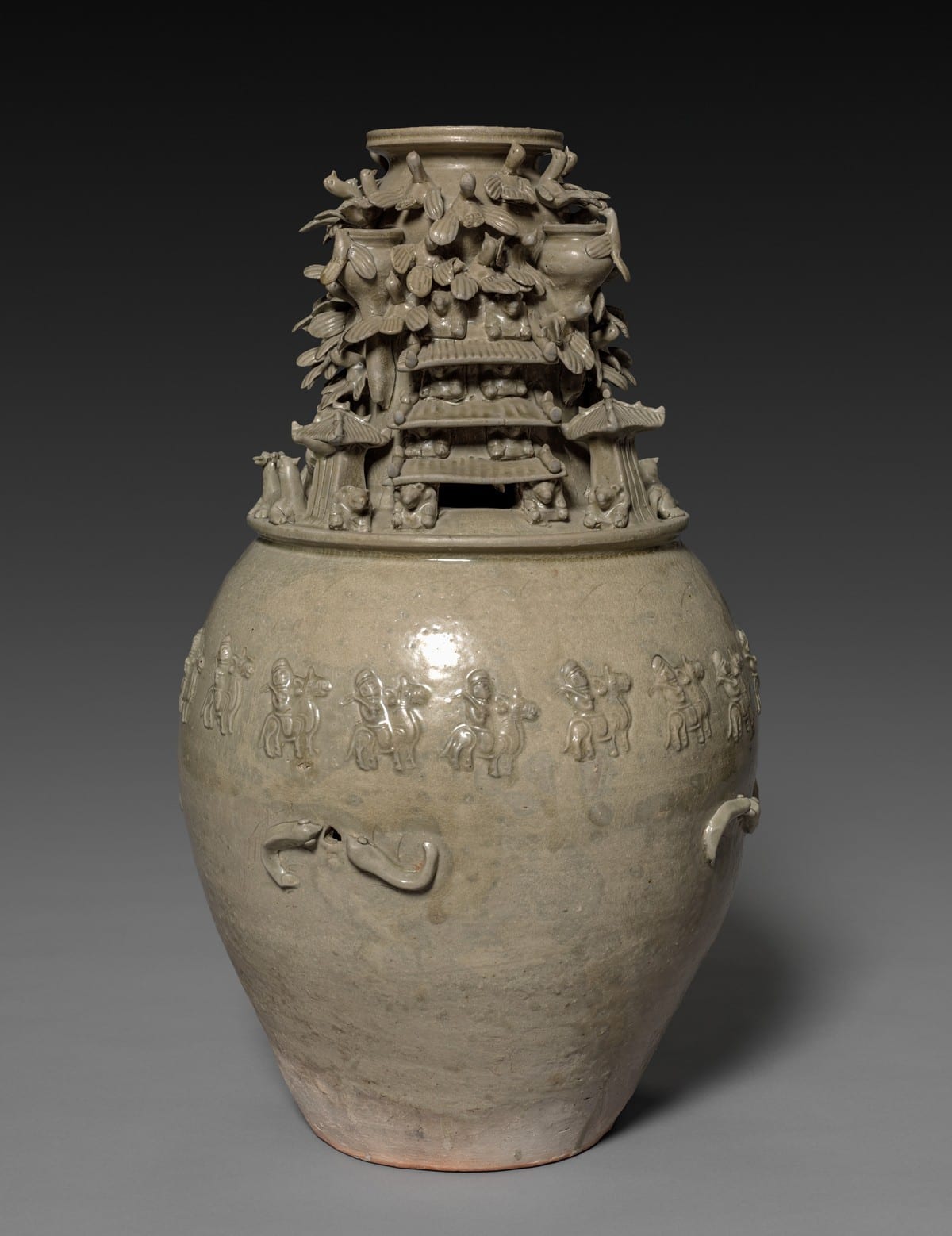
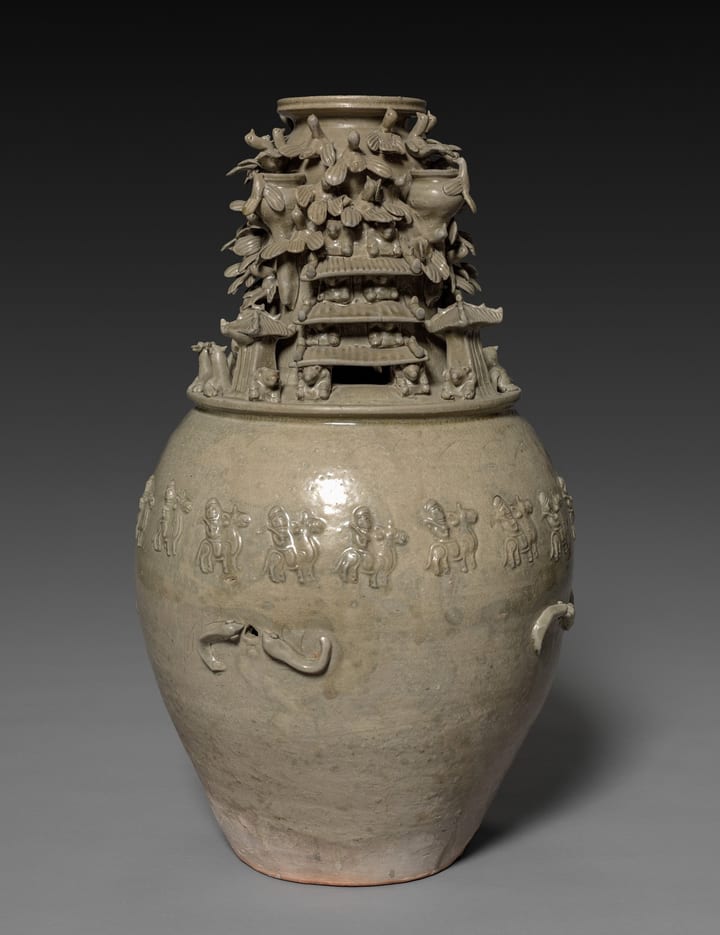
Cleveland dates the illustrated urn, 2017.22, to 265–316 CE. It measures 53 by 30 centimeters. Its catalogue identifies glazed stoneware with molded and sculpted decoration.
Look first at the broad lower body and then at the much busier upper section. A row of small figures encircles the shoulder, while birds and roof-like forms rise above it. The complete photograph lets the eye compare the relatively quiet wall with the crowded outline. It cannot show the reverse or an interior hidden by the modeled structure.
A second urn offers a qualified explanation of use
Cleveland’s 1988.21 is dated to the late 200s CE. Its record describes multistory towers accompanied by people, animals and birds. The museum proposes a relationship with a southern funerary practice in which the wandering soul was called back. It suggests that architectural urns, sometimes containing grain, could offer a place of refuge.
Keep the conditional language and the object distinction together. The interpretation helps explain why a vessel might carry such an elaborate setting, but it does not establish the contents of every urn. The presence of a jar-shaped body does not by itself prove everyday storage, and a modern title does not supply a recovered ancient instruction for use.
Belief can be read through the arrangement of figures
The Met’s Western Jin urn, 1992.165.21, is Yue stoneware with an olive-green glaze. Its catalogue describes a palatial structure supported by birds, with an elephant and deer among the surrounding animals. A row of seated Buddhas accompanies this paradise imagery. The museum interprets their combination as evidence of Buddhist ideas entering an existing religious setting.
The same record presents an eternal dwelling for the deceased’s soul as one modern theory of the urn’s function. That phrasing matters. Compare the position of the named figures and structures before extending the interpretation to a different urn whose decoration has not been identified in the same way.
Molded detail and modeled structure are different scales of work
Compare the repeated low-relief figures around the shoulder with the projecting architecture above. Trace the boundary between the smooth container wall and the attached-looking detail, then consider how the crowded silhouette changes as the viewer moves around the object.
The photograph records the finished surface. It does not establish a firing temperature, a glaze recipe or the exact sequence in which every component was joined. Those questions require technical examination. Reading the catalogue’s material terms alongside the visible form gives a useful account of the craft without reconstructing a workshop that the evidence does not document.
Compare a funerary ensemble with a single object
The Met’s essay on early Chinese burials places mingqi, or spirit goods, within a larger group of tomb objects and architecture. It explains that miniature buildings and tools could provide imagined comforts for the deceased, while the relationship among objects helped create a funerary setting. This is broader context rather than a claim that each excavated object had one identical task.
Our ceramic granary-model guide examines architectural containers in another form. The Yue-ware guide follows a ceramic tradition across different vessel uses. Comparing these pages helps separate three questions: what kind of object is pictured, how its surface and structure were made, and what its burial context may have meant.
The name also appears on later objects
The Davis Museum catalogues a Longquan funerary urn and cover as hunping, 2006.89.2a–b. Its date is Southern Song, 1127–1279, and its material is stoneware with a blue-green glaze. The record lists two heights, 27.3 and 26.7 centimeters, and identifies China as the place of origin.
A shared English or Chinese name therefore needs a period and an object record beside it. Do not make the Western Jin architectural silhouette a requirement for every later funerary urn. A useful comparison begins with the museum’s date, material, overall outline and separately documented decoration.
Images and credits
Funerary Urn (Hunping) with Figures, Pavilions, and Birds, China, Western Jin dynasty, 265–316 CE. Glazed stoneware with molded and sculpted decoration. Cleveland Museum of Art, 2017.22. Gift of Donna and James Reid. CC0. Complete museum photograph, resized.