Reading Chinese ceramic granary models from roof to foot
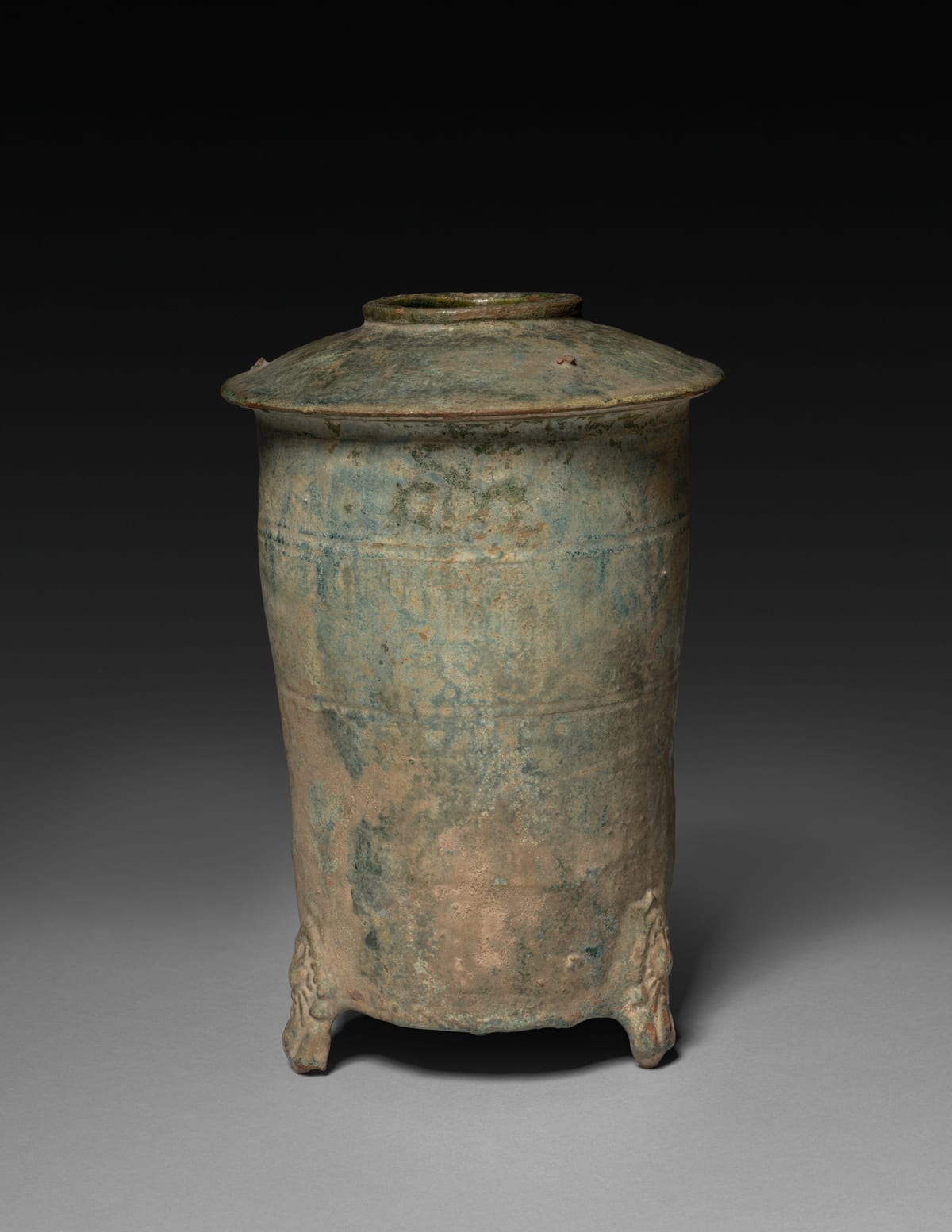
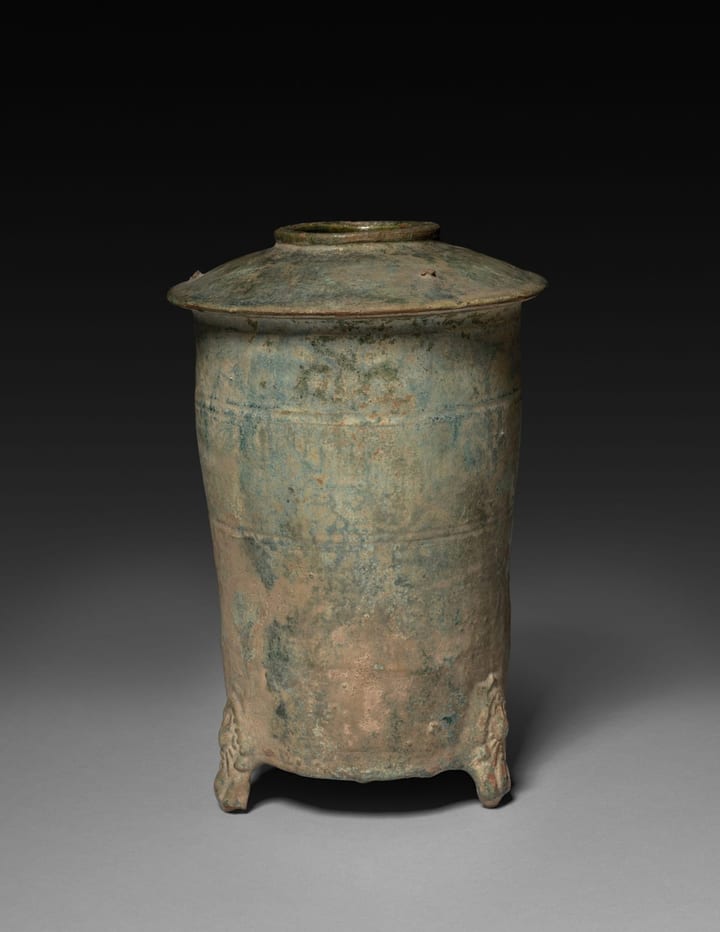
The pictured Cleveland object is catalogued as a Granary Urn, 1940.971, dated 206 BCE–220 CE. Its cylindrical wall rises to a broad, sloping shoulder and a small opening. Short modeled supports lift the body above its base. The record identifies glazed earthenware and gives a diameter of 26.1 centimeters. Begin with that whole outline before comparing individual details.
A roof can be represented on a round container
The National Gallery of Victoria’s model, 2584-D3, has a cylindrical body, a low conical tiled roof and a rimmed opening at the center. Three sets of incised bands divide the wall, and crouching bears form its tripod feet. The museum dates it to the second–third century CE and associates its production with Henan in northern China.
The roof and feet suggest a storage building at miniature scale. Our Chinese roof tile ends guide instead examines actual roofing components.
A rectangular model can show the work of storage
The Asian Art Museum’s Eastern Han storehouse, B60P130+, offers another arrangement. Its tall rectangular structure includes a worker carrying a sack upstairs and another waiting above. Two bears occupy the ground floor as guardians. These figures introduce movement and labor into the building model.
The museum records earthenware, molded decoration and an uneven lead glaze, and describes two kiln firings. That account does not specify the photographed urn’s construction.
The burial object and the building have different scales
The Met’s Granary Tower, 13.100.11, is 30.8 centimeters high and dates to the first–early third century. Its record places pottery houses and farm buildings within Eastern Han provisions for the afterlife. The object represents architecture, but its scale and burial purpose belong to ceramic model-making.
A Met research publication adds a useful qualification: some Han granary-shaped earthenwares held real grain in tombs. Excavated examples have inscriptions identifying rice, wheat or millet. A model could therefore represent storage and also contain an offering. This evidence does not establish the contents of every museum example discussed here.
Openings suggest how the represented granary worked
The University of New Mexico’s Maxwell Museum explains an actual granary as a structure filled from above, with grain released through a lower opening into a container. Its teaching page presents a Han model as a tomb offering. It also cautions that grain in ancient China was not synonymous with rice: millet was important.
Look for a represented entrance, filling opening or outlet, then check whether the particular record explains it. A small opening in a model does not by itself document the capacity or performance of a working storehouse.
Images and credits
Granary Urn, China, Han dynasty, 206 BCE–220 CE. Glazed earthenware. Cleveland Museum of Art, 1940.971, Bequest of James Parmelee. CC0. Complete institutional photograph, uncropped and resized.