Chinese baibaoqian inlay is broader than hardstone
The Palace Museum defines baibaoqian through a combination of worked materials forming relief images on a supporting object. Its examples range from large furnishings to desk equipment. The important question is how those components contribute to a design, rather than whether a catalogue lists a particular number of “treasures.”
Read a catalogue in two layers: first identify the support, then the inserted materials. This keeps a wooden container distinct from the shell or stone used for its surface image, and leaves room for combinations that a single material label would conceal.
Different substances require different work
A Palace Museum account by Li Jiufang describes the coordination behind these objects. Jade, crystal, agate and coral require rotating grinding tools, abrasive and water. Bamboo, wood, ivory and horn involve carving; metal components involve their own casting or chasing work. Lacquer preparation and finishing demand another set of skills.
The resulting image brings together components prepared in different ways. A stone element and a carved wooden element should not be imagined as products of one interchangeable cutting method. This account explains the material-specific work without supplying a universal tool size, adhesive formula or workshop recipe.
A surface can rise in relief or remain level
Zhang Rong’s Palace Museum essay distinguishes inlay that projects above its support from inlay that remains level with it. Raised components give the image an effect like relief; flatter work lets its materials meet the surrounding plane. Both are part of the discussion of baibaoqian.
When viewing an object, follow the edge of a leaf, robe or rock. Notice whether it stands above the ground and whether several materials share one pictorial outline. These relationships help explain the design more precisely than treating every polished fragment as an isolated jewel.
An inkstone box with recorded contrasting materials
The Palace Museum’s rectangular rooster-design inkstone box, 新00086141, dates to the Daoguang reign of the Qing dynasty. Its lacquer-sand surface supports a composition of a rooster, chrysanthemums and rocks. The catalogue lists Xiuyan jade, mother-of-pearl, red coral, turquoise, ivory and tortoiseshell.
The base carries a red-lacquer maker’s inscription reading Lu Kuisheng zhi. The box also contains a lacquer-sand inkstone. Here the decorative image belongs to a container for a writing implement, joining pictorial work with a specific use. The named materials come from the museum record, rather than an identification of colored areas in a photograph.
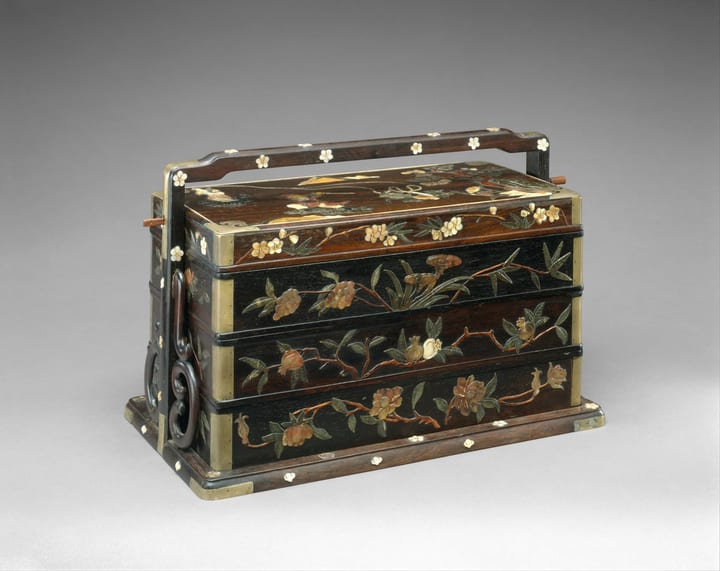
The illustrated basket includes soapstone
The Met’s nineteenth-century Chinese Picnic basket with scene from Investiture of the Gods is catalogued as zitan hardwood inlaid with mother-of-pearl and soapstone. Its Chinese title identifies baibaoqian. The museum associates the lid’s narrative with the novel Investiture of the Gods.
The photograph presents the assembled basket from one angle. Soapstone is the catalogue’s material term here; this object should not be relabelled as an exclusively hardstone-inlaid basket. Nor does the photograph establish an adhesive or a sequence of manufacture.
How to compare it with other Chinese inlay crafts
Mother-of-pearl lacquer inlay offers a focused comparison: its shell pieces contribute their own changing reflections against lacquer. Baibaoqian adds the problem of coordinating dissimilar substances within one image. Gold-and-silver inlay in metal asks a different question about fitting precious metal into a metal body.
For a useful close reading, move from the whole object to its support, then to the image’s outlines and relative heights. Return to the catalogue to check the materials. This makes the construction legible while allowing the subject, such as a rooster or a literary scene, to remain central.
Images and credits
Picnic basket with scene from Investiture of the Gods. Zitan, mother-of-pearl and soapstone. The Met, 1977.262a–g; Gift of Mr. and Mrs. Willaim Corbus, 1977. CC0. Complete photograph, resized.