What official means, and why the northern question matters
Guan means official. The National Palace Museum’s historical exhibition account uses the term for kilns producing for the court, while distinguishing the Northern Song capital’s official kiln from the later southern establishments. Its account reports that a specific northern kiln site had not been identified.
The same discussion considers Ru ware within the wider question of official production. That is an interpretation of court supply, not a reason to erase Ru as a named ceramic category. It also shows why Guan needs a period and context rather than serving as a label for all imperial ceramics.
Southern Song kiln names meet excavated evidence
The National Palace Museum relates Southern Song Guan to the court’s establishment of the Xiuneisi and Jiaotanxia kilns after the move south. In Hangzhou, archaeology has identified the Jiaotanxia site and the Laohudong kiln near Phoenix Mountain.
Its comparison treats one site as the historical Jiaotanxia kiln and the other as possibly Xiuneisi. Their production periods overlapped. Some transmitted court objects correspond to excavated types, while others remain difficult to match. This is a relationship between documents, excavated material and surviving collections, with different degrees of certainty.
The illustrated vase brings profile and glaze together
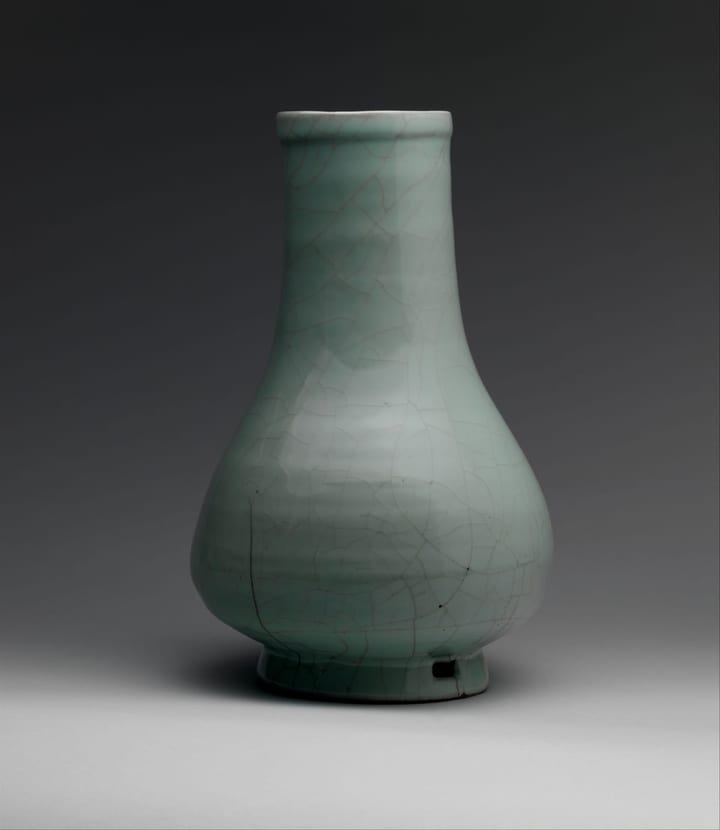
The Met’s Vase, 26.292.81, is dated to the twelfth–thirteenth century, Southern Song dynasty. Its recorded medium is stoneware with crackled celadon glaze, identified as Guan ware. At 34 centimetres high, it gives the glaze a long neck and broad lower body to occupy.
The full photograph preserves that changing profile and the complete foot. Look at the transition from neck to shoulder before following the crackles across the body. It shows a finished historical vessel, rather than a reconstruction of its workshop or firing.
A dark body can remain part of a pale-glazed design
The Palace Museum’s account explains the familiar purple-mouth and iron-foot wording through dark ceramic material showing at a thinly glazed rim and an exposed foot. These names concern body colour and glaze coverage.
Its overview also records several glaze colours, including pale blue, powder blue and beige tones. Guan should therefore not be reduced to one colour swatch. Shape, glaze coverage and the body beneath it contribute to the completed appearance.
A shallow dish and a small wheel-thrown bowl
Cleveland’s Flat Dish: Guan ware, 1957.69, is catalogued broadly to the Song dynasty, 960–1279. Its medium is glazed reddish-brown stoneware. The recorded 15.3-centimetre diameter and 3.5-centimetre height establish a low, open form, different from the tall vase illustrated here. That broad museum date should remain broad.
LACMA’s Bowl (Wan), M.73.48.129, is instead identified as Southern Song, made in Lin’an County, Zhejiang. Its medium explicitly records wheel-thrown stoneware with crackled blue glaze. At 7.62 centimetres across, it offers another scale for comparison. The forming method is part of this bowl’s description, not something inferred only from its round outline.
Crackle concerns the glaze, alongside the vessel’s form
The National Palace Museum explains glaze crackle through the expansion relationship between ceramic body and glaze, and notes that staining can make the network more visible. Its discussion includes several kinds of crackled celadon, rather than reserving the phenomenon for Guan.
Crackle is consequently useful to describe, but cannot supply a kiln name by itself. The Ge-ware guide examines a neighbouring attribution problem; the Ru and Longquan guides provide other documented comparisons. The material record and overall form remain necessary alongside the network of lines.
A Qing wall vase makes later reinterpretation concrete
The Palace Museum’s imitation-Guan-glaze cong-style wall vase, 新00088536, is a Yongzheng-period Qing object. It combines a rectangular body with a half-round opening and foot, a grey-blue crackled glaze and raised groups of Eight Trigrams. Its underside has an underglaze-blue Yongzheng mark.
This is an eighteenth-century adaptation with its own form and date, not a Song vase merely because the glaze refers to Guan. The cong-style name recalls another historical shape, while wall-vase construction serves a different display arrangement. Keeping both references visible makes imitation a specific design choice.
Material research adds evidence beyond a photograph
A 1984 study published by researchers at the Shanghai Institute of Ceramics and collaborating institutions examined Guan- and Ge-related ceramic sherds, their body and glaze compositions, and microstructure. It also investigated how Jiaotan samples changed under different firing conditions.
These experiments connect material choices with firing behaviour. The results concern the selected samples. Technical study, a dated excavation context and a museum attribution each contribute a different kind of information.
Images and credits
Vase, China, twelfth–thirteenth century, Southern Song. Stoneware with crackled celadon glaze (Guan ware). The Met 26.292.81, gift of Mrs. Samuel T. Peters, 1926. CC0; uncropped, resized.