Chinese folding fans: ribs, guards, and the leaf
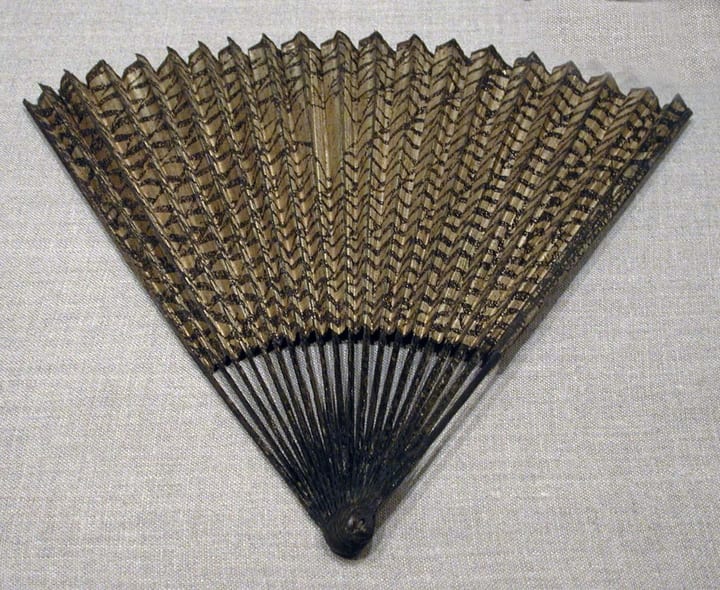
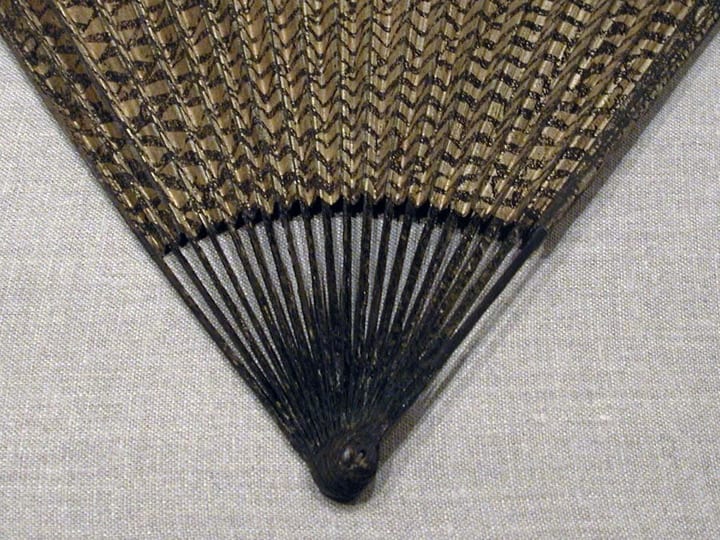
The ribs form a spreading support. The two outer ribs, often called guards, border the stack when the fan is closed. A pin or rivet at the base provides the pivot around which the ribs turn. The leaf opens along its folds as the ribs spread, then gathers back between the guards.
These parts must work together. A National Palace Museum conservation study explains how a poorly fitted pivot can hinder opening or leave the frame too loose to support the leaf. The mechanism is therefore part of the craftsmanship, alongside the visible decoration.
Bamboo and wood frames carry their own decoration
The Palace Museum records a Qing bamboo fan with thin inner ribs and thicker outer ribs. Its outer bamboo surfaces have burnt decorative marks, while the paper leaf includes scattered gold decoration. This example separates three choices that can otherwise blur together: frame material, frame treatment, and leaf treatment.
Wooden frames also appear in Chinese folding fans. A Fitzwilliam Museum export example has shaped and pierced wooden sticks, carved wooden guards, and a double paper leaf. Material labels belong to individual objects; neither the presence of bamboo nor a particular fan silhouette proves a Suzhou origin.
Preparing a paper or silk fan leaf
The leaf, or shanmian, is the surface carried by the frame. Suzhou’s official heritage account lists plain, coloured, and decorated paper leaves, alongside several kinds of silk leaf. A leaf can be plain or elaborately treated.
A Suzhou government workshop account documents one paper method: trimming Xuan paper, preparing and mounting layers, folding and cutting the leaf, and making channels to receive the ribs. This gives the Xuan paper guide a practical connection to fans. It does not mean every paper fan leaf is Xuan paper, or that every workshop follows this exact sequence.
Calligraphy and painting on a moving surface
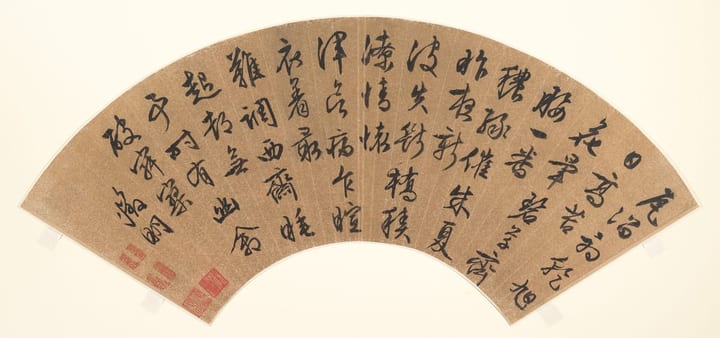
An opened folding leaf offers a curved field interrupted by folds, rather than a rectangular sheet. Writing and pictures must be considered within that shape. The Ashmolean notes that folding fans carry small paintings and calligraphic inscriptions, and that fan leaves are sometimes removed from their frames and preserved in albums.
A museum work described as a fan leaf may therefore preserve the artwork without its original operating frame. When looking at one, distinguish the image-bearing leaf from a complete fan. The Chinese calligraphy and Four Treasures of the Study guides introduce the brush, ink, and paper practices behind such writing.
Cooling, collaboration, and gifts
Cooling remains a basic function, but an individual fan can record personal relationships. The Met’s Folding fan with roses and calligraphy was a gift to bamboo carver Jin Xiya’s daughter. Its catalogue separately credits the frame carving, calligraphy, and painting, completed in different years during the 1930s.
That record shows why the whole fan should not automatically be attributed to the person who painted its leaf. It also provides a documented gift context without turning one family gift into a universal rule about fan symbolism. Read inscriptions and collection records before assigning a particular message or occasion.
Folded fans, fixed fans, and living craft
A fixed round fan, commonly called a tuanshan, holds its surface on a rigid frame attached to a handle. It does not gather into a rib stack. Both fixed and folding forms can carry painting, so a decorated surface alone does not identify the construction.
Suzhou’s official heritage platform records fan making as a national intangible cultural heritage project and describes shaping, mounting, carving, inlay, and lacquering. It includes several fan families. This is evidence for a specific living craft tradition, not proof that every Chinese folding fan was made there. Photographs on this page show catalogued museum objects, not a contemporary making sequence.
Museum photographs and credits
Wen Zhengming, After a Long Summer Rain, Ming dynasty: ink on gold-flecked paper, a folding fan mounted as an album leaf. The Met 1989.363.61, Bequest of John M. Crawford Jr., 1988. Public domain/CC0; resized. This leaf is preserved without an operating frame. Changes: resized without upscaling, metadata stripped and JPEG compressed. Source and rights links appear below. No museum endorsement is implied.
Folding Fan with Fishing Net Decoration, China, late 16th–early 17th century. The Met 1988.212, Purchase, The B.D.G. Leviton Foundation Gift, 1988. The catalog identifies ink on gold-flecked paper and gold-flecked lacquered bamboo fanbones and endpieces. Public domain/CC0; resized. This is a historical object photograph, not a making demonstration. Changes: resized without upscaling, metadata stripped and JPEG compressed. Source and rights links appear below. No museum endorsement is implied.
Lower detail of the same Folding Fan with Fishing Net Decoration, The Met 1988.212. The ribs converge toward the pivot. Public domain/CC0; cropped and resized. This is the same photographed object as the previous view, not a separate fan. Changes: Cropped, resized without upscaling, metadata stripped and JPEG compressed. Source and rights links appear below. No museum endorsement is implied.