Chinese round fans are a family of fixed forms
The Palace Museum’s study includes circular and elongated forms alongside lobed, hexagonal and octagonal outlines. “Round fan” is therefore a useful family name. Examine the contour of the actual fan rather than assuming that every tuanshan is a perfect disk.
Begin with three questions: what provides the perimeter, how does the handle meet the face, and what carries the decoration? These separate the supporting structure from the surface that a painter, embroiderer or other specialist may work on.
How the face and support come together
The museum describes several assembly methods. A face may be stretched over a shaped wire perimeter and joined to its support. Wire ends can also be secured within the support; alternatively, a split support can grip the face. These arrangements hold an extended, taut plane.
Construction affects how the object should be read. Follow an edge or joint before concentrating on a painted flower. A decorative border belongs to the whole fan, while a surviving textile leaf may preserve only part of that larger assembly.
Wood and bamboo work in a Suzhou practice
A 2018 official Suzhou profile describes Sheng Chun’s work on wood and bamboo frames. Selecting material, trimming, smoothing, shaping and fitting components form part of the recorded practice. Her designs also employ carved openwork and inlay.
The account connects her experimentation with a Palace Museum fan exhibition she visited in 2013. This is a specific modern maker’s response to historical objects. It gives a concrete example of studying older forms while developing new frames, rather than prescribing one construction for every Chinese fixed fan.
A court fan with a woven ivory face
A mid-Qing fan in the Palace Museum, accession 故00124733, shows how varied the materials can be. Its elongated, plantain-like face is woven from narrow ivory strips. Tortoiseshell forms the border, while the handle incorporates painted enamel and a bone bead; a yellow silk tassel hangs below.
Dyed ivory flower-and-bird decoration enriches the woven surface. The catalogue connects this ivory-strip weaving with Guangzhou craftsmanship. That attribution belongs to this technique and object: it does not make every court fan a Guangzhou product. The record also demonstrates why “ivory fan” need not mean that every component is ivory.
When a fan surface becomes an album leaf
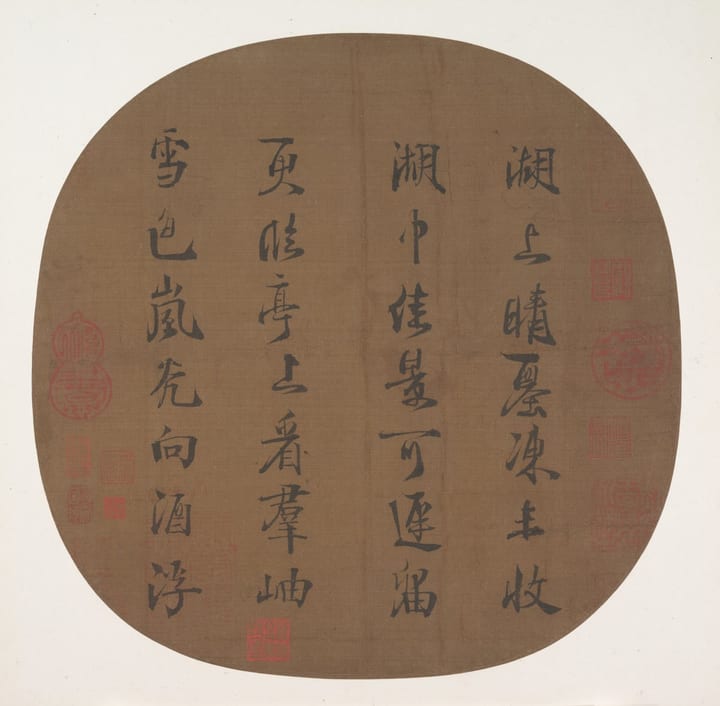
The illustrated work is Emperor Lizong’s Quatrain on snow-covered West Lake, catalogued by The Met around 1250–60. Its medium is “Round fan mounted as an album leaf; ink on silk.” The poem probably concerns West Lake; the approximate date comes from comparison with his calligraphy.
This photograph shows the calligraphic surface without a handle or frame. It is evidence for writing within a rounded fan format, rather than a complete handheld fan or a reconstruction of its original assembly.
Modern making includes reconstruction and experiment
Suzhou’s official account of the 2026 exhibition Jiangnan Made describes Cai Nianqun’s collecting, repair and making since 2006. The exhibition brought together work involving more than twenty making stages and varied decorative crafts.
His documented materials and approaches include kesi, gauze, silk, embroidery, straw, bamboo, lacquer and inlay. These combinations expand the possibilities of the fan surface and its frame. They describe the exhibition’s practice, rather than a checklist that every tuanshan must contain. The June announcement gave 3 September as the closing date; its account records contemporary experimentation.
Compare the complete fan with related formats
The folding-fan guide follows ribs that rotate around a pivot and a leaf that collapses with them. That mechanism has its own making requirements. The painting-albums guide considers bound leaves and viewing sequences, helping explain the present format of a fan surface preserved in an album.
Images and credits
Emperor Lizong, Quatrain on snow-covered West Lake. Round fan mounted as an album leaf. The Met, 1989.363.18; Bequest of John M. Crawford Jr., 1988. CC0. Complete photograph, resized.