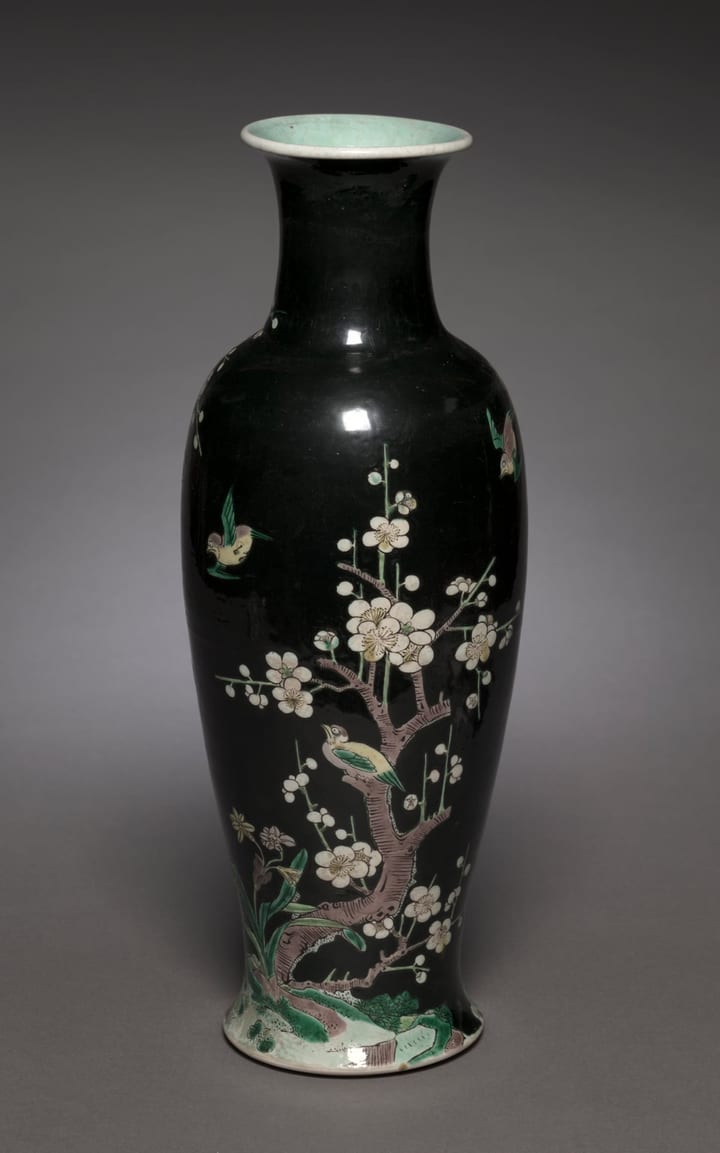
Chinese famille noire porcelain: a black ground with color
Famille noire means black family. Knittler’s National Museums Liverpool study identifies it as a subgroup of famille verte.
Look first at the relationship between the dark field and the lighter forms. A pale blossom can remain legible against a broad black area, while a branch connects one cluster to the next. The background contributes to the composition as actively as the pictured flowers and birds.
One documented enamel-on-biscuit sequence
The National Gallery of Art’s catalogue describes a Kangxi-period method: paint outlines on the fired body, fill the motifs with colored enamels, and form the background with brownish-black enamel beneath transparent green. A subsequent low-temperature oxidizing firing fixes the decoration.
This is the catalogue’s account of the technique, not a recipe for every black vessel. Keep the recorded decorating surface with the particular object.
A Cleveland vase with a precise date
Cleveland Museum of Art’s Baluster Vase with Blossoming Cherry Tree, accession 1947.678, is dated 1714 within the Qing dynasty’s Kangxi reign. Its current medium is porcelain with polychrome enamel decoration. The vase stands 40.1 centimeters high.
The National Gallery’s catalogue illustrates this same Cleveland object as a famille noire example. In the complete photograph reproduced here, a flowering tree occupies the lower body and branches continue around its curved surface. Pale blossoms and colored birds interrupt the dark ground. Compare that distribution with the quieter upper neck, keeping the catalogue’s title beside the image.
Biscuit is a material description, not a color
The National Gallery’s Baluster Vase, accession 1942.9.626, is catalogued to the Kangxi period, 1662–1722. Its medium explicitly specifies porcelain with famille noire enamels on the biscuit, and the museum records a height of 74.9 centimeters.
That description identifies where the enamel decoration belongs in the object’s construction. It is more informative than simply calling the vessel black porcelain. The catalogue also records a lingzhi mushroom mark inside a double circle beneath the base. A museum entry can distinguish the support, decoration and mark rather than compressing them into one color label.
An earlier reign name can appear on a later vessel
Toledo Museum of Art’s Vase, accession 1943.31, is catalogued as Chinese porcelain with famille noire decoration from the Kangxi reign. The label translates an inscription beneath it as referring to the Chenghua period of the Ming dynasty.
Toledo explains that this earlier reign reference honored a previous dynasty; it does not date the vase to that reign. This is a concrete reason to read a mark within the object’s assessed history. The written name and the museum’s production date answer different questions, even though they occur on the same piece.
Separate later manufacture from later decoration
Knittler distinguishes earlier wares, later-period wares, nineteenth-century inventions and older bodies altered with later decoration in the Lever collection. These categories represent different object histories.
Ask when a body was made and when its enamel surface was added or changed. An older support alone cannot date all its paint.
Read the image and the object record together
Begin with one branch or border and follow how it passes around the vessel. Then compare the density of the painted passages with the dark areas between them. A photograph can help with that visual reading, while laboratory findings, marks and provenance require documentary evidence.
The famille rose guide follows pink and opaque-white enamel effects. The grisaille guide concentrates on tonal, ink-like images. A black ground is another organizing choice, so keep the decorating layers and each catalogue’s terminology in view when moving among these related guides. Jingdezhen porcelain provides the broader ceramic context.
Images and credits
Baluster Vase with Blossoming Cherry Tree, maker unrecorded, China, 1714, Qing dynasty, Kangxi reign. Porcelain with polychrome enamel decoration. Cleveland Museum of Art, 1947.678; Bequest of Cornelia Blakemore Warner. CC0. Complete museum photograph, uncropped and resized for display.