Longquan celadon vs Jingdezhen porcelain: what the names tell us
Longquan names a kiln region with a celadon tradition; Jingdezhen names a production centre with many porcelain products. Celadon describes a glaze or ware family; porcelain describes a ceramic body. These terms emphasize different aspects of an object.
Blue-and-white is one important Jingdezhen tradition, but it does not define everything made there. Museum collections also document white-glazed porcelain, underglaze copper-red decoration, and combinations of underglaze blue with overglaze enamels. Begin with a particular type and period when making a close comparison.
The body beneath the glaze
The body is the shaped ceramic material beneath the surface coating. Official ICH and V&A accounts describe Yuan-period development of porcelain-stone and kaolin recipes at Jingdezhen. This historical change does not establish an identical formula for every workshop or century.
Longquan bodies also need to be described through examples. A Southern Song bowl in the British Museum has a pale-grey body under thick, pale-bluish celadon glaze. Its curatorial description uses porcelain-type stoneware, while the Hong Kong Palace Museum labels a Longquan jar stoneware with celadon glaze. These terms are more precise than assuming a universal opposition between coarse Longquan clay and fine Jingdezhen porcelain.
Glaze colour and painted decoration
In the British Museum's bowl, iron-derived colour and several glaze layers create the soft blue-green surface. Longquan's heritage record likewise emphasizes glazing methods and kiln control. The appearance is produced through materials and firing together; green colour alone cannot establish a vessel's production place.
For blue-and-white porcelain, the V&A describes cobalt pigment brushed onto a white body under the glaze. Here the reader can distinguish the painted design from its glaze covering. Jingdezhen can also use surface and relief subtly: Cleveland's sweet-white jar has floral and petal designs visible through its glaze. A pale, apparently plain surface may reward close looking just as much as a painted one.
How workshop processes overlap and differ
Both traditions involve preparing material, forming, trimming, applying surface treatments, and firing. The Jingdezhen heritage record describes a specialized chain of workers and techniques, including throwing, moulding, trimming, glazing, and kiln loading. The object results from connected tasks, not a single act at the potter's wheel.
Longquan's record gives particular attention to building glaze layers and managing firing conditions. Some thick-glazed products involve repeated glazing and preliminary firing. This is a described method for those products, not a required sequence for every celadon vessel. Likewise, a Jingdezhen blue-and-white vessel and an enamelled vessel should not be assigned one identical decoration sequence.
Connected histories, rather than a quality ranking
The Hong Kong Palace Museum documents early Ming court production at both Longquan and Jingdezhen. Its Longquan jar has forms and designs connected with court instructions, and the exhibition notes similarities between the two centres' wares. Longquan ceramics also served as diplomatic gifts. The comparison includes shared patrons and exchanges, as well as distinct workshop knowledge.
UNESCO's Longquan element concerns traditional firing technology and the communities transmitting it. Appreciating that knowledge means asking how makers achieve a surface and pass on judgment. For an individual object, look for a documented production place, date range, body description, and decoration method.
Museum photographs and credits
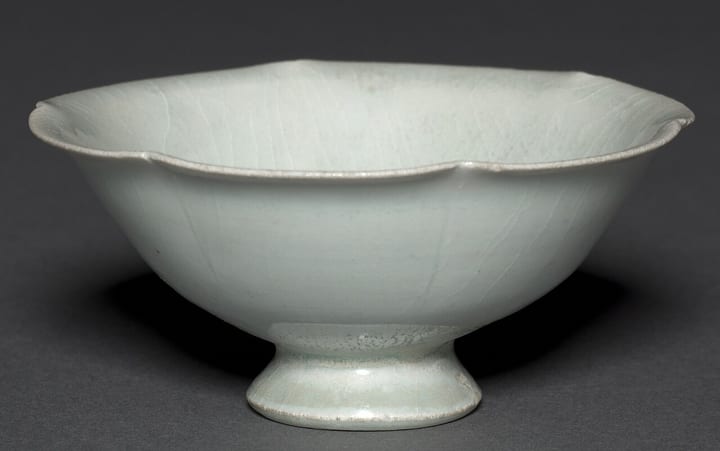
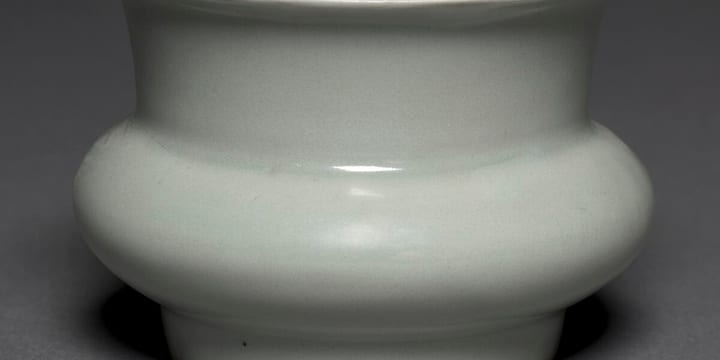
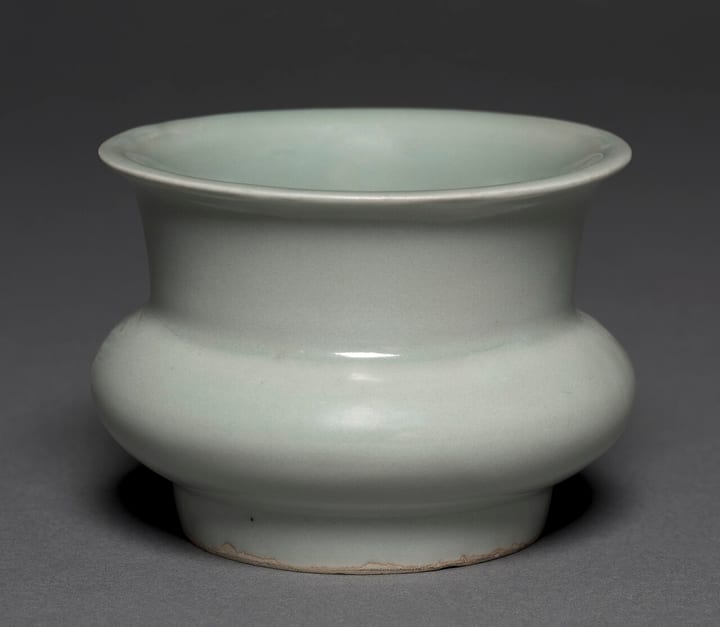
The hero is the Longquan Zhadou vessel, Southern Song dynasty, Cleveland Museum of Art 1957.73, Gift of Mr. and Mrs. Severance A. Millikin. The pale qingbai cup is Jingdezhen porcelain, Southern Song dynasty, Cleveland Museum of Art 1980.185.a; the source image was previously cropped on Wikimedia Commons by Johnbod. The last image is a new detail crop of the same Longquan vessel as the hero. These museum object images are CC0, resized for web display. They illustrate bodies, shapes and glazed surfaces; they are not workshop-process photographs or representative of every product from either region.