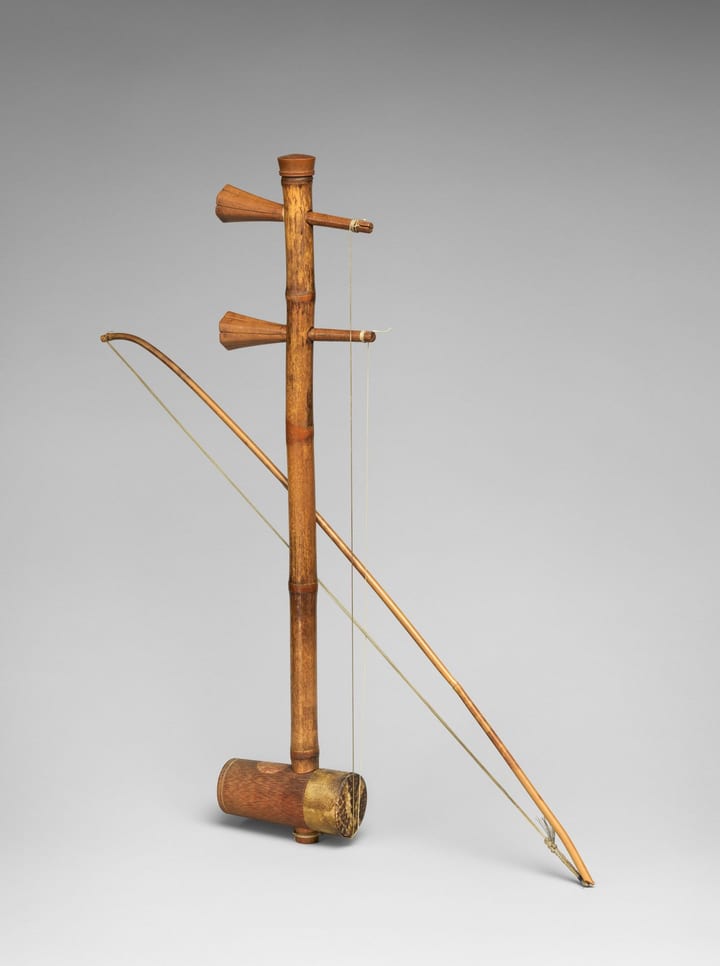
An identified historical jinghu includes its maker
The Met identifies the pictured instrument and bow as Jinghu, accession 89.4.107a, b, from the nineteenth century. It names the Japanese maker Shinsai, “Katsu” Tajima and assigns the culture Japanese/Chinese. Those attributions remain part of this example’s identity.
The complete photograph shows a museum display, not a playing posture or a documented Beijing performance.
A bamboo neck runs into a small resonator
The National Museum of History’s jinghu 82-00273 provides a separate construction example. It is catalogued to the Republican period, measures 49.5 centimetres long and has a five-section purple-bamboo neck, wooden tuning pegs and a soft bow. Its description explains the neck’s passage into the cylindrical resonator.
The account also notes one open end and a skin-covered end. These parts form a working relationship: the neck supports the strings, and the resonator gives the vibrating surface its enclosure. Do not transfer this object’s date, dimensions or soft-bow description to the Met instrument.
Making responds to a particular performer
China’s national heritage record for jinghu making describes selecting bamboo for the neck and resonator, shaping components, preparing peg holes, fitting the skin and bridge, making pegs and bow, and finishing the surface. It identifies the Shi and Hong traditions as distinct approaches.
The account emphasizes matching the instrument to the singer’s range and timbre, the repertory and school, and the instrumentalist’s handling. Its 2021 extension listing concerns the named jinghu-making craft in Beijing’s Xicheng district. It is a specific Chinese heritage entry, not a UNESCO inscription for every jinghu.
Accompaniment follows a particular vocal setting
ChinaCulture’s 2009 instrument introduction connects jinghu’s high, vigorous sound with Peking-opera melody and close coordination with the singer. It lists different relative string tunings for different tone systems, rather than one pitch assignment for every performance.
Follow how the bowed line meets the sung phrase and notice its entries between vocal passages. The chosen music supplies the practical reference. The dated introduction gives examples; it does not prescribe a universal modern tuning or one arrangement for every scene.
Teaching connects posture, bowing and repertory
A National Academy of Chinese Theatre Arts retrospective credits He Shunxin with recording Jinghu Basic Training Materials. It describes instruction beginning with posture and hand methods, then explaining bowing, fingering and the use of techniques in both hands.
The same account records teaching performances made with singers and musicians experienced in particular theatrical schools. It connects practical exercises with stage knowledge and repertoire. This is an institutional history of teaching materials, not current admissions advice or a recording of the pictured instrument.
An orchestral chart describes a different working arrangement
Hong Kong Chinese Orchestra’s 2025 instrumentation table assigns jinghu doubling to one gaohu player. The same chart lists the broader bowed-string forces separately. This is evidence of that orchestra’s available instrumental combinations, not a claim that its everyday scoring reproduces a Peking-opera pit.
A programme may ask a player to change instruments for a particular passage. Read the instrument credit before attributing every high bowed melody to jinghu. The related erhu and ensemble guides provide comparisons, while the actual instrument and musical part settle which sound is being described.
Images and credits
Jinghu and bow, Shinsai “Katsu” Tajima; Japanese/Chinese, nineteenth century. The Met, 89.4.107a, b, The Crosby Brown Collection of Musical Instruments, 1889. Public domain/CC0. Complete photograph, uncropped and resized.