Start with the board and the bow
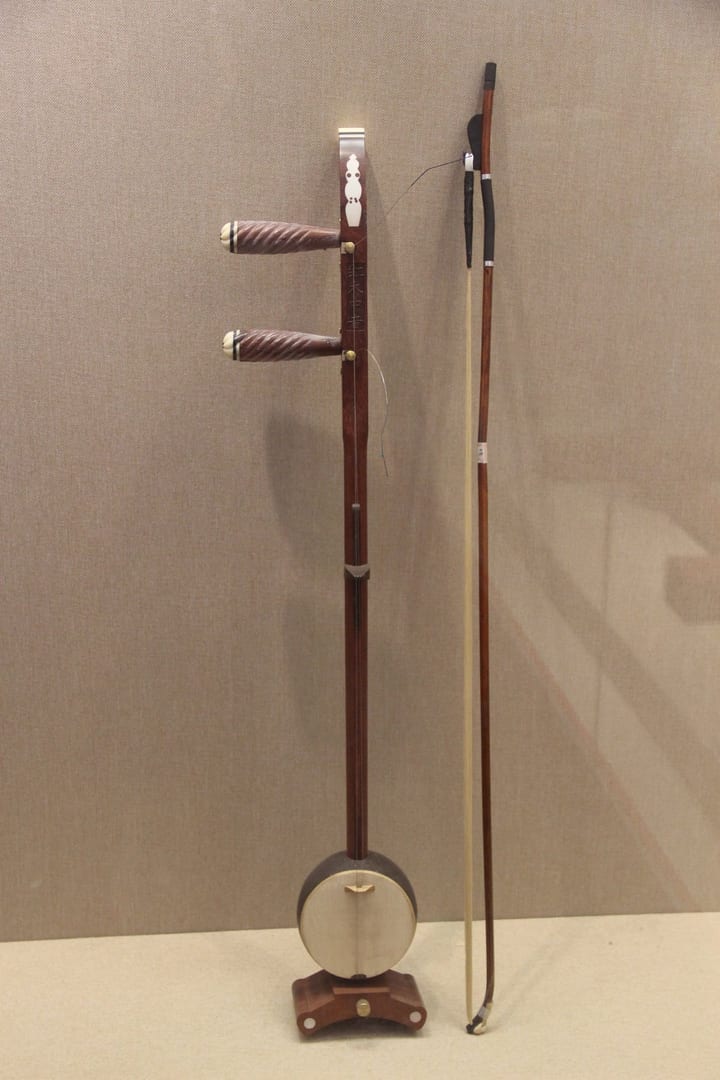
Middle Tennessee State University describes a neck passing through the resonator and two strings running along it. The pale round face in the photograph offers a clear view of the soundboard. Follow the strings down to the small bridge to see where they meet that face.
The display photograph includes the bow beside the fiddle, so use the instrument gallery to understand how its hair sits during playing. The two lateral pegs and the bow beside the fiddle are easy to pick out in the photograph.
A documented instrument made for a player
Auckland Museum’s banhu, 2017.82.2, is catalogued to about 2014 in Taiwan. It was made for Wan Wen Lung, whom the museum identifies as leader of the Tainan City Traditional Orchestra. The thin board closes a coconut-shell soundbox, and the record also lists a horsehair bow and a black knee rest.
The object includes a vinyl travel case. That detail gives the reader another way to understand this example as equipment for a working musician. The museum’s individual material choices and date belong to its instrument. The accompanying photograph on this page documents a different fiddle displayed in Jiangxi.
Qinqiang gives the fiddle a leading melodic role
The national heritage entry for Shaanxi Qinqiang describes two sections of the theatre ensemble. The banhu leads the wenchang, the melodic side, with instruments including flute, sanxian and yueqin. Drums and gongs belong to the wuchang, the percussion side.
In a Qinqiang recording, follow a sung line and then the instrument that continues across a breath or pause. Try another passage in a different rhythmic pattern and compare the support under the singing.
Hebei and Henan offer different ensembles
The Hebei Bangzi record includes the banhu, flute and sheng, and describes the clapper marking the beat through several vocal patterns. In listening, pick out the brief, hard clapper sound and then trace the longer bowed line through the same phrase.
The Henan Yu Opera record names both banhu and erhu in its melody section, alongside plucked strings and flute. It also distinguishes regional singing styles within the opera. Look for the instrument credits when more than one bowed fiddle is present, then compare how each part accompanies the singer.
A named concert part is another way to hear it
Hong Kong Chinese Orchestra’s September 2024 programme for Wang Danhong’s Morning Star Lilies Forever credits Shen Cheng on banhu in the fifth movement, The Porters. The programme places that movement among music inspired by northern Shaanxi and gives other named roles to a folk singer, a sanxian player and a suona soloist.
A movement credit helps you locate the banhu in a larger work. Compare that focused concert role with the interaction between fiddle and singer in a staged opera excerpt.
Images and credits
Banhu on display at Tengwangge in Nanchang, Jiangxi. Gary Todd photographed it on 9 December 2016. CC0. Complete photograph resized for display.
