How Chinese embroidered sleeve bands met the cuff
RISD’s Aldrich Collection explains the role of an oversized sleeve. The plain face could give way to a more densely worked reverse as the fabric draped forward. Begin with the place where the cuff bends. That change in direction determines which area of decoration a viewer sees.
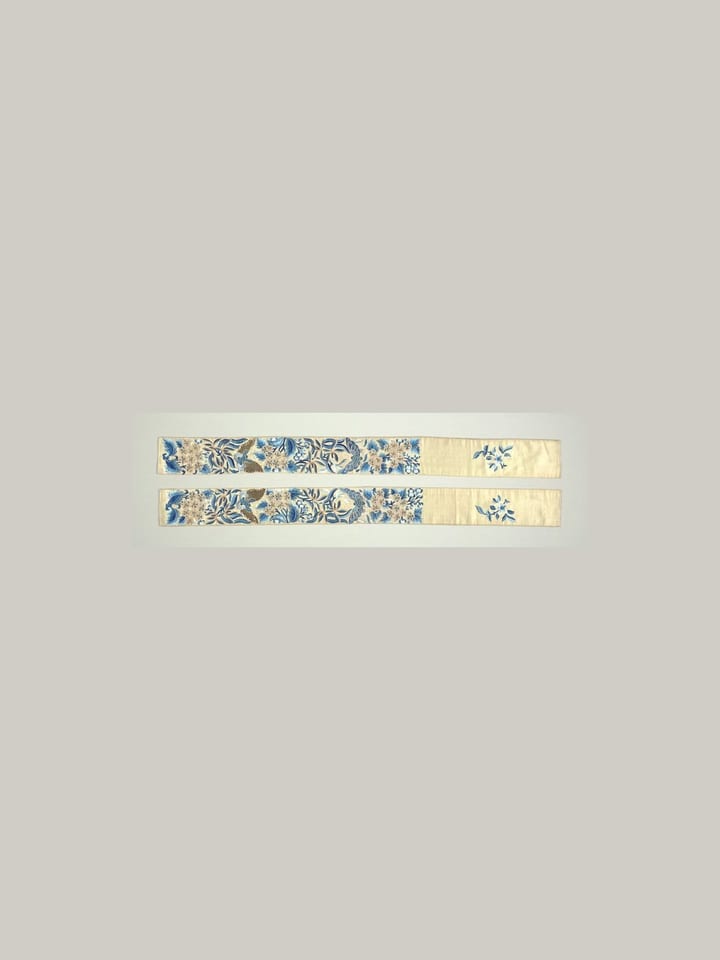
In Cleveland’s nineteenth-century pair, dense blue ornament occupies one stretch of each pale silk satin band. Farther along, a lone sprig sits in open cloth. Looking at both pieces side by side brings the repeated arrangement into view. The catalogue leaves the pair’s wear history open.
Bands survive before and after assembly
In the Aldrich Collection, some lengths preserve the embroidery before the individual bands were cut free. RISD also records bands that never went onto clothes and bands mounted on paper scrolls. The object on display can represent a different stage from the garment an owner would have worn.
Cleveland lists an overall length of nearly 95 centimeters for the pictured pair. The photograph shows each strip from end to end, so the open portion survives alongside the elaborately worked area.
Cleveland’s second example, 1943.92, has an assigned range of 1880 to 1940 and could be Qing or Republican. Its bands average just over 82 centimeters long. Compare catalogue dimensions when viewing museum photographs, since objects with different lengths can appear the same size on a screen.
One seam can connect textiles made at different times
The Metropolitan Museum of Art describes a Chinese imperial robe with a seventeenth-century catalogue date. Its main textile is tapestry woven, while the embroidered neck and sleeve bands were made later. Their dates therefore need to be read separately. When a catalogue discusses the sleeve trim as its own part, it can tell us something the overall date cannot.
Threads make different parts of a design legible
On pair RSN.1459, dated to the turn of the twentieth century, gold passing thread is secured by couching around major motifs. Chinese knots fill selected designs, including a wheel and a treasure vase. The school also identifies satin and long-and-short stitches. Look at a motif’s edge and then its center to see why a catalogue may name several methods for the same strip.
Our Chinese seed stitch embroidery guide goes closer into one family of small knots. The cuff provides a larger frame for seeing how a detail, a border and the unworked ground can share a piece of dress.
The cuff could carry a story
RISD reads the scene on bands 34.687a,b as the tale of Lord Wei. He waits for his sweetheart beneath the Blue Bridge and stays as the water rises. Reading that pair as a narrative helps explain why a cuff could carry people and a setting as well as familiar auspicious motifs.
Images and credits
Pair of Sleeve Bands, Qing China, nineteenth century. Embroidery on silk satin. The Cleveland Museum of Art, 1921.919, Gift of Mrs. Charles William Wason. Complete institutional photograph, resized. CC0. Display adds a neutral border.