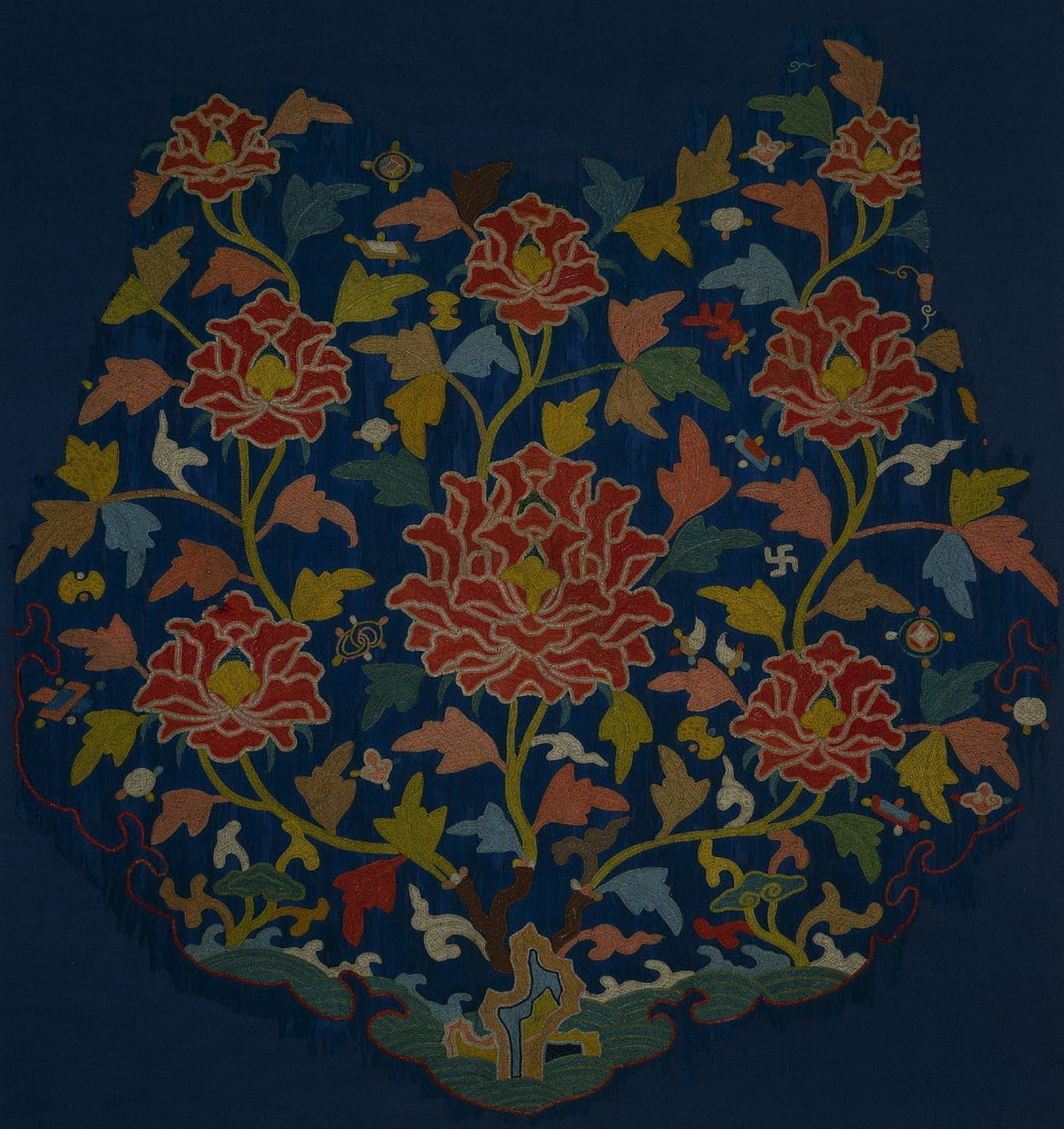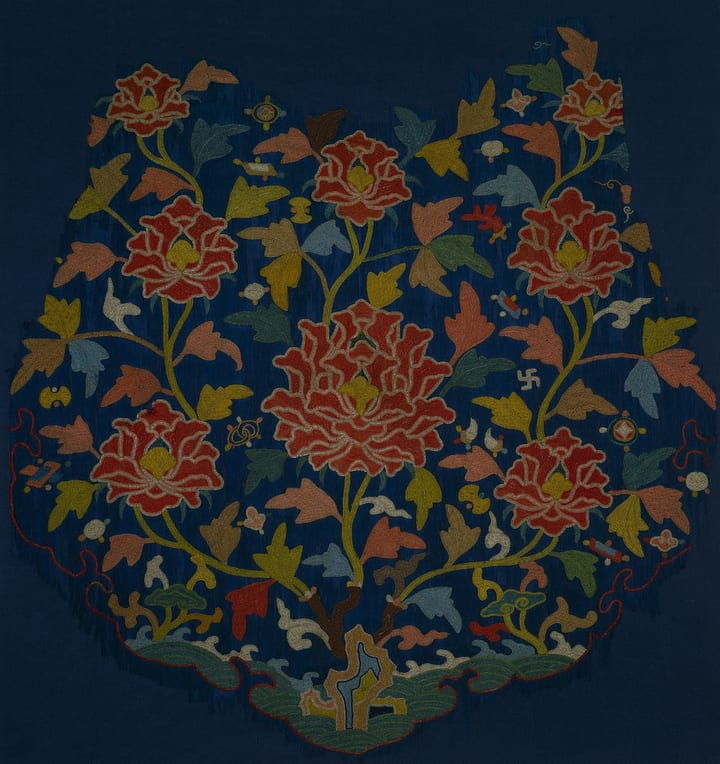
The photograph preserves part of a collar
Cleveland’s 1993.10, dated to the 1300s, is embroidery from a cloud collar. The museum identifies the surviving fragment as most of one lobe. Its record describes silk and silver thread with silvered paper, and needle looping over a dark blue ground. Peonies signify wealth and honor, rocks longevity; small Buddhist symbols occur among the flowers.
Look at the photographed outline before imagining a whole garment. The lower border survives, while the upper area does not show a complete neck opening. A mounted fragment supplies evidence for its decorated field, but not an intact collar’s closure or all its layers.
Three tiers show how an accessory is assembled
Cambridge’s 1988.420 has three tiers of embroidered silk, bordered with ribbons, stiffened with paper and lined in pink silk. The record distinguishes the red neckband, red upper tier, yellow middle tier and white lower tier. A netted fringe, tassels and metal discs extend beyond the shaped pieces. Two knot-and-loop fastenings open one side.
This catalogue also preserves uncertainty. Its date is recorded as 1900–1910 with a questioned Qing attribution. The name yunjian was added in a 2024 catalogue amendment through comparison with other museum collars. Read that history alongside the object rather than treating a modern name field as an unchanged label supplied by its maker.
An uncut panel records a different stage
Asian Art Museum’s 1992.21 is an uncut panel for a cloud collar, catalogued as Chinese silk from approximately 1800–1911. It measures 59.1 by 50.8 centimeters. The title identifies a stage before the shaped accessory has been cut out.
Compare that panel with a surviving assembled collar and with the illustrated fragment. Each answers a different question: planned pieces on a cloth field, an arrangement ready to wear, and part of a once larger design. Their outer edges do not all have the same significance. A straight museum mount should not be mistaken for the original outline of a finished shoulder piece.
The stitch list can be more precise than the general name
The Spencer Museum records its 1951.0003.02 as a dancer’s cloud collar, made in China in the 1800s or 1900s. Its materials include silk, gold thread, stone and ribbons. The listed techniques include embroidery, braiding, knotting, satin stitch and stem stitch.
These terms distinguish several kinds of work within an accessory. A stitched image, a braided length and a knotted fastening occupy different structural roles. A catalogue’s technique list is a useful guide to what to examine, while its broad date leaves room for questions. The word “cloud” names the collar; it does not identify the stitch.
A neck opening gives the lobes their arrangement
The Textile Museum of Canada’s nineteenth-century Chinese collar T90.0327 measures 55 by 53 centimeters. It records silk and silk floss with a metal button, and techniques including satin stitch, appliqué, sewing, fringe and tassels. Its account relates the name to lobes resembling clouds or petals, often arranged in layers, and describes use over robes on special occasions.
Begin at the opening and follow one lobe outward, then return to compare the next. This exercise makes repetition and changes of direction easier to see than starting with an isolated flower. On a layered object, also ask which edge belongs to the piece above and which to the piece below.
Compare cloud collars with other embroidered dress pieces
The Met’s nineteenth-century Chinese cloud collar, 67.179.1, is catalogued as silk and metallic thread, measuring 60.96 centimeters in each direction. Its concise record identifies material and scale without naming an owner or a particular occasion. Those gaps should remain visible when comparing it with more fully described examples.
Our sleeve-band guide follows decoration at a turned-back cuff, the rank-badge guide follows insignia on official dress, and the purse guide follows a small container. Here the central question is how shaped pieces surround the neck and shoulders. Compare object type before connecting a shared flower, metallic thread or stitch to the same use.
For a useful study note, keep the complete object’s date, materials, opening, layers and fastenings together. Mark a fragment or uncut panel clearly. Then add the museum’s motif interpretation, if supplied. This leaves room to appreciate the embroidery while preserving the difference between a surviving part and a reconstructed garment.
Images and credits
Embroidery from a Cloud Collar: Ocean, Rocks, and Peonies, China, 1300s. Surviving fragment of one lobe. Cleveland Museum of Art, 1993.10. Purchase from the J. H. Wade Fund. CC0. Complete photograph resized.