Start with the complete outline
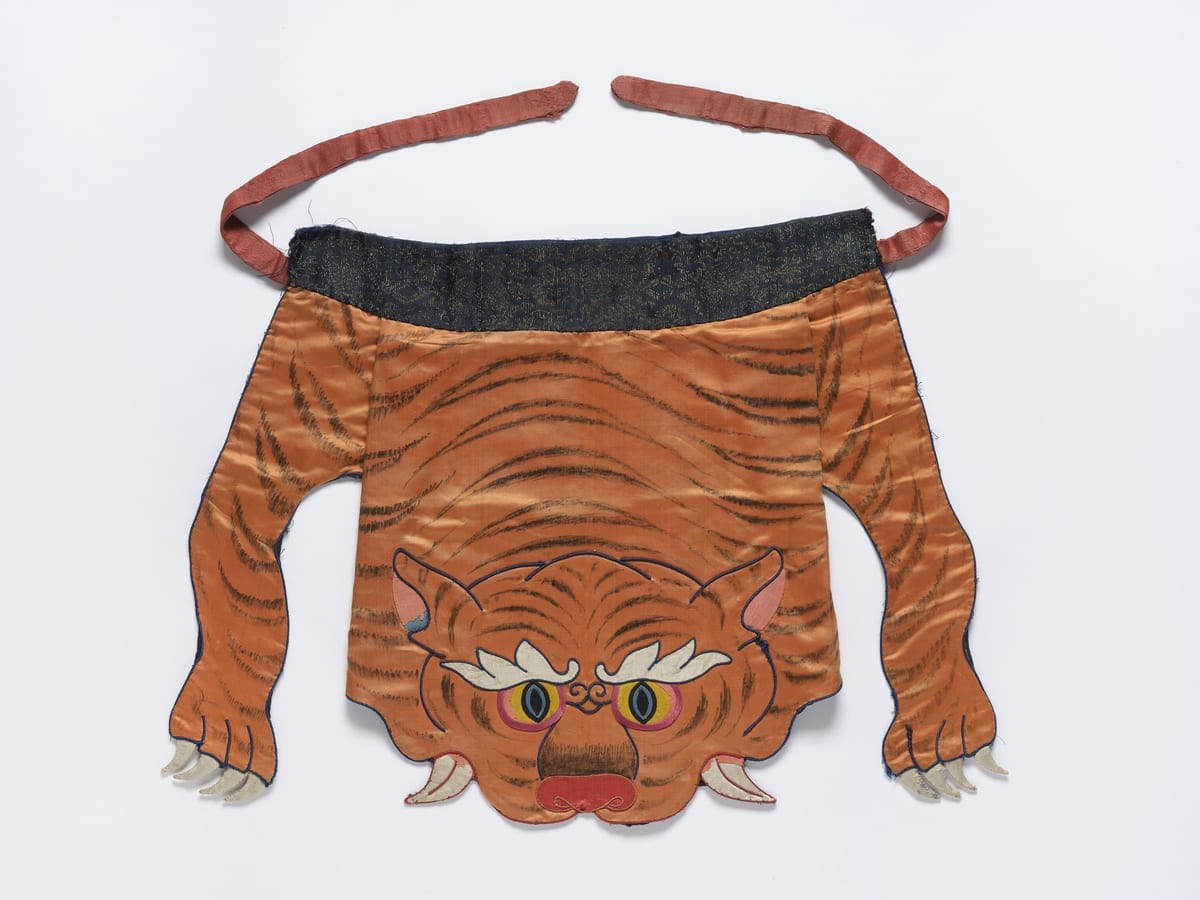
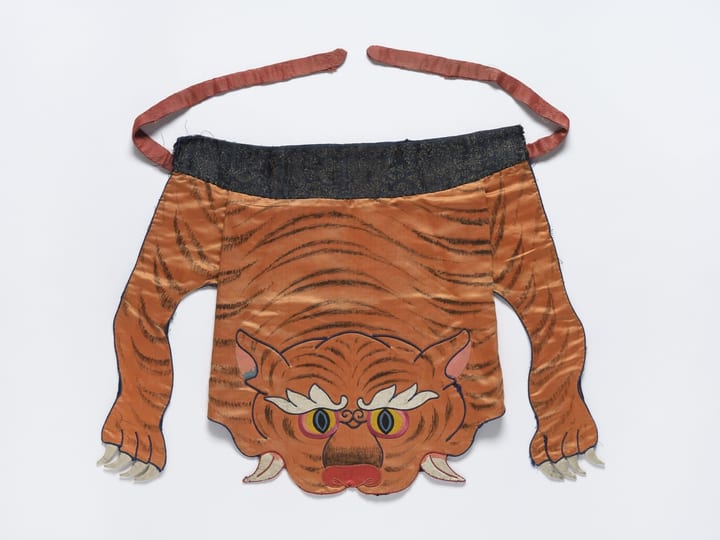
The illustrated National Palace Museum object is catalogued as Apron, China, 南購織001293N000000000, measuring 41 by 42 centimeters. The selected record identifies it as a textile but supplies no date or named stitch.
In the photograph, red ties extend above a dark waistband. A broad orange body has a striped field, an animal-like face and two hanging side shapes. Follow the outer edge before looking at the surface lines. The complete image makes the relationship between ties, band and body visible without reconstructing how the object sat on a particular wearer.
Panels and borders can carry different kinds of work
Museum of International Folk Art’s festival apron A.2016.55.1 is a Miao object from Guizhou, dated around 1989. Its cotton-and-silk body is assembled from three panels. The description records satin-stitch embroidery and supplementary-weft brocade within the decorated arrangement, with a blue commercial-cloth lining and commercial ribbon along three sides.
Look for joins before calling every patterned area embroidery. A woven pattern belongs to the structure of its cloth; a recorded embroidered area involves a different operation. The museum’s description of several techniques within one accessory makes the assembled object more informative than a single close-up of a motif.
A fringe may be assembled from ribbons
The same museum’s A.2022.7.67 is a twentieth-century Miao apron from Guizhou, described as possibly in the Zhouxi style. Its upper front panel runs horizontally and its lower panel vertically. The record identifies silk embroidery in colored stripes, metal beading and zigzag stitching. It describes the lower fringe as attached silk ribbons rather than one woven fabric, with two woven waist ties.
That distinction changes how the edge is read. Follow one hanging strip upward to its attachment before comparing it with the neighboring strip. The boundary between a decorated panel and its fringe can reveal assembly choices that disappear when the object is reduced to an overall pattern. Preserve the catalogue’s qualified style identification.
Front and back pieces need to be compared separately
The Embroiderers’ Guild of South Australia Museum records front and back apron panels, 1998-030, from the group it calls “Tin Miao.” They are Chinese pieces dated to 1970–1999, embroidered on hand-woven, indigo-dyed material. The museum identifies geometric tin embroidery and notes denser embroidery on the back panel. The front measures 46 by 20 centimeters and the back 45 by 19 centimeters.
Read the two pieces as a comparison, not as interchangeable copies. Begin with their size and distribution of ornament. A catalogue that identifies front and back gives a firmer basis for that distinction than a viewer’s guess from a detached textile. Its technique name also prevents the reflective material from becoming merely a general impression of shine.
Wearing evidence and collection history answer different questions
Bowers Museum’s Miao apron 2015.9.9 is assigned to Guizhou and the middle to late twentieth century. The materials include cotton, silk and Job’s tears seeds. Its description explains wearing aprons over women’s skirts and notes differences in ornament, while qualifying this example as probably made for the tourist trade.
A collection date is a different kind of evidence. Academia Sinica’s Embroidered Apron E00055 was collected in 1940 at Anshun in Guizhou. The record gives a length of 60 centimeters and width of 34 centimeters. That collection entry does not make 1940 a documented manufacturing date. Keep the two events separate when comparing it with a broadly dated museum object.
Compare an apron with other decorated garments
Our dragon-robe guide follows the construction of a full garment, while the sleeve-band guide follows decoration at the cuff. The purse guide examines a container’s opening, lining and fastening. Here the useful questions concern a decorated apron’s body, waist attachments, panel joins and edges. Similar threads or animal forms do not make these object types serve the same purpose.
For a careful study note, first record whether the piece is complete or survives as a panel. Add the catalogue’s place, community identification and date without applying them to every apron from China. Then map the techniques and fittings to their actual positions. Where a record leaves original use or manufacture open, that gap is part of the evidence rather than an invitation to supply a universal story.
Images and credits
Apron, China. The National Palace Museum, Taipei, CC BY 4.0 @ www.npm.gov.tw. Object 南購織001293N000000000. The 720- and 1200-pixel files retain the complete photograph, resized and JPEG-compressed. The hero layout crops the display; View full image shows the full frame. The catalogue names no stitch.