Find the parts of Chinese embroidered purses
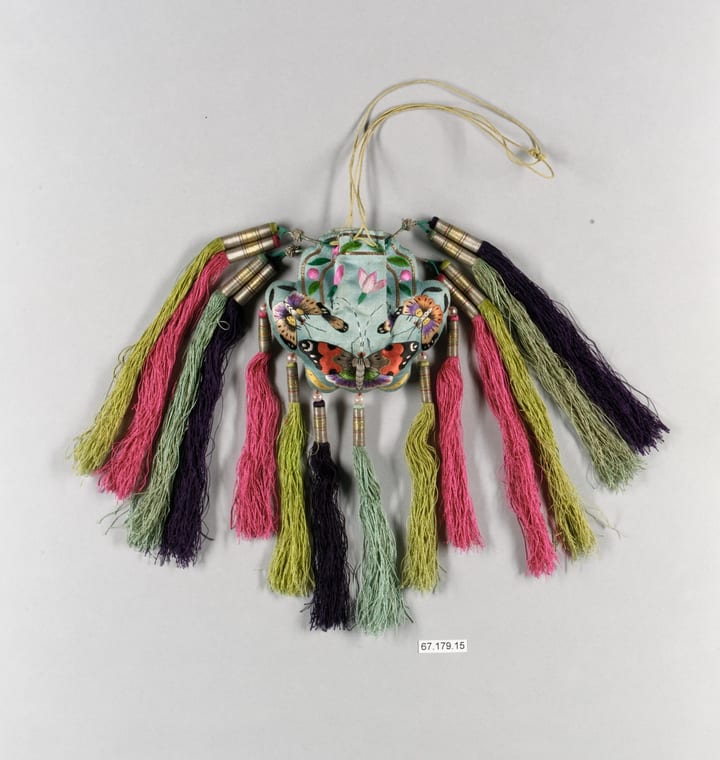
The Met’s nineteenth-century purse 67.179.15 has a compact body surrounded by long colored tassels. Butterfly and floral forms fill the pale ground. The small opening, cord and hanging fringe are all visible in the full photograph. The museum classifies the work as embroidery and records a height of 20.3 centimeters. Its catalogue gives no original contents.
Follow the edge from the mouth around the lower curve, then compare that enclosed area with the spread of the tassels. A photograph can make the ornaments seem as prominent as the container.
Stiff and soft forms use different supports
Duan Gaifang distinguishes stiff and soft constructions. In the stiff type, pasted layers of cloth form a support beneath the satin embroidery ground. Soft examples join an embroidered face to a textile lining. A cord drawn through the mouth gathers the opening into folds. These choices shape the outline and closure.
A small landscape can sit above a knot and tassel
A circular purse in the China National Silk Museum measures 12 by 10.5 centimeters. Its white silk carries a landscape worked in seed stitch. The catalogue also records a green endless knot, pale yellow silk tassel and square jade ornament. The bag has a surviving tie.
Look at this documented combination as an assembly. The embroidered ground, tied thread and stone fitting occupy different positions. Their arrangement gives a way to compare the pouch with the ornament that hangs below or above it.
A purse could belong to a coordinated ensemble
The same museum’s 2018 embroidery exhibition included eight accessories for the Guangxu Emperor’s wedding. A pair of purses appeared with a tobacco pouch, a double-ended bag, a watch case, a fan case, a thumb-ring case and a spectacle case. The catalogue describes yellow satin decorated by dingling embroidery. Shaped silk pieces were cut to the design and stitched onto the ground, producing flowers and double-happiness characters.
The inventory matters when looking at the group. A purse, a fitted case and a bag with two ends answer different needs even when their fabrics and decoration coordinate.
Gift records help explain the occasion
The Palace Museum discusses embroidered purses in the exchange of gifts at the turn of the year. Its account connects the emperor’s gifts to family, clan and officials with maintaining relationships. It quotes a Qianlong poem describing gold beans inside purses. The wording supplies evidence for that gift setting and its contents.
Our scent sachet guide follows bags documented as fragrance containers. Here, the named contents, case shapes and records of giving help explain a wider group of embroidered accessories.
Images and credits
Purse, China, nineteenth century. Silk and metallic thread. The Metropolitan Museum of Art, 67.179.15, Gift of Florance Waterbury, 1967. Complete institutional photograph, resized, with accession label visible. Public Domain, CC0.