Start with a compact case and its dimensions
The Met’s silk example 30.75.687 is identified as Chinese, from the eighteenth or nineteenth century, and classified as embroidery. It measures about 15.9 by 5.1 centimetres. That scale anchors a reading of the object before its decoration is enlarged on a screen.
Check the outline and the edge of the opening separately. A narrow format is useful evidence for comparison, but a closed photograph cannot establish the internal fittings or the exact pair of spectacles once stored inside. Record the dimensions beside any drawing or detail photograph.
Metallic thread is a catalogue distinction
A second Met case, 30.75.696, is dated to the same broad period and catalogued as silk with metallic thread. It measures approximately 14.6 by 7 centimetres. The differing proportions and medium entry provide two concrete points of comparison with the narrower silk example.
Look for the relationship between the border and the central field. A bright line in an image can draw the eye, while the material entry supplies a more specific description. Do not turn that description into a claim that the case contains solid gold or silver.
Read the complete object, including its attachments
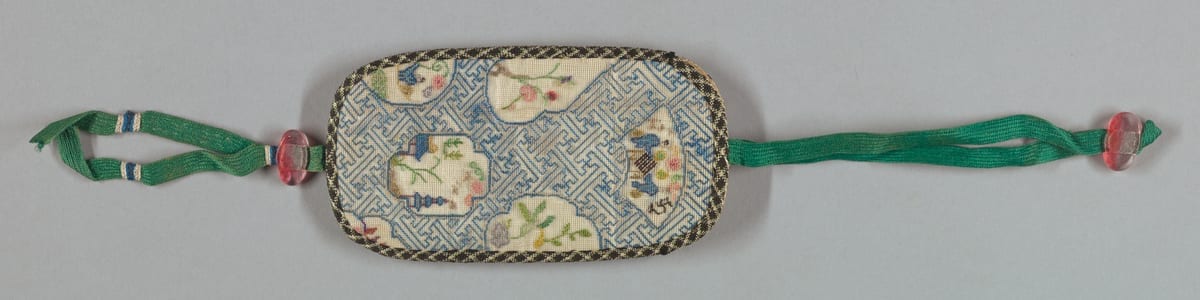
The illustrated Smithsonian case, 1939-37-18, is Chinese and nineteenth-century. Its record lists canvas, silk and a glass bead, with tent-stitch embroidery. The recorded overall dimensions are 41 by 7.5 centimetres. The complete photograph includes the decorated oval body and long green attachments.
Shown horizontally, the photograph is rotated from the museum’s vertical view. Compare the decorated body with its attachments before comparing overall dimensions.
A lining is different from an embroidered cover
The Science Museum Group identifies 1921-323/243 as a Chinese case associated with spectacles 1921-323/242. Its description specifies a full lining and an embroidered cover. Its materials field cautiously proposes cork and paper, retaining question marks.
This separates three questions: what formed the container, what lined it, and what decorated the exterior? A textile-covered object need not have a textile-only structure. Preserve the catalogue’s uncertainty instead of converting tentative material names into a definite workshop recipe.
The fit can follow the folded glasses
Helena Heroldová’s study of the Náprstek Museum collection describes a wooden container shaped to protect folded pince-nez. It also discusses later solid paper-and-textile cases. Her catalogue’s 20224ab is an oval, flat, soft case with yellow satin, different embroidered motifs on its two sides, and a ribbon with two green glass beads.
These examples make fit and construction worth asking about separately from decoration. Compare the shape of the stored spectacles with the cavity or outline of the case when both survive. Avoid assuming that every oval embroidered case had the same rigidity or opening mechanism.
Compare an embroidered case with another material
Corning’s Chinese folding eyeglasses and case, 2011.3.117, are dated probably to the nineteenth century. The museum describes a circular black shagreen-covered case with a hinged lid, yellow textile interior and ribbon fastener. The glasses fold at a wooden nose-piece.
This is a comparison, rather than another embroidered example. It demonstrates how a different surface and closure can answer the same storage problem. Our mirror-case and purse guides follow other kinds of textile accessories; retain the eyeglass case’s relationship to its particular contents when comparing them.
Images and credits
Spectacle case, China, nineteenth century. Cooper Hewitt, Smithsonian Design Museum, 1939-37-18. Gift of Marian Hague. CC0. Complete photograph rotated 90 degrees and resized.