Follow the decorated upper of Chinese embroidered shoes
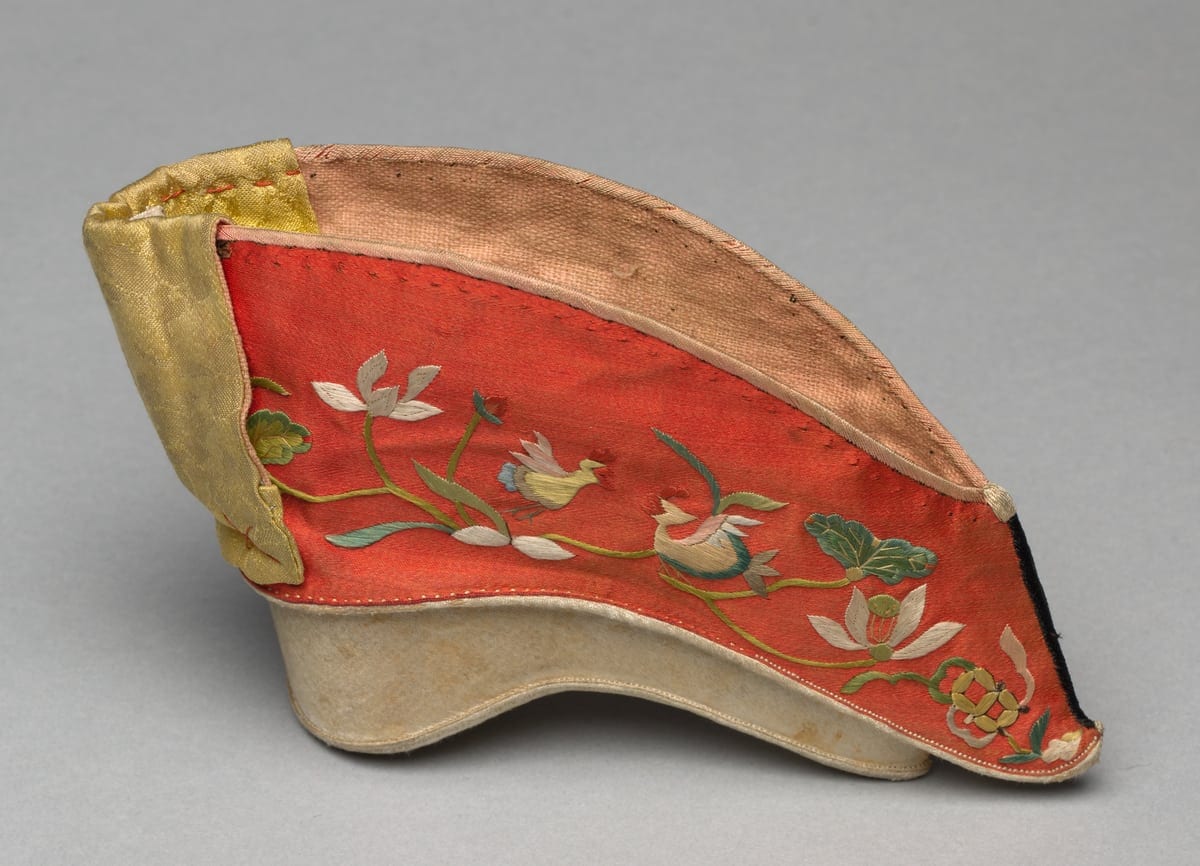
The pictured shoe belongs to the Cleveland Museum of Art. Its catalogue dates it to nineteenth-century Qing China and records embroidered silk, with overall dimensions of 9 × 5.5 × 13 centimetres.
In the photograph, a green stem carries flowers and birds across the orange-red side. Pale binding follows the opening, while a yellow panel finishes the heel. Follow the decoration toward the pointed toe: the stitched scene occupies a long, narrowing space above the pale sole.
Look beneath the decorated surface
A Ming pair in the China National Silk Museum reveals how several materials could work together. Patterned yellow satin forms the upper, and cloud shapes made from the same fabric are applied at the toe and heel. White cotton lines the shoes.
The recorded sole combines white cotton cloth with a hemp lining and cotton-thread stitching. It also contains a substantial layer of brown, long-fibred material. One sole is missing and the other is badly damaged. The surviving layers give a concrete view of the supporting structure beneath the ornament.
Applied cloth can become the ground for embroidery
The silk museum’s late-Qing black-ground floral shoe measures 28 centimetres long and 9 centimetres wide. Its description identifies coloured embroidery worked over appliqué, with a small red cloth piece at the heel.
Here, looking for the edge of an applied shape is as useful as following individual threads. Notice how the cloth shape and its stitched decoration cooperate. The museum’s account gives you a specific construction to look for within the colourful floral surface.
Different parts of an upper can carry different patterns
A surviving silk upper dated to the Northern Dynasties, 386–581, offers another arrangement. The China National Silk Museum records diamonds on its side areas and stripes around the opening. Pale green, white, ochre and dark-brown silk threads decorate the brown ground.
The fragment measures 32.5 × 19.4 centimetres. Those are the dimensions of the surviving textile, rather than a finished shoe’s length. Trace the border separately from the larger patterned field when studying this example.
The toe and sides can tell different parts of a design
A Republican-period silk shoe in the same museum places a tiger face and an endless-knot motif on the front, with butterflies along the sides. Black velvet in a ruyi-shaped outline is applied at the toe and edged in purple.
The arrangement rewards looking around the shoe. Its frontal design and side decoration occupy distinct surfaces, each framed by the shape and edging of the upper.
A named owner changes what a shoe can tell us
Queen Victoria Museum & Art Gallery records a Chinese-made pair purchased by Ann Chung Gon and brought to Launceston. Cotton embroidery depicts plants, flowers and fauna against purple silk and brushed cotton. Small iron nails secure leather lifts to the shaped heels. The insoles measure about 22 centimetres.
The collection notes say that Ann shared the shoes with her sisters. Their soles show little wear. The museum also records that Ann’s feet were unbound; her mother, Mei, had undergone painful footbinding and did not continue the practice with her daughters. Keeping these personal histories beside the materials helps explain the differences between particular surviving shoes.
Images and credits
Shoe, Qing China, 1800s. Embroidered silk; overall 9 × 5.5 × 13 cm. Cleveland Museum of Art, 1918.828, Gift of Mrs. Charles William Wason. CC0. Full institutional photograph resized.