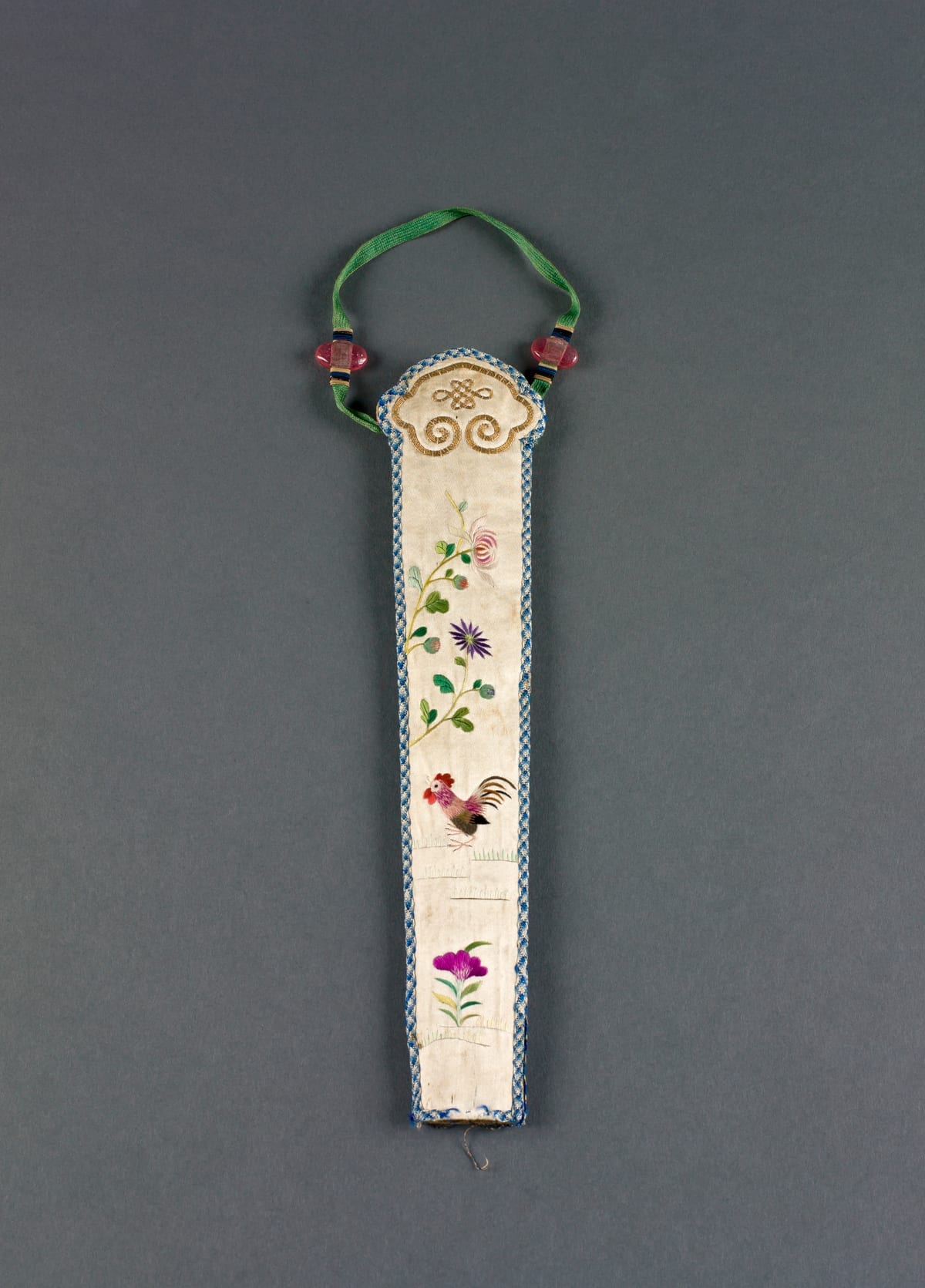
The illustrated case combines a textile face with a firm support
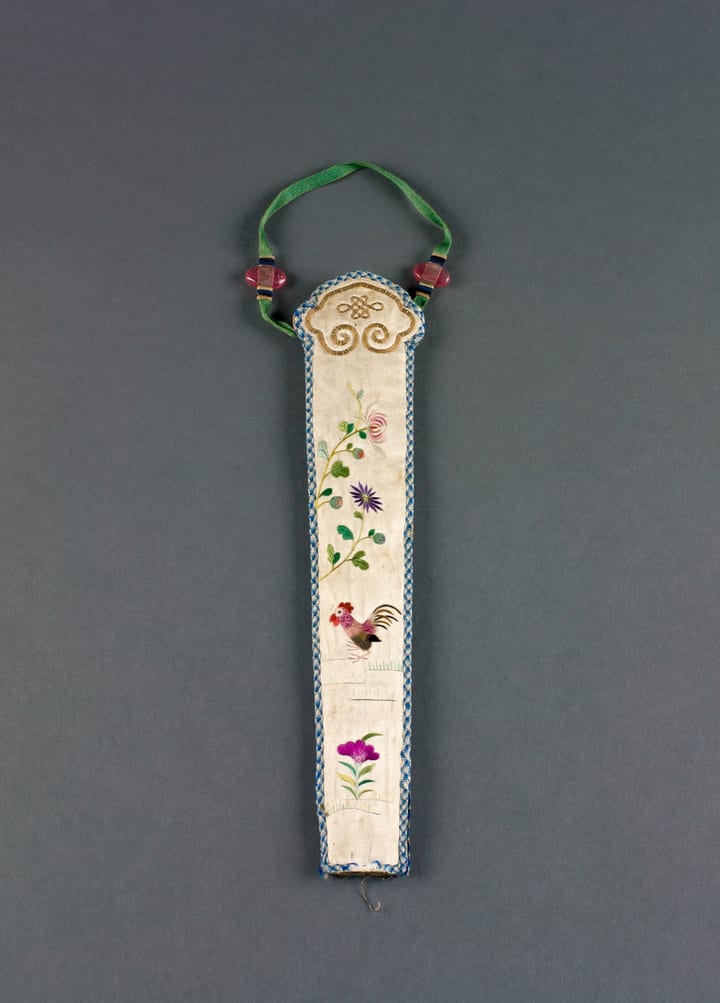
Saint Louis Art Museum’s Fan Case with Design of Birds and Flowers, 138:2011.2, is catalogued as embroidered silk over cardboard with glass beads. The record associates it with Wuchang in Hubei and dates it to the late nineteenth century. It measures 31.1 centimeters without its carrying cord and 40.6 centimeters with it.
In the complete photograph, follow the green loop down to the narrow pale body. A blue border surrounds the decorated field, and the rounded upper outline differs from the long sides below it. Compare the cord with the container rather than letting the overall length stand for both.
Lining, binding and an extra compartment are separate features
The Horniman’s Chinese case 1971.762 has turquoise satin on the front, blue damask on the back and pale blue silk lining. Its description identifies a stiffened paper interface, braided edging and a blue satin flap with a ruyi-like outline. Attached bands and a further cover create another space, which the museum suggests could hold something such as a brush.
The record also identifies a braided cord loop and a silver hook with a butterfly in repoussé. It describes silk embroidery and couched gilt-metal thread on both sides. These details make the entry useful for reading construction: surface, support, lining, closure and carrying fittings should each be examined in turn. The possible contents of the extra space remain a suggestion.
Knot stitching and symbols belong to a particular case
Asian Art Museum’s 1988.50.4 is dated approximately 1850–1911 and identified as embroidered silk with knot stitching. Its label names Peking knots and describes butterflies among stylized peonies. It interprets that design as a blessing for joy, love and good fortune. The cloudlike upper shape is compared with lingzhi fungus and linked to longevity and wishes.
Use this interpretation beside the exact object it explains. A curatorial identification of a peony or fungus-like form is more specific than a general impression of flowers. Another case may use similar materials while arranging different images; the shared word “embroidered” does not supply a single message for every design.
A catalogue can distinguish a technique from a material
The Spencer Museum’s Qing fan case, 0000.1189, lists silk, satin, glass beads and gold thread together with embroidery and couching. This vocabulary separates what the maker worked with from how a thread was attached. The record does not name a maker.
When examining a shiny line, first ask whether the catalogue identifies its material. Then ask whether it supplies a stitch name. Metallic appearance alone does not distinguish gold thread from another reflective material, and a distant photograph may conceal the small securing stitches. Keep the named technique attached to the documented example.
Scale and thickness change the comparison
Minneapolis Institute of Art dates its Chinese case 2019.52.9 to the early nineteenth century and records silk, metallic threads and cardboard. Its dimensions without the cord are 23.34 by 5.56 by 0.64 centimeters. The thickness measurement gives another way to compare an accessory that might look almost flat in a frontal image.
The Met’s nineteenth-century Chinese case 67.179.31 is catalogued as embroidered silk and measures 26.67 by 9.53 centimeters. Those measurements describe a broader object than the Minneapolis example. Compare proportions before assuming that every surviving fan case had the same fit or pattern. Neither entry identifies a particular fan as its original contents.
Keep the fan and its container distinct
Our folding-fan guide explains the ribs, pivot and leaf of the object that opens. This guide follows an accessory’s edges, layers and fittings. The round-fan guide introduces a different rigid form, while the mirror-case guide concerns covers associated with reflective objects. The functional question helps keep these related textile and fan traditions separate.
For a useful comparison, record the opening, overall profile, dimensions with and without fittings, and the available reverse view. Next note the catalogue’s materials and named techniques. Finally, match any symbolic interpretation to its specific source. This sequence leaves space for close looking without turning an isolated case into a reconstruction of its owner’s complete dress or belongings.
Images and credits
Fan Case with Design of Birds and Flowers, China, late nineteenth century. Saint Louis Art Museum, 138:2011.2. Gift of Elizabeth McDaniel Peterson. Public domain. Complete museum photograph resized.