A mirror case can be small or large
The Met records a compact Chinese example, 30.75.636, as silk with a metal rim. Dating from the eighteenth or nineteenth century, it measures about 8.3 by 8.9 centimetres. Its material entry separates the textile surface from the firmer edging.
This gives a useful starting point for comparison: check the dimensions before imagining how a case was held or displayed. The name alone does not tell you whether you are looking at a small personal accessory or a much larger decorated cover.
Two faces can use different silk grounds
A nineteenth-century case showing boys at play, Met 30.75.61, measures 41.9 centimetres across. The catalogue identifies two sides: silk embroidery on simple silk gauze, and silk with metal-thread embroidery on silk satin.
Here the choice of ground belongs to the construction as well as the design. Follow the museum’s separate views when comparing the two faces. A photograph of one surface cannot show the materials, joins or decoration of the other.
The lunar scene joins a picture with a wish
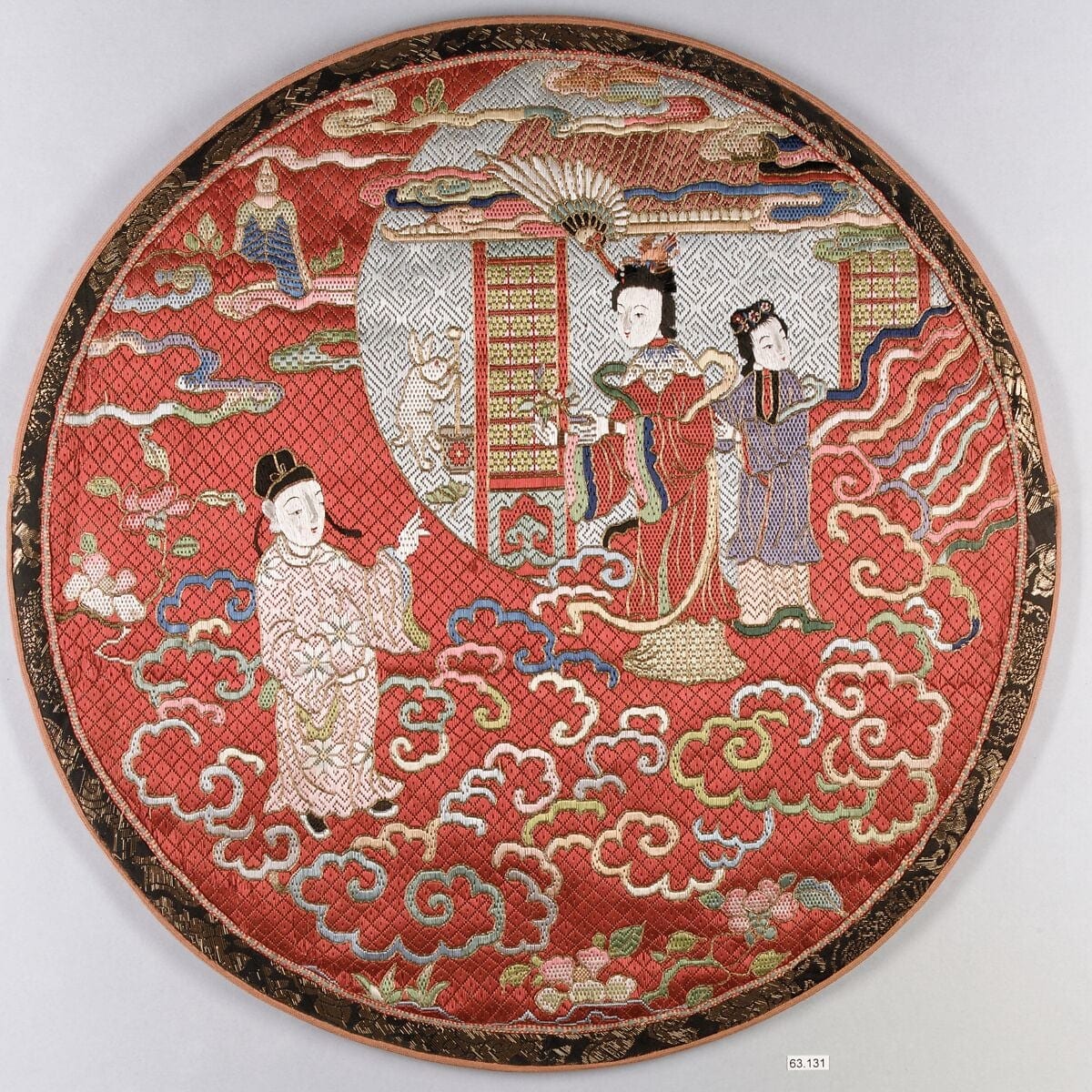
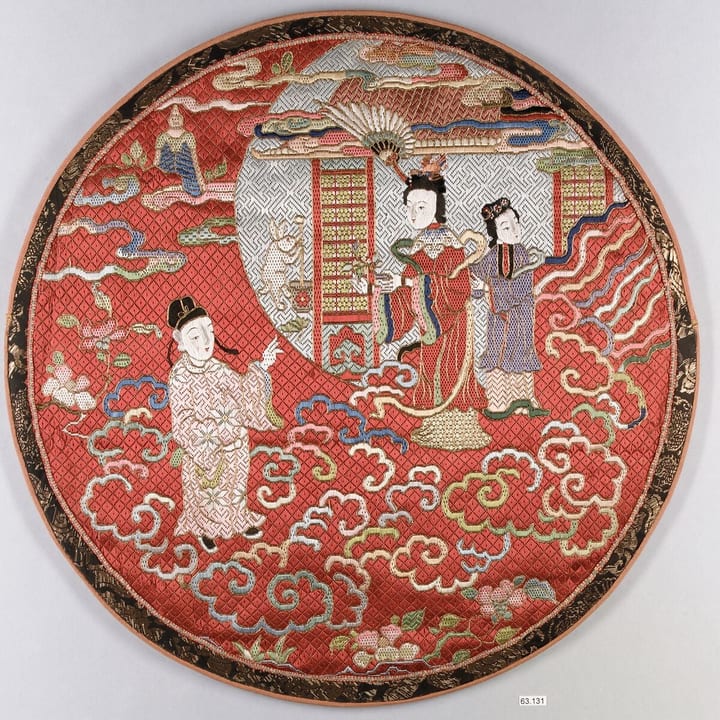
The pictured case, Met 63.131, is a nineteenth-century Chinese example embroidered on silk gauze, 43.2 centimetres across. Figures occupy a cloud-filled scene.
The museum identifies Chang’e, her attendant and a rabbit. It explains the offered osmanthus branch as a wish for success in the civil-service examinations. Read that meaning with this composition; a floral or geometric case need not tell the same story.
Stitch names need object-level evidence
The Met specifically records split stitch and couching on case 30.75.60, a nineteenth-century Chinese silk and metal-thread example measuring 35.6 centimetres across. These are documented techniques for that object.
Use such entries to distinguish a named stitch from a general impression of shine or texture. A metallic-looking line in a photograph does not by itself identify its fibre, attachment method or metal. The catalogue can supply details that a distant view leaves unresolved.
A marriage wish has its own set of symbols
Asian Art Museum’s case 1988.10 dates to approximately 1800–1900 and is made of embroidered silk gauze. The museum reads a box and lotus as the implements of the Two Immortals of Harmony and Mirth. Together with a wish-granting wand, they express hopes for a harmonious marriage and fulfilled wishes.
This is a different subject from the examination scene. When comparing covers, first locate the objects or figures named by the curator; then connect the interpretation to their arrangement. A shared material does not make every embroidered accessory a wedding gift.
Read the whole object alongside its decorated surface
Another eighteenth-century silk example, Met 51.102, measures 39.4 centimetres square in its overall dimensions. Its record provides separate front and reverse images. Those views offer a fuller comparison than a single decorative detail.
For a museum visit or online study, note scale, outer outline, borders and the available reverse view before concentrating on individual motifs. This sequence keeps the textile’s role as a cover in view while leaving room to appreciate the embroidery. It also helps distinguish an object’s recorded construction from an attractive pattern seen in isolation.
Images and credits
Mirror case with lunar scene, China, nineteenth century; embroidered silk gauze. The Met, 63.131. Gift of Mrs. Isabel Mayer, 1963. CC0/public domain. Complete photograph resized.