Read the garment before the individual dragon
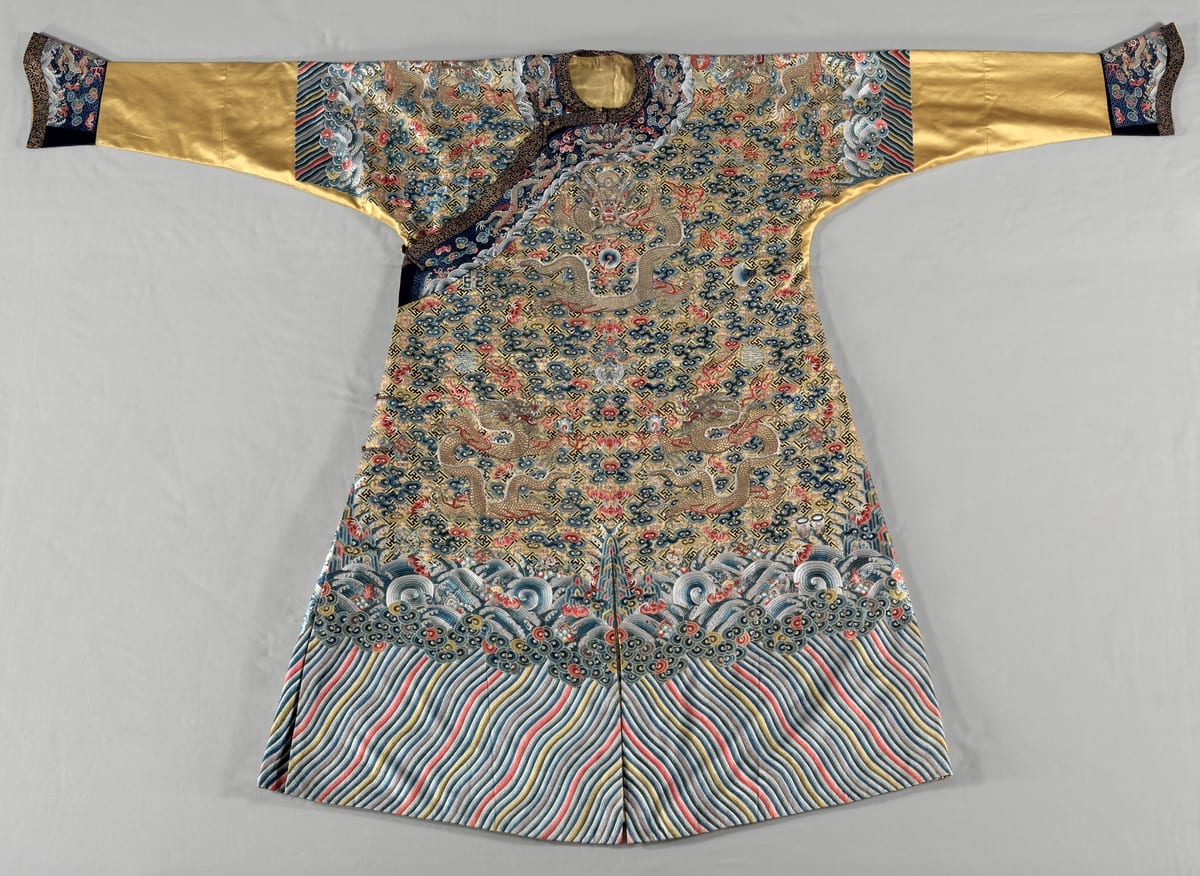
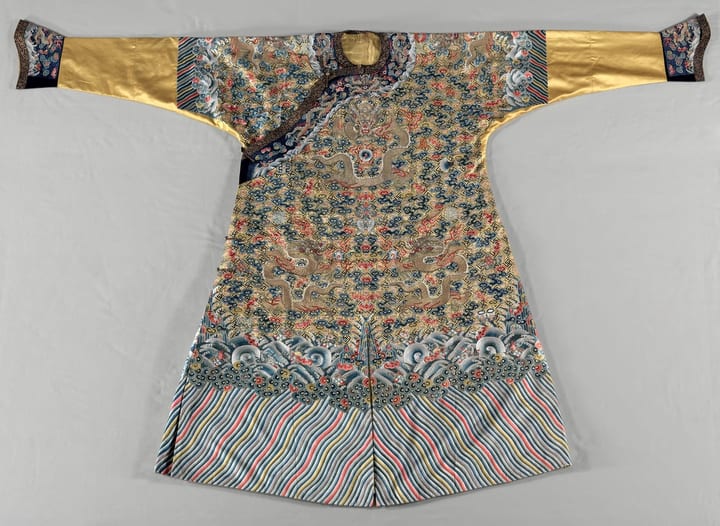
The complete photograph shows Cleveland’s Semi-formal Court Robe (Jifu), 1983.32. Its medium is silk satin with silk- and metal-thread embroidery. The record gives a shoulder width of 226.1 centimetres and a neck-to-hem length of 154.9 centimetres. Its date line says late 1700s, alongside a Jiaqing-period attribution of 1796–1820.
Trace the asymmetrical opening and compare the decorated body with the long plain sleeve sections and patterned cuffs. At the lower edge, diagonal stripes meet a band of waves. Keeping the entire outline in view makes these changes of surface easier to follow.
Jifu and chaofu are not interchangeable labels
The Smithsonian calls its F2015.7 a summer chaofu: formal court clothing for a ranking individual visiting court. Dated about 1820–75, it is silk gauze embroidered with silk and metallic-wrapped threads. The museum connects its large five-clawed dragons and eighteen dragon roundels with a first-rank prince.
Compare that label with the semi-formal designation of the Cleveland garment. Read the garment type and season alongside the decoration, rather than replacing every catalogue name with “dragon robe.” The material and the form of dress each contribute different information.
Silk does not specify a single surface technique
The Met’s eighteenth-century Dragon Robe, 56.210.6, is recorded simply as silk and classified as Costumes-Woven. Its dimensions are 139.7 by 170.2 centimetres. That brief entry does not name an embroidery stitch.
Seattle records satin stitch and gold-thread couching for robe 90.2. Those named stitches cannot be inferred from the Met’s simpler medium entry.
Waves, rocks and clouds can organize a complete setting
Asian Art Museum identifies its 2001.15 as a court robe for a young prince, dated 1875–1906. The label reads the wavy lower stripes as the sea, prism-shaped rocks as the earth and four directions, and cloud-borne dragons as the sky. It also identifies implements of the Eight Daoist Immortals and longevity symbols, connecting this particular robe with celebrations.
Locate the named elements before following the interpretation. Their positions across a garment matter as much as an isolated motif. The label’s account belongs to this robe and should travel with its accession number when it is compared with another.
Claws and color need a dated object context
Seattle describes the blue silk and nine five-clawed dragons of its circa-1875 robe 90.2 as evidence that it probably belonged to an aristocrat or high official. The label also reads its red bats and shou characters as wishes for luck and long life. Its wording retains uncertainty about the wearer.
This is why counting claws is only one part of reading court dress. Keep the date, color, garment type and museum’s attribution together. A surviving robe without a named wearer does not acquire one merely because a familiar emblem appears on its surface.
Openings, slits and belts belong to wearing the robe
Bowers Museum’s jifu, 2015.24.1, is catalogued as Qing silk with gold thread. Its account discusses semi-formal court occasions, front and back hem slits that eased riding, and belts from which purses could hang. It also names lishui, the diagonal lower stripes, among the designs on this type of garment.
Follow these practical features as well as the symbols. Our rank-badge guide examines separate insignia, while the brocade-and-embroidery comparison distinguishes pattern-making processes. Here the question is how a complete garment brings shape, decorated surface and documented use together.
Images and credits
Semi-formal Court Robe (Jifu), China, Qing dynasty. Cleveland Museum of Art, 1983.32. Purchase from the J. H. Wade Fund. CC0. Complete photograph resized.