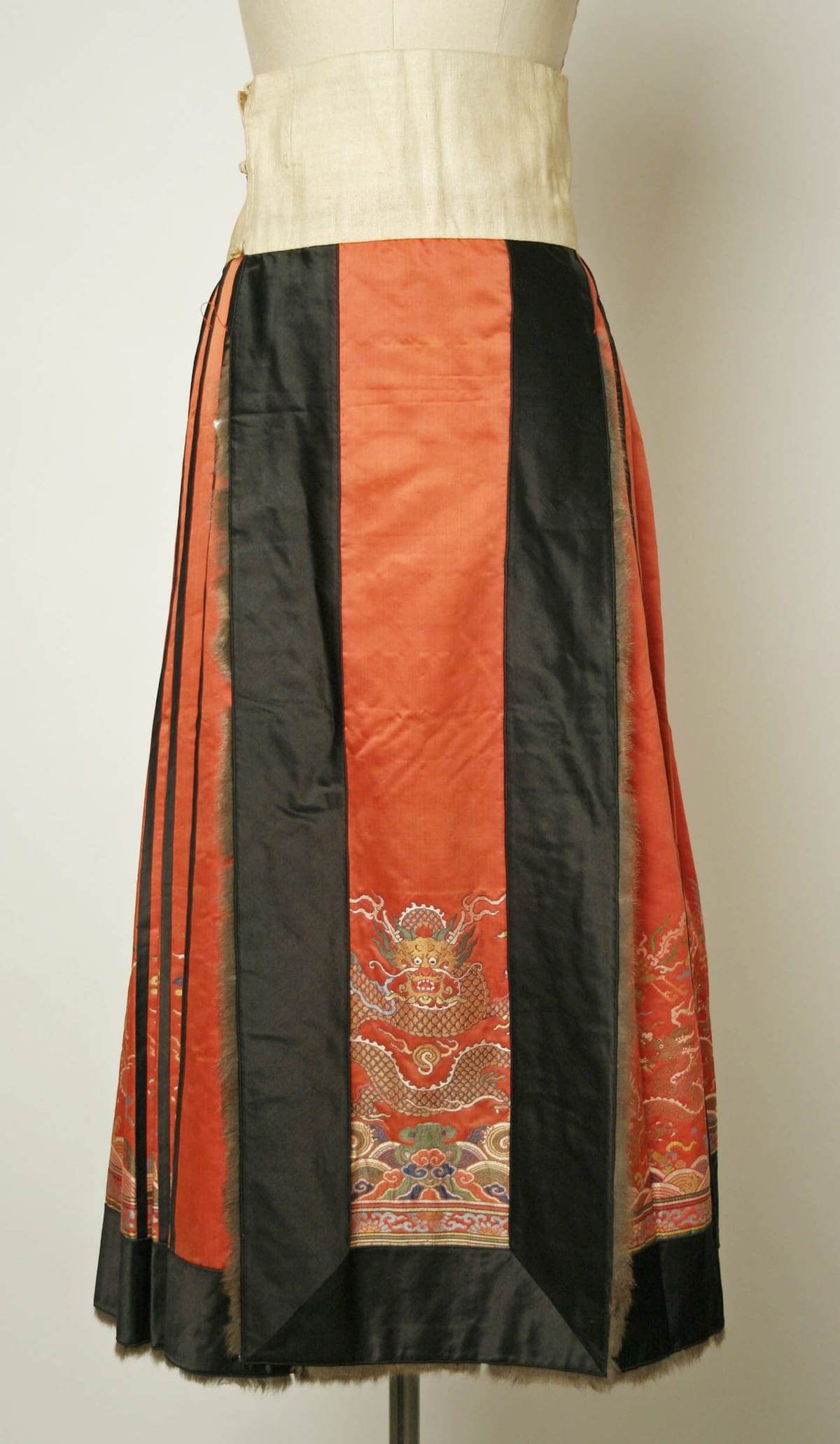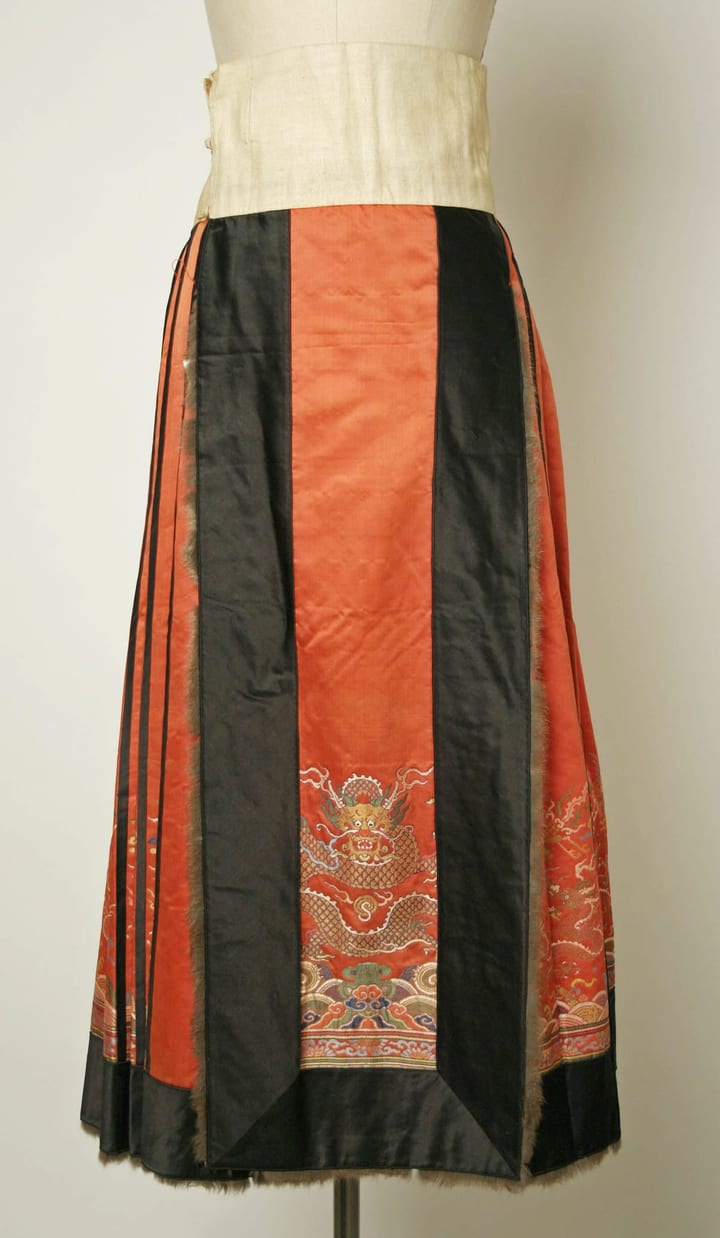
Begin with the whole skirt and its flat fields
The photographed Met skirt, 1973.110.2a, b, is Chinese and dated to the early nineteenth century. Its materials are silk, bast fibre and fur. The record measures its two components separately, each about 99 centimetres long.
In this view, broad red and dark vertical areas contrast with narrower folded sections at the sides. Decoration is concentrated near the lower edge, and the pale waistband remains visible above the silk. Follow these transitions across the complete photograph before isolating a dragon or a border.
Overlapping sections explain the apron comparison
Cooper Hewitt describes a Chinese skirt arrangement made from two matching sections, each combining a decorated panel with side and pleated or gored areas. The sections overlap around the body. In its account, fabric loops and knotted buttons secure them to a broad cotton or hemp waistband.
The museum identifies its phoenix-decorated example as ma mian qun, or horse-face skirt. That is a documented name for this form, rather than a replacement for every skirt with folds. Compare the number of sections, their overlap and the waistband before applying the term to an unfamiliar garment.
A jacket can explain where embroidery stops
Asian Art Museum’s skirt 1995.56 is dated approximately 1850–1900. Its label discusses women wearing full-length skirts with thigh-length jackets, sometimes with matching material or decoration. Since the jacket concealed the upper part, durable cotton could be used there and ornament concentrated lower down.
For this yellow example, the museum distinguishes patterns woven into the silk from embroidered butterflies and flowers on the central panels and trims. It links those motifs with harmonious unions and family reunions. Keep that interpretation with this particular design instead of assigning one meaning to every floral skirt.
Pleating and embroidery are separate operations
Spencer Museum’s nineteenth-century Chinese skirt 1946.0031.b has a detailed material and technique list: silk damask, gold thread, sequins and ribbon, with satin stitch and couching. Those entries identify several kinds of surface and applied decoration within one garment.
Compare a fold with a stitched line. A fold changes the way the cloth lies; embroidery places thread on the cloth. In a display photograph, shadows between pleats can obscure the ground or interrupt a motif. Consult the technique entry before interpreting every visible line as the same process.
Different woven grounds can support added decoration
LACMA’s Chinese Woman’s Skirt, M.2013.215.36, is dated around 1900. Its medium combines plain-weave silk with warp and weft patterning, silk-satin trim and silk embroidery. The museum records a centre-back length of 94.3 centimetres.
This gives a useful comparison with Spencer’s damask entry. Start with the fabric structure named in each record, then locate any separately identified trim or embroidery. A garment can combine several textile processes; a broad label such as silk does not explain how every pattern was formed.
Names and pleat arrangements can change
The National Gallery of Victoria catalogues its Chinese silk skirt 2024.857 as mamianqun and dates it to the late nineteenth century. Its short record supplies a specific name and broad date while leaving many construction details unstated.
Cooper Hewitt discusses another late nineteenth-century fashion, the fish-scale skirt. Horizontal stitches secure many small pleats into sections that resemble scales. Such differences make the folds themselves worth studying. Our sleeve-band and dragon-robe guides examine other clothing surfaces; here, compare flat fields, pleat direction, attachments and waistband before moving to individual motifs.
Images and credits
Skirt, China, early nineteenth century; silk, bast fibre and fur. The Met, 1973.110.2a, b. Gift of Caroline Ferriday, 1973. Public domain/CC0. Complete photograph resized.