The upper surface of Chinese ceramic pillows
A rectangular white porcelain pillow in the National Museum of China has a gently sunken center and slightly upturned ends. A peony is incised on top, and the four sides carry rectangular panels. The upper surface organizes where the head rests and gives the maker a wide area to decorate.
Begin with a side view to judge the dip and the height. Then look from above to see how much of the design lies inside the curve. Side panels occupy a different field and remain visible when something rests on top.
Marbled clay can recall the grain of wood
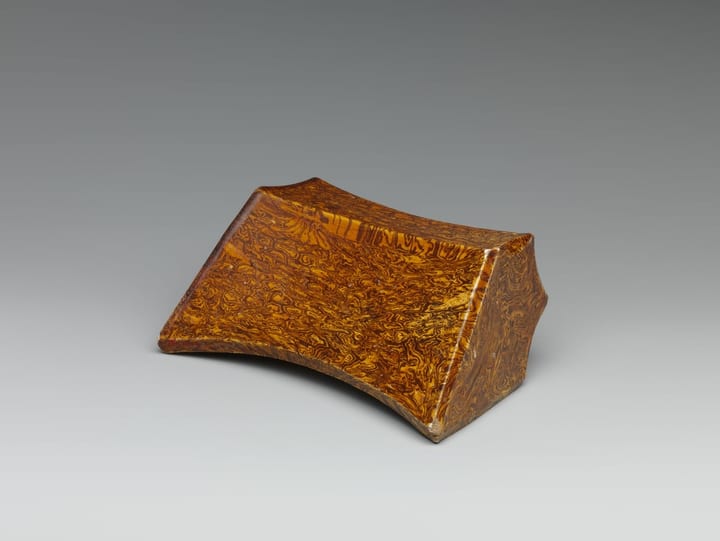
The Met dates the illustrated pillow to around 700, in the Tang dynasty. Brown glaze covers its patterned clay veneer. Dark streaks turn and fold across the photograph’s broad face and visible end.
A different Tang marbled pillow in the National Museum of China was excavated from a tomb in Henan. The museum describes differently colored clays twisted together and likens the result to the swirls of figured wood. The resemblance is produced within the clay pattern.
A reclining figure can shape the headrest
The Palace Museum’s Song Ding pillow takes the shape of a boy lying on his front. The figure’s back forms the raised resting surface, and relief ornament decorates the sides of the platform under him. The catalogue records an unglazed base with two holes.
The same object can look quite different from above and below. Compare the outline of the support with the parts that carry the sculpted scene. The base is a useful second view when the catalogue offers it.
Impressed details work differently from marbling
The Met identifies a Jin Cizhou earthenware pillow with both mold-impressed and scratched decoration beneath colored glazes. Impressions transfer a design into the surface. The museum’s separate reference to scratched decoration identifies another way of making marks on the same object.
Our Cizhou ware guide follows the broader history of that ware and the roles of slip, pigment and glaze. Here the pillow shape gives those surface choices a setting of their own.
Excavation gives a place and context
The National Museum of China records a small Tang pillow with sancai glaze from a burial in Luoyang. It discusses two interpretations for the piece, a wrist support or an object made for burial. Its small scale and burial context help frame the question of use.
Measurements, find context and written records can each contribute a different clue. Compare those kinds of evidence before assigning one specific purpose to a small support.
Images and credits
Pillow, China, Tang dynasty, about 700. Earthenware with marbled veneer and brown glaze. The Metropolitan Museum of Art, 2002.181. Purchase, Friends of Asian Art Gifts, 2002. Complete museum photograph, resized. Public Domain, CC0.