The Shang bronze gu held wine for ritual
The Walters Art Museum dates its bronze Wine Vessel (Gu), 54.2183, to the twelfth or eleventh century BCE. Its account places the cast vessel among differently shaped bronzes on a ritual altar, where it held wine.
The wide opening and narrow middle give the older shape an identifiable outline. These proportions remain recognizable when a later potter changes the material, height or surface. The object records supply the separate use histories of the bronze vessel and the ceramic vase.
Chinese gu-shaped vases can emphasize the outline
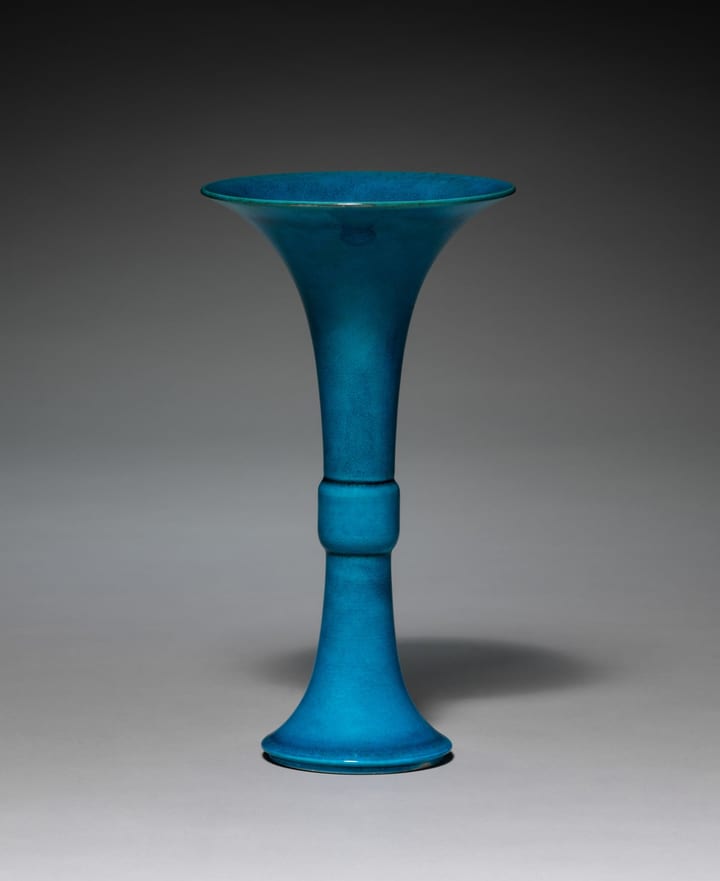
Cleveland’s vase 1942.689.1 bears a Kangxi mark and dates to that reign, 1662–1722. The museum identifies peacock-blue glaze over Jingdezhen porcelain. The vessel stands 27.7 centimeters high.
Follow the edge down from the broad lip. The sides draw inward for a long stretch before reaching a rounded band, then sweep back out at the foot. A largely uninterrupted blue surface lets these shifts in width carry the design.
Raised bands give the waist a different emphasis
The Palace Museum’s Kangxi vase 故00147686 carries sky-blue glaze. Raised bosses encircle the rounded waist, with three horizontal ridges above and three below. The underside has white glaze and a blue reign mark.
The bands mark off the waist even where the surface color stays consistent. Comparing this example with the Cleveland photograph shows how the same general silhouette can carry different degrees of relief.
A Yongzheng example adds four lobes
The National Palace Museum’s green-glazed begonia vase, 中瓷003833N000000000, follows an archaic bronze gu outline while carrying four lobes from mouth to base. Dark crackle lines appear in the gray-green glaze. The museum describes Ge-style crackle and a dark finish at the foot that recalls older wares.
The comparison works from two angles. The side view shows the outward sweep at mouth and foot. A look into the opening reveals the lobed cross-section, another design choice within the gu family.
Painted plants occupy three bands
The University of Michigan Museum of Art dates vase 2022/1.63 to around 1640, in the Ming dynasty. The blue decoration lies beneath glaze. Plum blossom, orchid, bamboo and chrysanthemum form the Four Gentlemen theme, which the museum associates with scholarly character.
The museum relates the painting’s three sections to its bronze model. Ornament can register the changes in profile through a new set of subjects and a new medium.
Technical notes document one thrown example
The National Gallery of Art dates its small porcelain vase 1972.43.16 to late Kangxi or Yongzheng, about 1700–1735. Its technical account records a thrown white body and a trimmed foot ring. Incised leaves occupy the upper and lower sections, with flowers and leaves around the waist.
Our guide to cong-shaped vases follows another antique reference through a square ceramic body. For gu-shaped vessels, start with the widening mouth and foot. Compare the visible profile with the individual catalogue’s account of glaze, ornament and making.
Images and credits
Beaker Vase in Form of an Archaic Gu, China, Kangxi mark and reign, 1662–1722. Jingdezhen porcelain with peacock-blue glaze. Cleveland Museum of Art, 1942.689.1. Bequest of John L. Severance. CC0. Complete photograph, resized.